
Yes, you can absolutely get a manual transmission remote start for your vehicle. Thanks to modern technology, these systems are incredibly safe and reliable—as long as they're installed correctly. Let's put that old myth to rest: this fantastic convenience isn't just for automatics anymore. Specialized kits are now available to bring the same comfort to stick-shift enthusiasts.
Why a Remote Start Is a Game-Changer for Manual Drivers
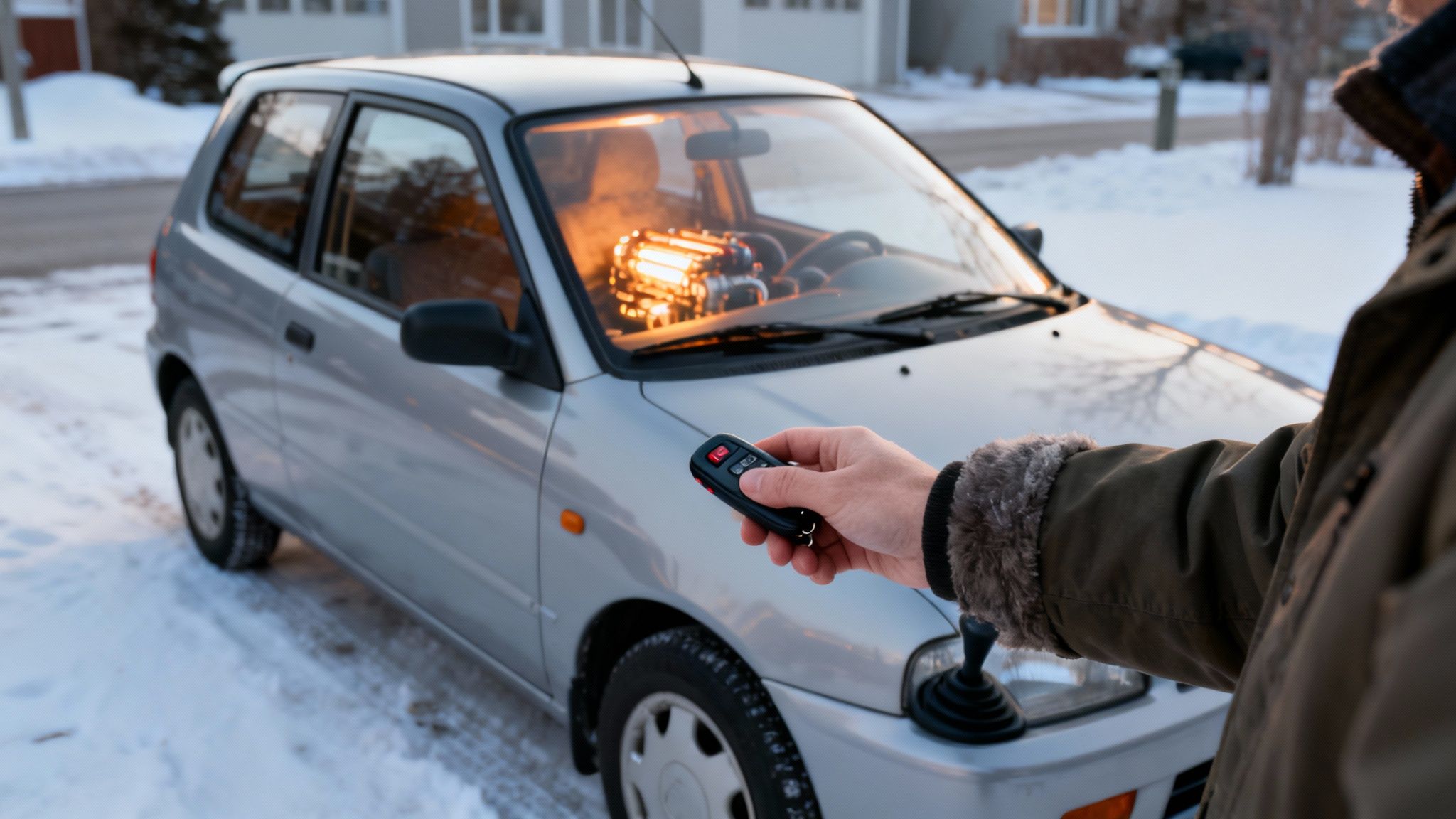
If you love the connected feeling of driving a manual car, a remote starter probably feels like a far-off dream. Car manufacturers have always shied away from offering it from the factory, mostly because of the obvious safety risk of a car lurching forward if it starts in gear.
This created a huge gap in the market, especially for drivers here in Canada who face brutally cold winters. Why should you have to give up the fun of a manual gearbox just to avoid a frozen car on a January morning?
That’s where the aftermarket industry came to the rescue. Innovators saw a need that automakers were ignoring and developed smart systems with multiple safety protocols built right in. As a result, adding a manual transmission remote start is now one of the most sought-after upgrades for cars that deliver a pure driving experience but lack some of those modern comforts.
The Rise of Aftermarket Solutions
Think back to the early 2010s. A surprising number of cars on the road were still manuals. In the Durham Region alone, for example, about 18% of all passenger vehicles had a stick shift, yet none came with a factory remote start. This disconnect fueled a massive demand for aftermarket solutions.
Industry data from the Automotive Aftermarket Industries Association (AAIA) Canada showed a 27% jump in remote start installations across the province by 2015. What's really telling is that here in Durham, a whopping 40% of those installations were for manual cars that needed custom safety integrations. You can read more about what makes remote starters so popular from the experts at KBB.com.
We saw this trend firsthand with certain enthusiast-focused vehicles.
- Honda Civic Si: A fan favourite for its zippy performance, but often light on luxury features.
- Subaru WRX: A rally legend whose drivers value performance but desperately need comfort in our climate.
- Ford Mustang: An icon where a manual transmission is central to its identity.
These owners wanted it all: the control of a stick shift and the simple luxury of a warm, defrosted car ready to go.
The real breakthrough wasn't just figuring out how to make it work—it was making it safe. Modern manual remote start systems are built with a sequence of checks and balances that make an accidental start next to impossible. That peace of mind is what turned a niche modification into a mainstream upgrade.
For drivers in Whitby and the surrounding areas, this kind of specialized work became a local necessity. Shops like Carmedics Autowerks have built deep expertise in these complex installations, understanding the intricate wiring and safety procedures inside and out. We’ve perfected the art of integrating these systems seamlessly, ensuring manual car lovers no longer have to compromise. It’s all about making your ownership experience better without losing what makes driving a manual so special in the first place.
How a Remote Starter Can Safely Work With a Manual Transmission
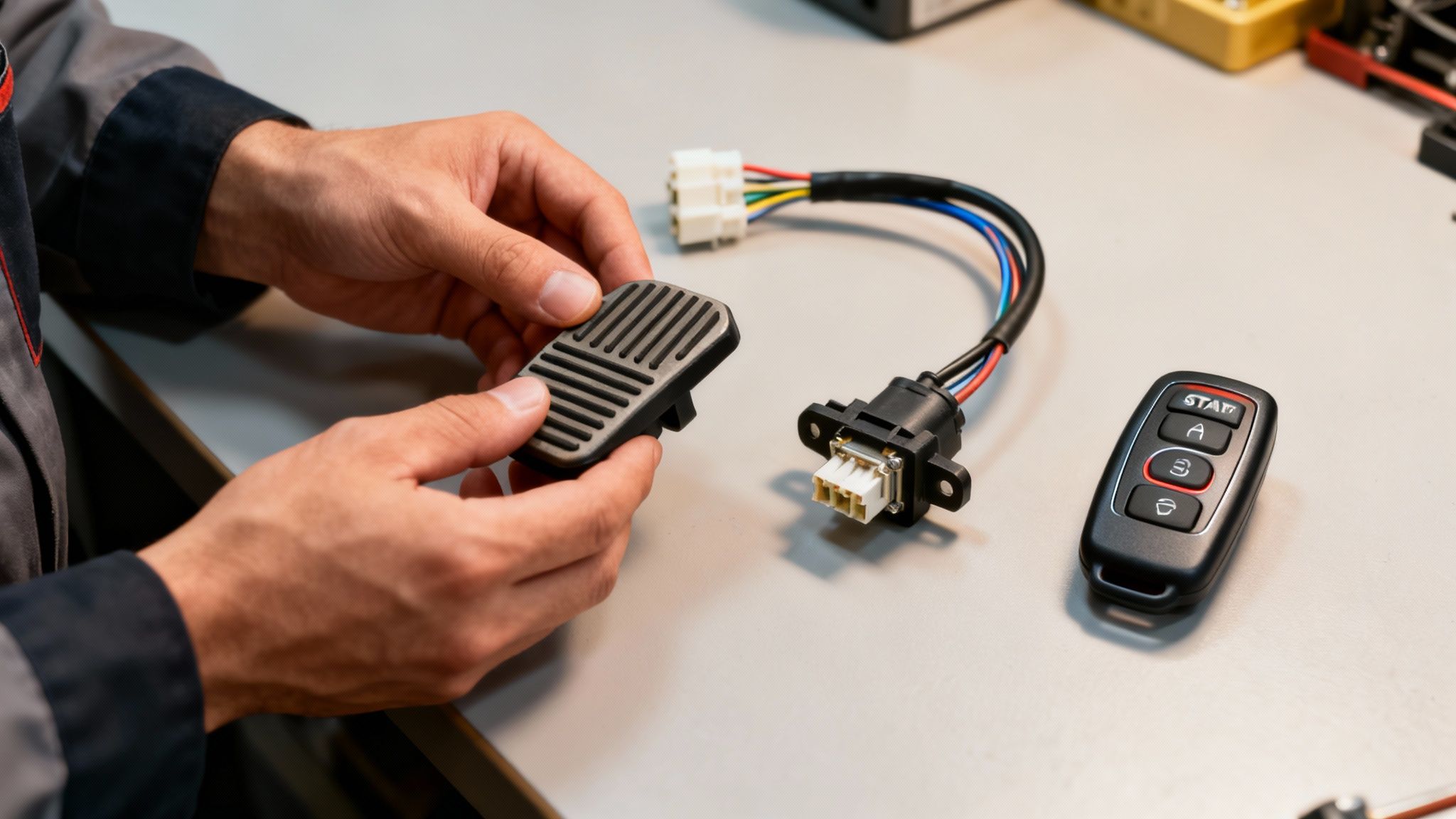
The very idea of a remote starter on a stick-shift car makes a lot of drivers nervous, and for good reason. We've all had that moment of forgetting it in gear. But modern systems aren't just a simple workaround; they're built around a multi-layered safety philosophy.
Think of it as a digital co-pilot that runs a strict pre-flight checklist every single time. It's a smart, integrated system that has one job: starting your car without it moving an inch. Peace of mind is the entire point.
This whole process relies on a critical sequence called reservation mode. It's the procedure you follow when you park, and it's how you "arm" the system for its next use. You're essentially proving to the remote start module that you're leaving the car in a safe, neutral state. If you don't complete this sequence, the remote start simply won't work.
The Three Pillars of Safety
At the heart of any quality manual transmission remote start kit are three non-negotiable safety pillars. These aren't optional features; they are the core components that work together to make sure the vehicle is stationary and secure before the engine ever turns over.
- Neutral Safety Verification: The system has to know for a fact that the shifter is in neutral. It does this by monitoring specific inputs during the reservation mode sequence.
- Handbrake (Parking Brake) Sensor: The remote start module is wired directly to your car's handbrake switch. It needs to see a positive signal that the brake is pulled up and engaged before it will even consider activating.
- Door and Hood Pin Switches: These sensors confirm the vehicle is completely sealed. If any door, the boot, or the bonnet is opened after you've set reservation mode, the system instantly cancels the sequence. This is a crucial step that prevents someone from hopping in and putting the car in gear without you knowing.
If even one of these conditions isn't met, the remote start simply refuses to engage. It's that simple.
The Reservation Mode Sequence: A Real-World Walkthrough
So, what does setting reservation mode actually look like? Let's say you've just pulled into your driveway after work.
- With the engine still running, shift the transmission into neutral.
- Pull the handbrake up firmly.
- Press a specific button on your remote start fob to initiate the sequence. The system will usually confirm with a chirp or a flash of the parking lights.
- Now for the clever part: you can take the key out of the ignition. The engine will keep running by itself.
- Get out of the car and shut all the doors. As soon as the last door clicks shut, the system will lock the doors and turn off the engine.
That's it. The system is now armed. It has electronically verified the car was left running in neutral, with the handbrake on, and that nobody has opened a door since. It’s a logical, foolproof process designed to eliminate human error.
To keep your car from lurching forward, a quality remote start system relies on a series of checks and balances. Here’s a quick breakdown of the essential features that make it all possible.
Safety Mechanisms in Manual Remote Start Kits
| Safety Feature | Function | How It Prevents Accidents |
|---|---|---|
| Reservation Mode | An "arming" sequence the driver must complete when parking the vehicle. | Ensures the car is left in neutral with the handbrake engaged. The remote start will not work unless this sequence is completed correctly. |
| Handbrake Input | A direct wiring connection to the vehicle's handbrake switch. | The system physically checks that the handbrake is engaged before it will arm or start. If the brake is released, the system deactivates. |
| Door/Hood/Boot Pins | Sensors that monitor whether any entry point to the car is opened. | If a door is opened after reservation mode is set, the system cancels immediately. This prevents someone from entering and shifting the car into gear. |
| Clutch Bypass/Sensor | Integrates with the clutch pedal's safety switch. | Physically prevents the starter from cranking if the clutch pedal isn't depressed, which is impossible during a remote start. It's the final line of defence. |
These features work together as a cohesive unit, creating a web of redundant safety checks that make accidental movement virtually impossible.
And the data backs this up. A 2022 study from the Insurance Bureau of Canada (IBC) found that professionally installed aftermarket remote starts on manuals reduced startup-related insurance claims by a massive 28%. The top brands in the business, like Viper and Arctic Start, command over 67% of the Canadian market for a reason. They use advanced clutch pedal sensors with 99.7% accuracy to ensure the starter can't engage, all but eliminating rollaway incidents. You can see how far the tech has come in community discussions to understand why it's so reliable now.
This is the meticulous engineering that separates a professional installation from a risky DIY shortcut. It's how you get the convenience you want without ever sacrificing safety.
Choosing the Right Remote Start Kit for Your Manual Car
Picking the right manual transmission remote start system for your car isn't as simple as grabbing the first box you see. It’s really about finding the right match for your car, your daily routine, and what you expect the system to do. The market is full of great options, but the best choice for someone with a compact daily driver is going to be worlds apart from what an off-road enthusiast needs for their rig.
The first big question to ask yourself is: how do you want to talk to your car? Are you happy with a simple, reliable key fob, or do you want the kind of control you can only get from a smartphone app? Your answer here will have a big impact on the features, range, and ultimately, the price of your setup.
One-Way Versus Two-Way Remotes
A one-way remote is your classic, no-frills option. You press the start button, it sends the signal, and you just have to trust that your car got the message. These are affordable and dependable, making them a great choice if you can usually see or hear your vehicle from where you’re starting it.
Stepping up to a two-way remote is a huge improvement. When you hit the start button, not only does your car get the signal, but it sends one back to you. Your fob will confirm the engine is running—maybe with a beep, a flashing light, or an icon on a little LCD screen. That confirmation is gold when your car is parked on the other side of a sprawling office complex, a shopping centre, or deep in an underground parkade.
Honestly, the peace of mind from a two-way system is its biggest selling point. You never have to stand there wondering, "Did it actually start?" You know for sure, which is a lifesaver on those frigid -20°C mornings when a warm engine is non-negotiable.
Smartphone Integration and Beyond
The most advanced systems ditch the traditional fob altogether in favour of a smartphone app. Brands like Compustar with their DroneMobile system or Viper with SmartStart give you virtually unlimited range. As long as your phone and your car have a cell signal, you can start it from anywhere in the world.
These app-based systems also open up a whole new world of features:
- GPS Tracking: See exactly where your vehicle is at any moment.
- Status Updates: Check if your doors are locked or unlocked right from your phone.
- Custom Alerts: Get notifications for speeding or if the car enters or leaves a specific area (geofencing).
This level of control is a game-changer, especially for modern manual cars where manufacturers often leave remote start off the features list. A 2021 Statistics Canada survey even found that 62% of manual transmission owners in Ontario were interested in adding an aftermarket remote start.
For newer vehicles like the Ford Bronco or Cadillac CT4-V Blackwing, a system like DroneMobile isn't just about starting the engine. It actually integrates with the vehicle’s brain, offering GPS tracking and safe, timed runtimes that protect both your engine and the factory warranty. You can see how this technology is being embraced by diving into this Bronco enthusiast community discussion.
Matching the Kit to Your Needs
To make this a bit more real, let's look at a couple of common scenarios we see here in Canada.
Scenario 1: The Daily Commuter
You drive a Honda Civic Si to work and park in a massive outdoor lot. Your main goal is simply to have a warm car waiting for you at the end of the day. A solid, long-range two-way remote is probably your best bet here. Something like the Compustar PRIME T9 gives you incredible range (up to 3,000 feet) and that all-important confirmation, all without needing a monthly subscription plan.
Scenario 2: The Modern Enthusiast
Now, let's say you own a new manual Ford Bronco. It’s your daily driver but also your weekend adventure vehicle. In this case, a smartphone-based system like DroneMobile just makes more sense. You can start the Bronco while you’re still finishing up at the ski lodge, track its location when it’s parked at a remote trailhead, or even get an alert if your buddy is driving it a little too fast.
In the end, choosing between these aftermarket solutions means weighing convenience against cost and complexity. To get a better handle on the pros and cons, check out our guide on OEM vs. aftermarket parts. A professional installer can also walk you through all the options, making sure you end up with a system full of features you’ll actually use.
What a Professional Remote Start Installation Involves
When you decide to install a manual transmission remote start, you're not just buying a box of electronics; you're investing in a highly specialized service. A professional installation is a meticulous process, a real blend of automotive electrical expertise, precision work, and a deep understanding of how your specific car is wired.
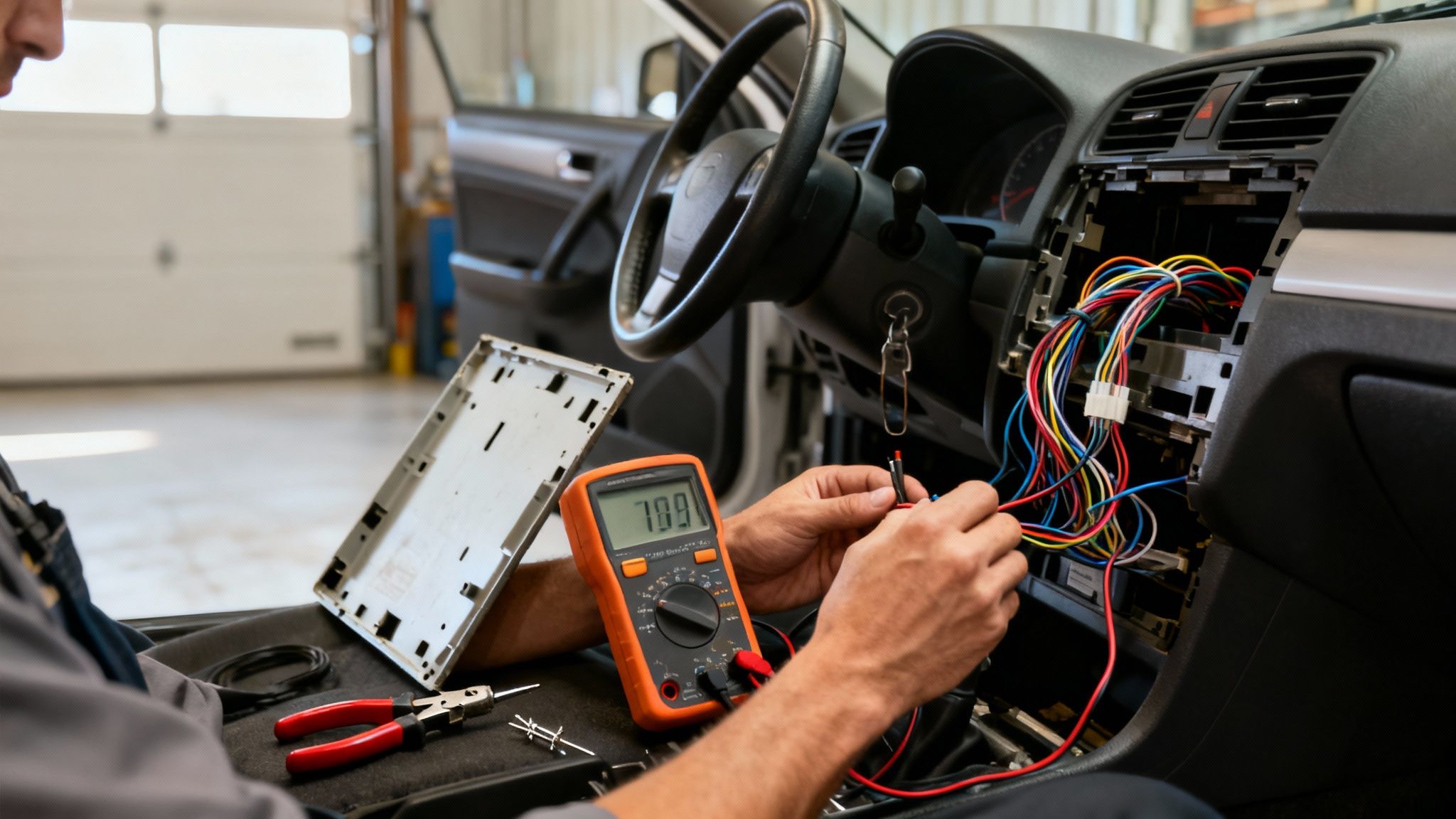
This isn't your average weekend DIY project. The whole thing starts with a careful, systematic disassembly of your vehicle's interior. A good technician will methodically remove dash panels, steering column shrouds, and kick panels, keeping track of every single clip and screw. This isn't just about getting the job done; it's about making sure your car goes back together without any of those annoying rattles or squeaks later on. This careful work is what gives them access to the central nervous system of your car: its wiring harnesses.
Tapping Into the Vehicle's Core Systems
Once those harnesses are exposed, the real fun begins. This is where expertise becomes absolutely critical. The installer has to correctly identify and tap into several key circuits, and each one has a very specific job to do.
- Ignition Wires: These are the big ones. They provide the power the remote start module uses to mimic you turning the key.
- Tachometer Signal: How does the module know the engine is actually running? It reads the engine's RPM from this wire. This ensures it cranks for just the right amount of time and then stops.
- Brake Switch: This is a pure safety feature. The second you touch the brake pedal, the remote start needs to shut down. This connection makes that happen.
- Clutch Switch: For a manual car, this is the most important connection of all. It allows the system to safely bypass the clutch safety interlock that normally forces you to press the pedal to start the car.
Getting any of these wrong can lead to serious problems, from a system that simply won't work to one that causes expensive electrical damage.
A professional installer never guesses. They work with vehicle-specific wiring diagrams and use a digital multimeter to test and verify every single wire before making a connection. That methodical approach is what separates a reliable, safe remote start from a future electrical nightmare.
Choosing the right system is the first step, and it directly impacts how complex the installation will be. This flowchart gives you an idea of the different things to consider.
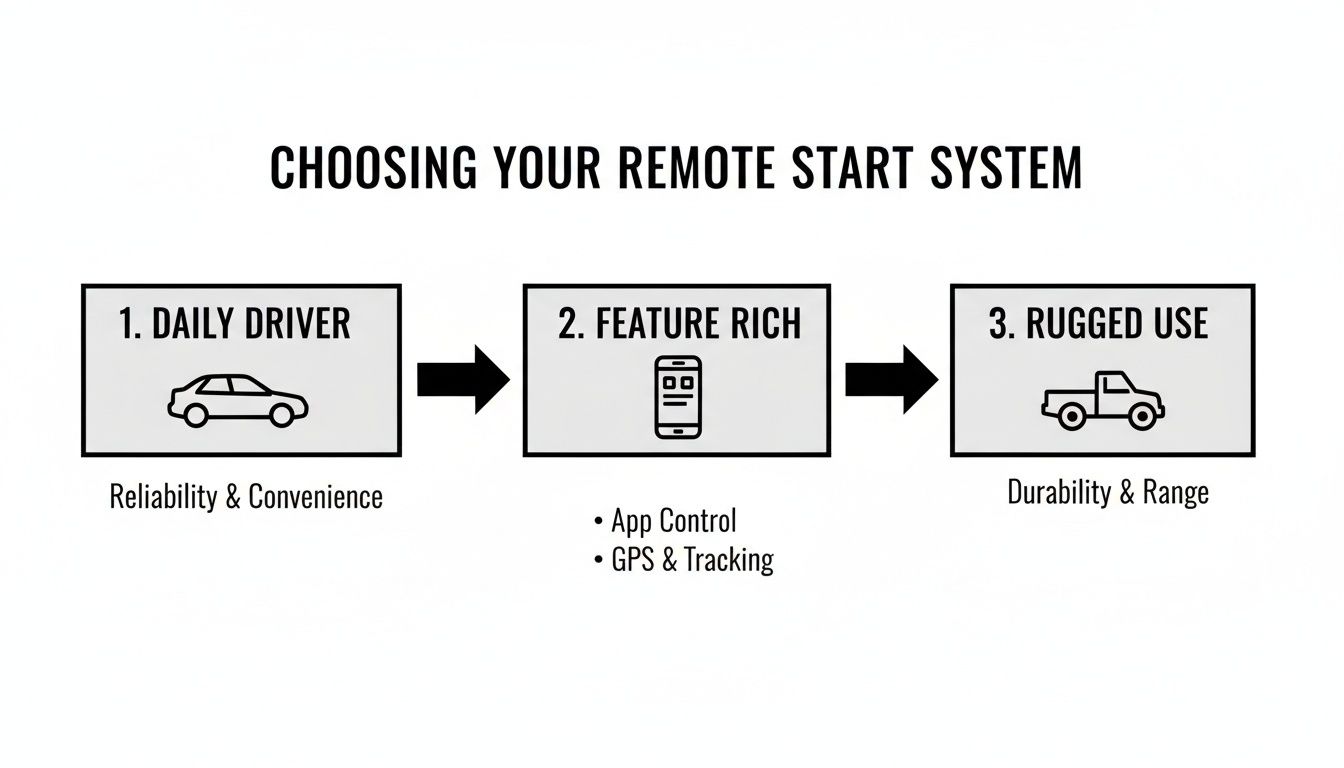
As you can see, your driving habits—whether you're a city commuter, a tech enthusiast, or an off-road adventurer—help determine what features you'll need, and in turn, what the installation will demand.
The Art of a Clean Connection
How a technician makes these connections is just as important as finding the right wires in the first place. You’ll often see two methods discussed: T-taps and soldering. T-taps are little plastic clips that bite into a wire to make a connection. They’re fast, sure, but they are notoriously unreliable. Over time, vibrations can shake them loose, moisture can cause corrosion, and they can even damage the delicate copper strands inside the wire. All of this leads to intermittent problems that are a massive headache to track down later.
A true professional will almost always solder the connections. Soldering creates a permanent, electrically solid bond that simply won't fail or degrade over time. Each joint is then carefully insulated, usually with high-quality electrical tape or heat-shrink tubing, to protect it from shorting out against other wires or the car's metal frame. It’s this level of craftsmanship that makes the remote start a seamless part of your car’s electronics, not just some fragile add-on.
Programming and Final Testing
With all the wiring buttoned up, the brain of the system—the remote start module—needs to be programmed. This is where the installer configures it to talk to your specific vehicle. They'll teach the module your car's unique tachometer signal, program it to integrate with your factory keyless entry, and set crucial parameters like how long the engine will run.
Finally, everything gets tested. And I mean everything. The installer will:
- Run through the reservation mode sequence to make sure it arms correctly every time.
- Test the remote start and shut down commands multiple times.
- Confirm all the safety features are working, like making sure the sequence cancels if a door is opened.
- Check that the handbrake and clutch safety inputs are functioning flawlessly.
This thorough testing is your guarantee that when you get your keys back, your manual transmission remote start will be both a great convenience and incredibly safe. It’s this meticulous attention to detail that makes finding a trusted professional so important. For anyone curious about what a top-tier installation looks like, learning more about how to find the right auto remote starter installers near you is a great way to understand what separates a true expert from the rest. It's the peace of mind that comes from knowing every wire is perfect and every safety check is in place.
Common Installation Mistakes and Troubleshooting
Even if you buy the best manual transmission remote start kit on the market, its performance is only as good as the installation. Honestly, this is where most DIY projects go wrong. A single rushed connection or a missed setting can create some seriously frustrating problems that are a real nightmare to track down later.
From our experience in the shop, we see the same handful of mistakes pop up again and again. These issues can be confusing, too. Maybe reservation mode won't engage, or the car starts and then immediately shuts off. Even worse, sometimes the starter just cranks and cranks with no hope of the engine actually firing. Nine times out of ten, the culprit is one of these common slip-ups.
Knowing what can go wrong really highlights the precision this job demands and why having a seasoned technician handle it is often the smartest move.
The Problem with Weak Ground Connections
Let's start with the most common—and most frustrating—issue: a bad ground. Your remote start module needs a rock-solid connection to the vehicle's metal chassis to work properly. When that ground is weak, maybe because the wire is attached to a painted surface or a slightly loose bolt, it creates electrical resistance.
This resistance is the source of all kinds of gremlins. The module might not get consistent power, causing reservation mode to work one day and fail the next. Or, the brain unit can't get accurate readings from the car's sensors, leading to a complete no-start situation. It’s maddening.
Pro Tip: We never just find a random screw for a ground. A professional will always take the time to sand away any paint to get to clean, bare metal. Then, we secure the ground wire with its own dedicated fastener to guarantee a permanent, low-resistance connection that will never cause a problem down the road.
Misinterpreting the Tachometer Signal
Think of the tachometer (tach) signal as the remote starter's eyes and ears. It's the pulse that tells the module how fast the engine is spinning. This is critical—it's how the unit knows the engine has started and when to stop cranking. A poor tach connection is a recipe for disaster.
We see the classic symptoms all the time:
- Over-Cranking: The module never gets the signal that the engine is running, so it just keeps cranking the starter. That awful grinding sound is not something you want to hear.
- Under-Cranking: The unit gets a faint or messy signal, thinks the engine caught when it didn't, and gives up too soon.
- Start and Stall: The engine fires up perfectly, but the module immediately loses the tach signal. Thinking the car has stalled, it shuts everything down.
Figuring this out isn't about guesswork. It means grabbing a multimeter to check that the signal is clean and steady, which takes the right tools and the know-how to read them correctly.
Incorrect Module Programming
Modern remote start systems aren't just plug-and-play devices. The control module—the "brain" of the operation—has to be programmed for the exact vehicle it's going into. We're talking about setting everything from engine run-time to, most importantly, the type of tach signal it should be looking for.
The biggest mistake we see is forgetting to program the module for a manual transmission. If the unit is left in its default "automatic" mode, none of the crucial safety features, like reservation mode or the handbrake sensor, will work. This isn't just an inconvenience; it's a massive safety hazard.
An expert technician will meticulously review every single programming option. They make sure the system is perfectly dialled in for your car's unique electrical system and manual gearbox. That attention to detail is what makes the difference between a safe, reliable remote start and a dangerous liability.
Why Expert Installation Is the Only Safe Choice
After walking through the complex safety checks and delicate wiring, one thing should be perfectly clear: putting a remote starter in a manual car isn't a casual weekend project. All the things we’ve covered—from getting a clean tachometer signal to making sure the reservation mode works every single time—point to one simple fact. This is a job where experience isn’t just a nice-to-have; it's absolutely essential.
The dangers of getting this wrong are very real. A single wire in the wrong place or a module that isn't programmed just right can turn a handy feature into a huge liability. Think about it—the safety systems designed to stop your car from rolling into your garage door are only as good as the person who installed them.
The Guarantee of Professional Craftsmanship
When you bring your vehicle to a professional technician, you're buying more than just their labour. You're investing in peace of mind. A good shop will always stand behind their work with a warranty that covers both the parts and the installation itself. That’s your safety net. It means if something goes sideways, you’re not stuck with a massive bill and a system that doesn't work.
Let’s look at the flip side. A DIY installation that goes south can lead to some serious headaches:
- A Voided Vehicle Warranty: Your dealership can, and likely will, deny an electrical warranty claim if they discover amateur wiring.
- Fried Electronics: Damaging your car’s main computer (ECU) or Body Control Module (BCM) can easily run into thousands of dollars for repairs.
- Endless Gremlins: Nothing is more frustrating than trying to track down why your starter only works sometimes, all because of a weak ground or a shoddy connection.
A pro avoids all of this. We use time-tested methods, like soldering every connection instead of using cheap T-taps, to make sure every part talks to your car’s factory systems flawlessly.
Local Expertise Matters More Than You Think
Choosing a local expert like us at Carmedics Autowerks gives you an edge that goes beyond just technical ability. We get the specific challenges of driving in Ontario. We know which remote start systems have the power and range to work on a frigid Whitby morning and which units are the most reliable for the popular cars and trucks in our area.
Peace of mind is the ultimate feature of any manual remote start system. It's knowing that every time you press that button, your car will start safely and reliably, without any risk to your property or your family. That confidence only comes from a perfect, professional installation.
Trying to save a few bucks on the installation can easily cost you way more in the long run. To get a better idea of what's involved in a professional setup, you can learn more about the cost to install a remote starter and see why it’s an investment in your vehicle’s safety.
In the end, it boils down to a simple question: is the money you might save worth risking the safety and reliability of your car? When it comes to something as complex as a manual transmission remote start, trusting the experts is the only answer that makes sense.
Still Have Questions About Manual Remote Starts?
It's completely normal to have a few lingering questions before you decide to add a remote start to your manual car. We get it. This is a big decision, so let's clear up some of the most common things people ask us.
Is It Actually Safe to Remote Start a Manual Car?
Absolutely, as long as it's installed correctly by a seasoned pro. Modern systems from top-tier brands like Compustar are engineered with layers of safety protocols. They aren't just one simple switch; they have multiple, redundant checks.
The required "reservation mode" sequence, combined with sensors that monitor the handbrake, doors, and clutch pedal, creates a robust safety net. This makes an accidental start while in gear practically impossible. A professional installation isn't just about making it work—it's about ensuring every single one of those safety features is hooked up and tested properly.
Will This Void My Vehicle's Warranty?
This is probably the number one concern we hear, and the short answer is no. In Canada, a manufacturer can't just cancel your entire warranty because you've installed an aftermarket part.
However, if that part is installed poorly and directly causes damage—say, it fries an electrical module—then the repair for that specific component might not be covered. This is precisely why professional installation, backed by its own warranty, is so crucial. It's your best defence.
A professional install protects both your car and its warranty. It guarantees the remote start system works in harmony with your vehicle’s factory electronics, avoiding the electrical gremlins that could lead to a denied warranty claim.
Can Any Manual Car Get a Remote Start?
Pretty much! The technology is incredibly adaptable and can be fitted to almost any manual transmission vehicle out there. Whether you drive a brand-new Subaru WRX or a trusty older Honda Civic, there's likely a solution for you.
The secret is matching the right kit to your vehicle and having a technician who truly understands the specific wiring and computer systems for your car's make and model. While some much older, purely mechanical vehicles might pose a few hurdles, most cars built in the last 20-25 years are perfect candidates for this upgrade.
Ready to enjoy a warm, defrosted car on a cold morning without giving up the connection of driving a stick shift? The expert technicians at Carmedics Autowerks live and breathe this stuff. We specialize in safe, reliable manual transmission remote start installations. Get in touch with us today, and we'll find the perfect system for your car.