


It's a question every driver asks: "How often do I really need to change my brake pads?" While the standard answer is a broad range of 40,000 to 100,000 kilometres, the truth is, there's no magic number. Think of it more as a guideline than a hard-and-fast rule.
The lifespan of your brake pads is deeply personal to your vehicle and how you drive it. The key is understanding what causes them to wear down in the first place.
Understanding Brake Pad Replacement Intervals
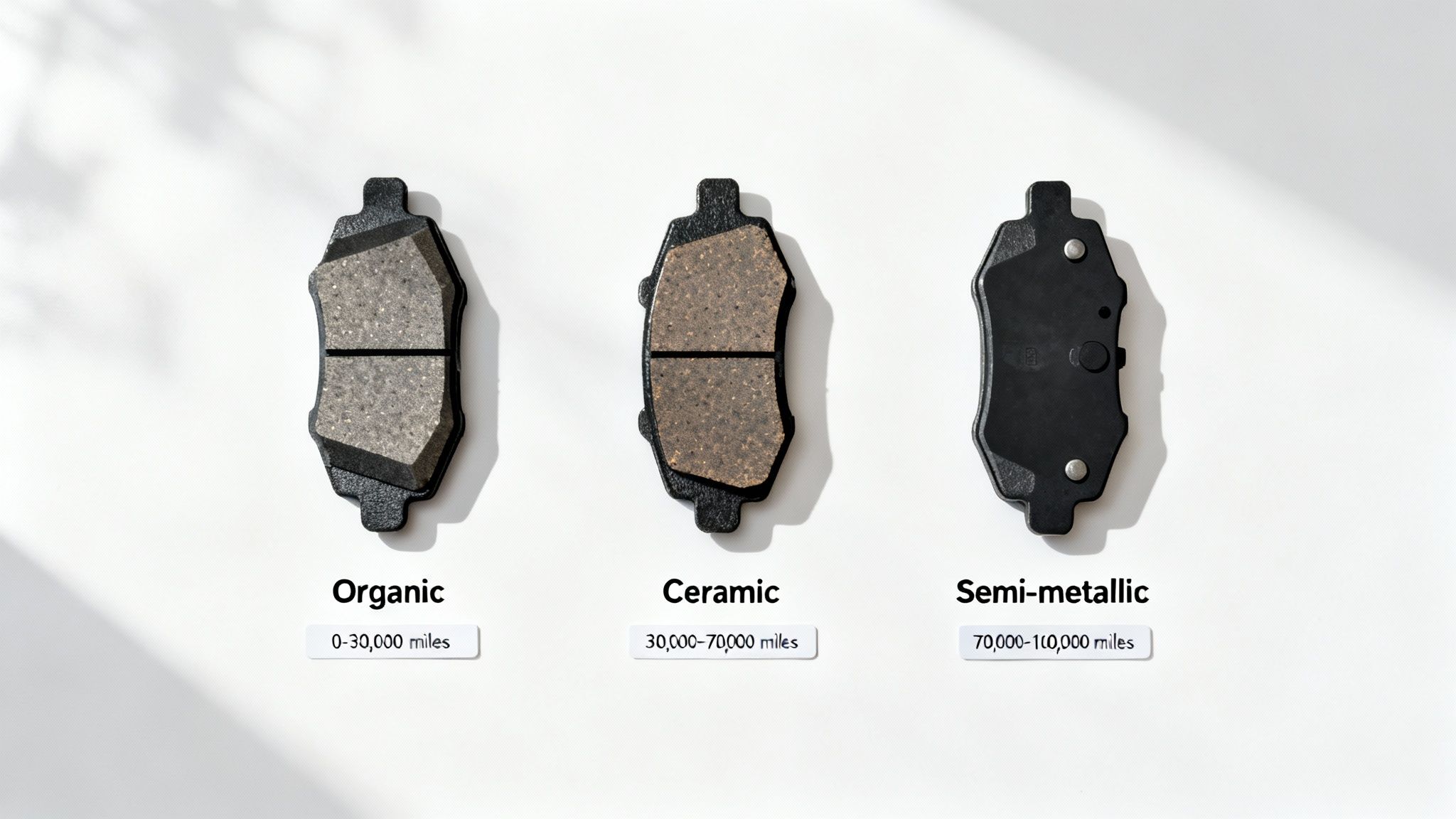
Pinpointing the right time for a brake pad change is less about the calendar and more about recognizing the signs of wear and tear. It helps to think of your brake pads like the soles on a pair of running shoes. A marathoner pounding the pavement every day is going to burn through their shoes much faster than someone who just walks the dog around the block.
Your driving habits, the type of vehicle you own, and even where you drive all play a huge role. Someone navigating the constant stop-and-go traffic in downtown Whitby is putting a lot more demand on their brakes than a driver who mostly cruises along Highway 401.
When it comes down to it, the three biggest factors that determine how long your brake pads last are the material they're made from, your driving style, and the sheer weight of your vehicle.
Lifespan Based on Brake Pad Material
The type of material used to make your brake pads is probably the single biggest factor in their durability. Each material offers a unique blend of stopping power, noise, and longevity, which directly affects how often you'll be heading to the shop.
Knowing the difference between these materials can give you a much better idea of what to expect from your brakes. Let's break down the most common types and see how their service life compares.
Brake Pad Replacement Intervals by Material
Here’s a quick summary of the typical lifespan you can expect from the three most common types of brake pads.
| Brake Pad Type | Typical Lifespan (Kilometres) | Key Characteristics |
|---|---|---|
| Organic | 30,000 – 65,000 km | Quiet and produce less dust, but they also wear out the fastest. |
| Semi-Metallic | 50,000 – 100,000 km | Very durable with excellent performance, but can be a bit noisy. |
| Ceramic | 65,000 – 110,000 km | Long-lasting, quiet, and create minimal dust; often the premium option. |
This table is a great starting point, but keep in mind that these are still just estimates. Your real-world results could look quite different depending on the other factors we’ll explore next.
Why Brake Pad Lifespan Is So Unpredictable

Ever wonder why your friend gets an extra 20,000 kilometres out of their brake pads, even though you both drive the same car? It’s not some big secret. The truth is, a handful of key factors make every vehicle's braking needs totally unique. Once you get a handle on these variables, you can stop relying on generic advice and start understanding the real health of your own braking system.
I like to use an analogy of two different athletes: a sprinter and a marathon runner. The sprinter goes all-out in short, explosive bursts, wearing themselves out in a hurry. The marathon runner, on the other hand, keeps a steady, efficient pace to save energy for the long road ahead. Believe it or not, your driving style is a perfect mirror of this.
An aggressive driver who’s always accelerating hard and slamming on the brakes is the sprinter. They’re putting a massive amount of stress on their brake pads with every single stop. In contrast, the driver who looks ahead, anticipates traffic, and coasts to a gentle stop is the marathon runner. That smooth approach can dramatically extend the life of their braking components.
Your Driving Habits and Environment
By far, the biggest factor in how long your brake pads last is how and where you drive. Constant stop-and-go traffic is the absolute worst enemy of brake longevity. Every single time you creep forward in a jam and tap the brakes, you’re creating friction and heat, which slowly grinds away at the pad material.
This is exactly why a car used for a daily commute in a busy area like Whitby will almost always need new brake pads sooner than one that spends most of its time on long, open-highway trips. It's a trend we see everywhere. A survey from 2020 in California, for instance, found that 68% of vehicles needed brake service between 48,000 and 80,000 km, with city drivers landing squarely at the lower end of that range. You can read more about these findings on brake wear in different driving conditions to see just how your own commute stacks up.
It all comes down to a simple truth: the more you use your brakes, the faster they wear out. Driving proactively—like keeping a safe distance from the car ahead and looking down the road to anticipate stops—is one of the best things you can do to make them last. These habits are a fundamental part of any solid preventive maintenance for vehicles plan.
Vehicle Weight and Load
Basic physics plays a huge part here. The heavier a vehicle is, the more energy it builds up when it’s moving. To bring all that mass to a halt, the brakes have to work much harder to turn that kinetic energy into heat through friction.
Just think about the difference between a little compact car and a big, three-row SUV loaded up with family and gear.
- A lighter vehicle, like a Honda Civic, doesn't need nearly as much force to stop, which puts very little strain on the brake pads.
- A heavier vehicle, like a Ford F-150, especially if it's towing a trailer or has a full bed, needs a ton of braking power to slow down.
This extra demand creates a lot more heat and friction, which leads directly to faster wear on both the pads and the rotors. If you regularly haul heavy loads or tow anything, you should plan on having your brakes inspected and replaced more often.
Key Takeaway: Every extra kilogram your vehicle carries adds to the workload of your braking system. Over time, this added stress measurably shortens the lifespan of your brake pads.
Brake Pad Composition
As we mentioned earlier, the actual material your brake pads are made from is crucial to how long they'll last. Each type is designed to offer a different mix of performance, quietness, and durability.
- Organic pads are known for being quiet and affordable, but they also wear out the fastest.
- Semi-metallic pads give you strong, reliable performance and good durability, but they can be a bit noisier and produce more dust.
- Ceramic pads really offer the best of both worlds, with a very long life and quiet operation, but they typically have a higher price tag.
The right choice really depends on your vehicle and how you use it. A performance car will get more out of the superior heat-handling of semi-metallic pads, while a daily commuter is probably better served by the quiet durability of ceramic pads. At the end of the day, understanding these three core factors—your driving habits, your vehicle's weight, and the pad material—is what empowers you to get a much more accurate read on your brake health.
Key Warning Signs Your Brakes Need Attention
Your car has its own way of telling you something’s wrong. When it comes to your brakes, listening to those signals is your first line of defence against bigger, more expensive problems down the road. Ignoring them is like ignoring a smoke alarm—it’s just not a good idea.
Thankfully, brake pads are designed to give you some pretty clear clues when they're getting tired. If you tune into the new sounds, feelings, and even what you see, you can catch the wear and tear early.
Listening to Your Brakes
One of the first and most common signs is a high-pitched squeal or screech you hear when you hit the brakes. That’s not just a random noise; it's by design.
Most brake pads have a tiny metal tab called a wear indicator. As the pad material wears down, this little tab starts scraping against the brake rotor, making that unmistakable sound. Think of it as your car's built-in alert system telling you it's time for a check-up.
But if you let that squeal go on for too long, it can morph into something much nastier.
That deep, metallic grinding sound? That's a red alert. It means your brake pads are completely worn out, and now it’s metal-on-metal—the pad's backing plate grinding against the rotor. This kills your stopping power and chews up your rotors, which are far more expensive to replace than just the pads.
Feeling for Brake Problems
Sometimes, the warnings are less about what you hear and more about what you feel through the pedal or the steering wheel. Any change in how your car behaves when you brake is a sign that something’s off.
Keep an eye out—or rather, a foot out—for these physical clues:
-
Vibrations or Pulsating: If you feel a shudder or pulse through the brake pedal or steering wheel, it often means your rotors are warped. Intense heat can cause the rotor's flat surface to become uneven, leading to that shaky feeling.
-
Spongy or Soft Pedal: Does the brake pedal feel mushy or sink closer to the floor than it used to? That could point to air in the brake lines or a fluid leak. It’s a serious issue because it reduces the hydraulic pressure needed to stop your car safely.
-
Pulling to One Side: If your car veers left or right when you brake, you could have a stuck caliper or just unevenly worn pads. This creates an imbalance, where one side is braking harder than the other.
Each of these symptoms points to a specific problem that needs a professional eye. Knowing what these feelings mean helps you explain the issue clearly to our technicians at Carmedics Autowerks, which leads to a faster, more accurate fix. Acting quickly is the best thing you can do for your car’s safety and performance.
How to Check Your Brake Pads at Home
You don't need to be a seasoned mechanic or have a garage full of tools to get a rough idea of your brake pad's condition. A quick visual check is one of the easiest ways to stay on top of things and catch wear before it becomes a real problem. It empowers you to know when it's the right time to give a professional a call.
This simple check is all about looking at the thickness of the friction material on the pads. The best part? You can often do it without even taking the wheel off. Just park on a level surface, turn your steering wheel all the way to one side, and you should get a decent view of the brake assembly.
The Pencil Test
Peer through the spokes of your wheel and locate the brake caliper—that's the clamp-like part that fits over the shiny metal disc (the rotor). Inside that caliper, you'll see the brake pad pressed up against the rotor. You’re looking for the friction material, which is the thicker chunk of the pad doing all the work.
A great rule of thumb is what I like to call the "pencil test." If that friction material looks thinner than a standard pencil (about 1/4 inch or 6-7 mm), that's a pretty clear sign your pads are on their way out.
It's a straightforward visual cue that tells you it's time to book a proper inspection, hopefully long before you start hearing any strange noises.
This infographic breaks down the typical sounds you'll hear as your brakes wear down, from that first high-pitched squeal to a truly nasty grinding sound.
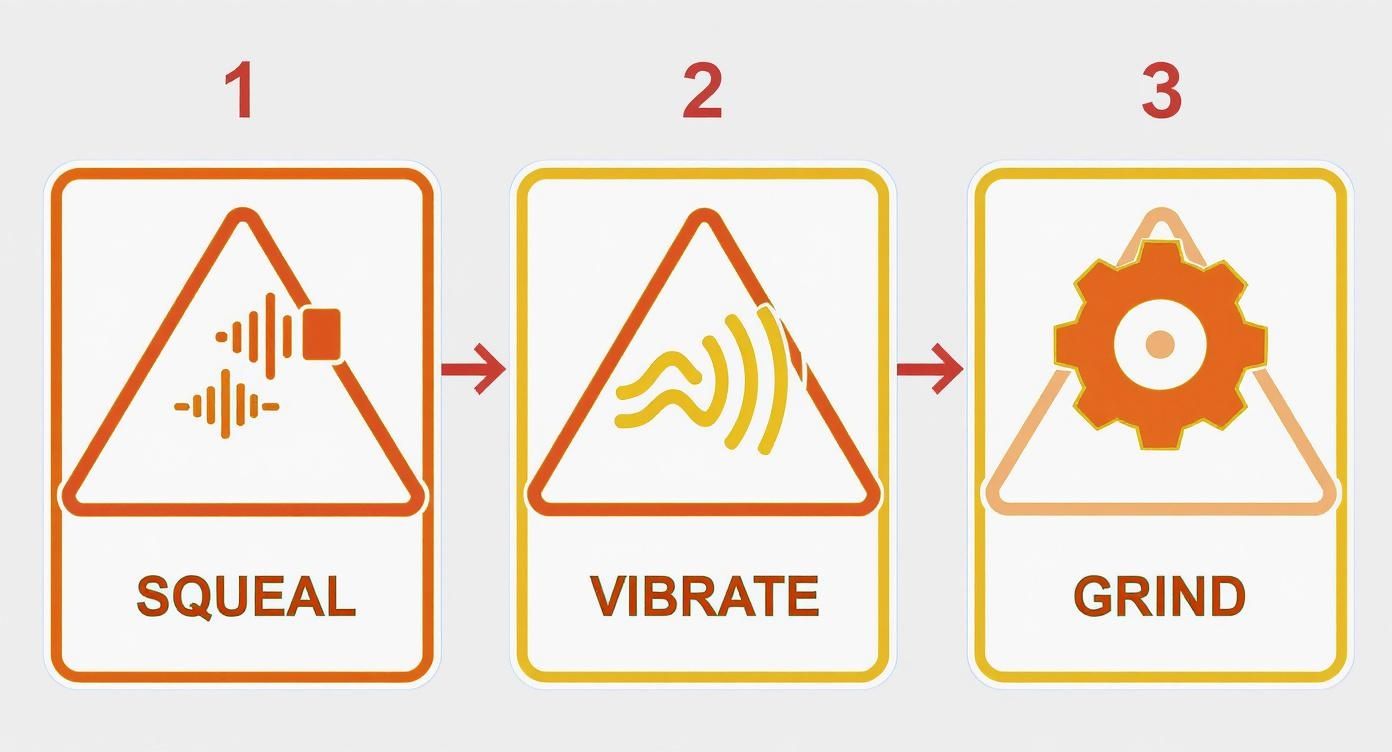
Each stage signals a more severe level of wear, which is exactly why catching it early with a quick visual check is so important.
Taking a hands-on approach like this can really build your confidence as a car owner. Of course, where you do most of your driving plays a huge role. Research has shown that drivers in busy urban centres can see their brake pads wear out 15-20% faster than folks in quieter areas, simply because of all the stop-and-go traffic. You can discover more about how driving environments affect brake wear to see how your own commute stacks up.
Ultimately, this isn't about doing the repair yourself; it's about being proactive and avoiding the headache of an unexpected, and often expensive, repair bill.
What’s This Going to Cost Me? A Look at Brake Pad Replacement Costs
Let’s get right to it—the bottom line. Knowing what a brake job might cost helps you plan for this crucial service and really drives home the value of not putting it off. The final price tag isn’t just a single number; it's a mix of factors, including your vehicle, the parts you go with, and how much wear and tear we find.
A straightforward brake pad swap is your best-case scenario, cost-wise. But if you’ve been driving on worn-out pads for a while, there’s a good chance the rotors are damaged too. Replacing those can nearly double the cost. Your vehicle type matters a lot here as well—parts for a big truck or a high-performance SUV are almost always pricier than for a small sedan.
Breaking Down the Costs
The parts you choose—the brake pads and rotors—are a huge part of the final bill. High-performance ceramic pads, for example, will cost more upfront than standard organic ones, but they also tend to last longer and run quieter. It really comes down to a balancing act between your budget and what you expect from your brakes. Understanding the differences between part grades is key, and it’s always smart to weigh the pros and cons when looking at OEM vs. aftermarket parts.
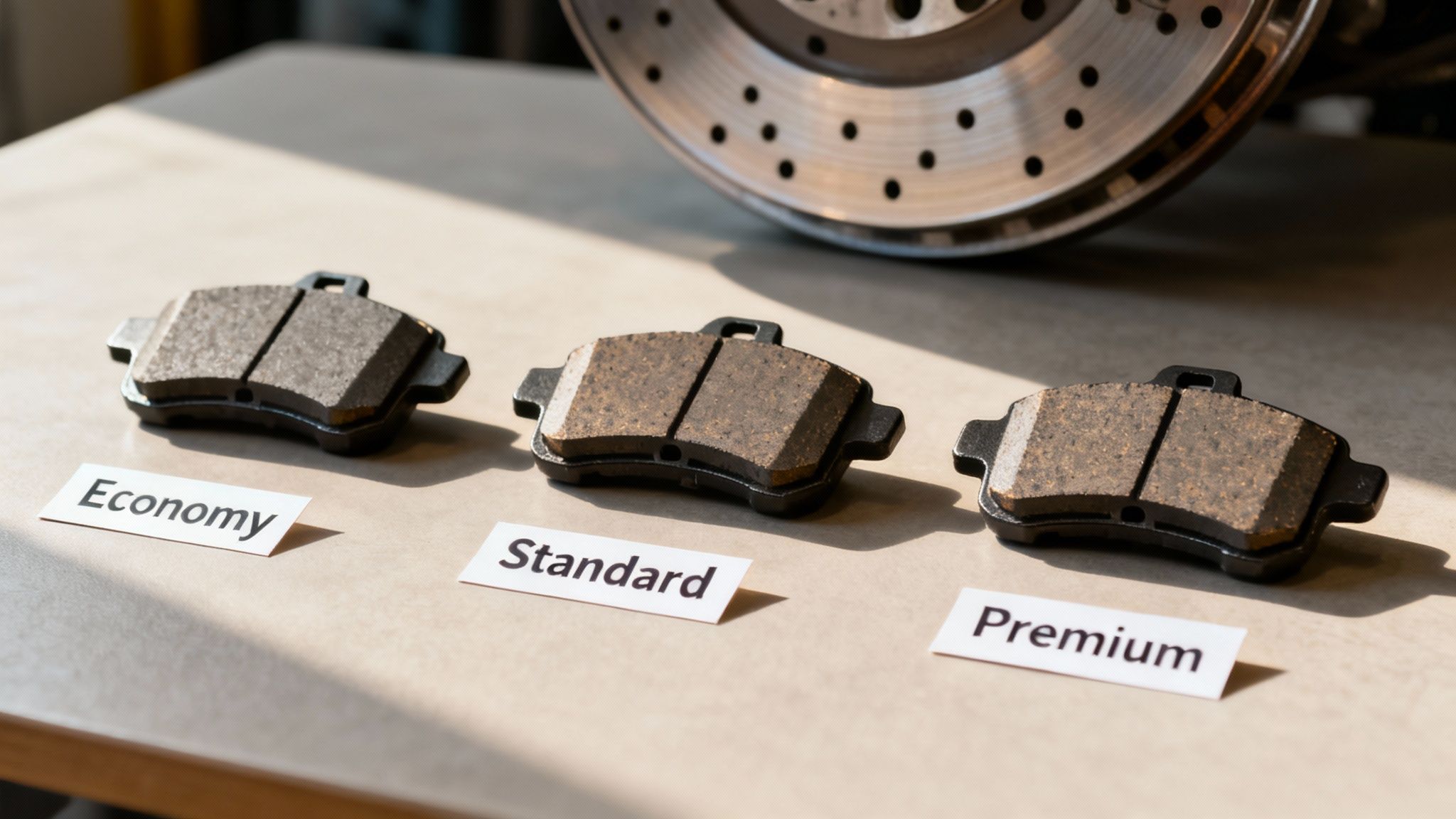
So, what can you actually expect to pay? The numbers can vary, but here’s a ballpark estimate for different brake services in our area.
Estimated Brake Pad Replacement Costs
This table gives a general idea of potential costs for brake pad services, showing how the price can shift based on your vehicle and the work required.
| Service Type | Compact Car (e.g., Honda Civic) | Large SUV/Truck (e.g., Ford F-150) |
|---|---|---|
| Front Brake Pads Only | $200 – $350 CAD | $300 – $500 CAD |
| Front Pads & Rotors | $400 – $600 CAD | $600 – $900 CAD |
| Full Brake Job (All 4 Wheels) | $700 – $1,100 CAD | $1,000 – $1,600+ CAD |
As you can see, the difference is significant. Bigger, heavier vehicles demand more robust (and more expensive) braking components.
Pro Tip: The best way to keep brake repair costs down is to act fast. Catching that first squeal and getting your pads replaced right away can often save you from needing new rotors, which can cut your repair bill in a big way.
Even things like environmental regulations can have an impact. For instance, recent laws have pushed for new low-copper brake pad formulas, and some research suggests these might wear a bit differently. As technology and regulations evolve, so do the parts we use. Thinking bigger picture, maintenance is also a key factor when looking at a broader comparison of ownership costs between EVs and petrol cars, as things like regenerative braking can completely change the game for brake wear.
Common Questions About Brake Pad Replacement
Even when you've got the basics down, a few specific questions always seem to pop up around brake service. Getting straight answers helps you make smarter choices for your car and your wallet, so you know exactly what’s what when you bring your vehicle in.
Let’s dive into some of the most common questions we hear from drivers right here in Whitby.
Can I Replace Just the Front or Rear Pads?
Absolutely. In fact, it's the standard way of doing things. Your front and rear brake pads almost never wear out at the same time. For most cars and SUVs, the front brakes do the heavy lifting, handling about 60-70% of the stopping power.
Think about it: when you hit the brakes, the car's weight lurches forward, putting a massive amount of pressure on the front axle. That extra work means more friction and heat for the front pads, so they wear down much faster than the rears. It's completely normal to go through two sets of front pads for every one set of rears.
OEM vs. Aftermarket: What Is the Difference?
This is a classic crossroads for any car owner. Deciding between Original Equipment Manufacturer (OEM) and aftermarket pads is all about finding the right balance of cost, performance, and a perfect fit for your car.
- OEM Pads: These are the exact same parts your vehicle was built with at the factory. You get predictable, reliable performance and a guaranteed fit, but they typically cost a bit more.
- Aftermarket Pads: These are made by other companies, and the variety is huge. You can find everything from a simple, budget-friendly replacement to a high-performance set that might even stop better than the original parts.
The key thing to remember is that "aftermarket" doesn't automatically mean lower quality. Many reputable aftermarket brands offer incredible value, but the trick is choosing the right part that meets your car's specific demands.
How Do EVs and Hybrids Affect Brake Pad Life?
This is where things get interesting. Electric and hybrid vehicles use a brilliant piece of tech called regenerative braking. Instead of just relying on the friction of brake pads to stop, they use the electric motor to do a lot of the work.
When you take your foot off the accelerator in an EV or hybrid, the motor essentially runs in reverse. This creates drag that slows the car down, and as a bonus, it recharges the battery at the same time. This system handles most of the gentle slowing you do in city traffic, which means the actual brake pads get used far less. The result? Brake pads on EVs and hybrids can easily last twice as long as those on a gasoline-powered car.
Of course, the overall health of the brake system is still critical, which includes knowing how often brake fluid should be changed to keep everything working as it should.
At Carmedics autowerks inc, our expert technicians can answer all your questions and provide the right service for your vehicle, whether it’s a standard car, a heavy-duty SUV, or an EV. Book your brake inspection with us today at https://carmedicsautowerks.com.com.