

That first scratch on your car is always the worst. It’s an instant cringe, followed by the immediate search for "quality automotive paint repair near me." But it's about so much more than just a blemish. A proper repair is a critical investment in your vehicle's long-term health and resale value. A cheap, corner-cutting job can actually cause more harm than good, while a professional repair will protect your car for years to come.
Why The Right Local Paint Shop Is Essential
Choosing where to get your paint fixed isn't like picking a place for a car wash; it's about trusting a craftsman with one of your biggest assets. A top-notch repair doesn't just match the colour—it restores the protective barrier that shields the metal from rust and corrosion, which is a massive issue with the salt and moisture we get here in Ontario.
Think about it this way: that scratch is a breach in your vehicle's defences. A quick, cheap patch might look okay from ten feet away, but it won't truly seal the deal. A true professional, on the other hand, rebuilds that protection layer by layer, just like the factory did.
Beyond a Simple Colour Match
There's a world of difference between a professional paint repair and a quick spray-over from a budget shop. The best technicians follow a meticulous process to ensure the fix is both invisible and durable.
- Proper Surface Preparation: This is the foundation of the entire repair. It involves carefully cleaning, sanding, and priming the damaged spot so the new paint has a perfect surface to bond to. Without this, you’ll see peeling and bubbling down the road.
- Precision Colour Blending: Technicians use specialized computer systems to get an exact match for your car's specific paint code. They then artfully blend the new paint into the surrounding panels, which is the secret to avoiding that obvious "patchwork" look.
- Protective Clear Coat Application: The final step is applying a durable clear coat. This isn't just for shine; it's the crucial top layer that provides UV protection and a finish that seamlessly matches the rest of your car.
I've seen it countless times: trying to save a few dollars on a subpar repair almost always costs more in the long run. A bad job can trap moisture and hide developing rust, leading to major, expensive bodywork later. If you care about your vehicle, finding a real artisan is non-negotiable.
Ultimately, your search for "automotive paint repair near me" is the first step in preserving your car’s condition and value. For those in the Durham region looking for a shop that gets it, you can find more on the comprehensive Whitby auto repair and detailing services that always put quality first. Your car deserves a lasting, professional solution, not just a temporary fix.
What Kind of Paint Damage Are You Dealing With?
Before you even start searching for "automotive paint repair near me," it’s crucial to figure out what kind of damage you're looking at. Not all scrapes and scuffs are the same, and knowing the difference will help you have a much more productive conversation with a repair shop—and avoid paying for work you don’t need.
Your vehicle's paint isn't just one layer; it’s a multi-layered system designed for protection and aesthetics. A light brush against a hedge might only touch the top clear coat, but a deep key scratch can slice right down to the bare metal.
Surface Scratches vs. Deep Gouges
Light, superficial damage that’s only sitting in the clear coat can often be handled through a process called paint correction. It's a meticulous job where a skilled technician uses special compounds and polishes to smooth out the clear coat, effectively erasing the scratch without any new paint.
So, how do you know if it's just a surface issue? Here’s a simple test I always recommend: run your fingernail gently over the scratch. If your nail glides over it without catching, paint correction is probably a viable option.
But if your fingernail gets snagged in the groove, you’re dealing with a much deeper problem. That scratch has cut through the protective layers, and the metal is now exposed. Ignoring it is asking for trouble, especially with the amount of salt used on our Ontario roads in the winter. For more on this, you can learn how to prevent rust on your car from our detailed guide.
A deep scratch needs a real repair, not just a quick cover-up. The process involves sanding the area down, applying fresh primer, perfectly matching the base colour, and then sealing everything with a new, durable clear coat.
To help you quickly assess the situation, here's a handy table that breaks down common types of paint damage and what it takes to fix them properly.
Identifying Paint Damage and Its Repair Solution
| Type of Damage | Common Cause | Typical Professional Solution |
|---|---|---|
| Light Scratches | Parking lot mishaps, automatic car washes, improper washing | Paint correction (polishing/compounding the clear coat) |
| Deep Scratches | Vandalism (keying), sharp object impacts, deep scrapes | Spot repair (sanding, priming, painting, and clear coating) |
| Rock Chips | Debris kicked up on highways (like the 401) | Chip repair (filling and sealing) or a full panel respray |
| Paint Swirls | Improper washing/drying techniques, abrasive cloths | Paint correction and polishing to restore a mirror finish |
| Oxidation/Fading | Prolonged sun/UV exposure | Major paint correction or, in severe cases, a complete respray |
This table should give you a solid starting point for understanding what your car needs. A small chip might seem minor, but if it goes to the metal, it requires a professional touch to prevent future rust.
This flowchart illustrates the choice you often face: a quick, cheap fix versus a quality repair that actually lasts.
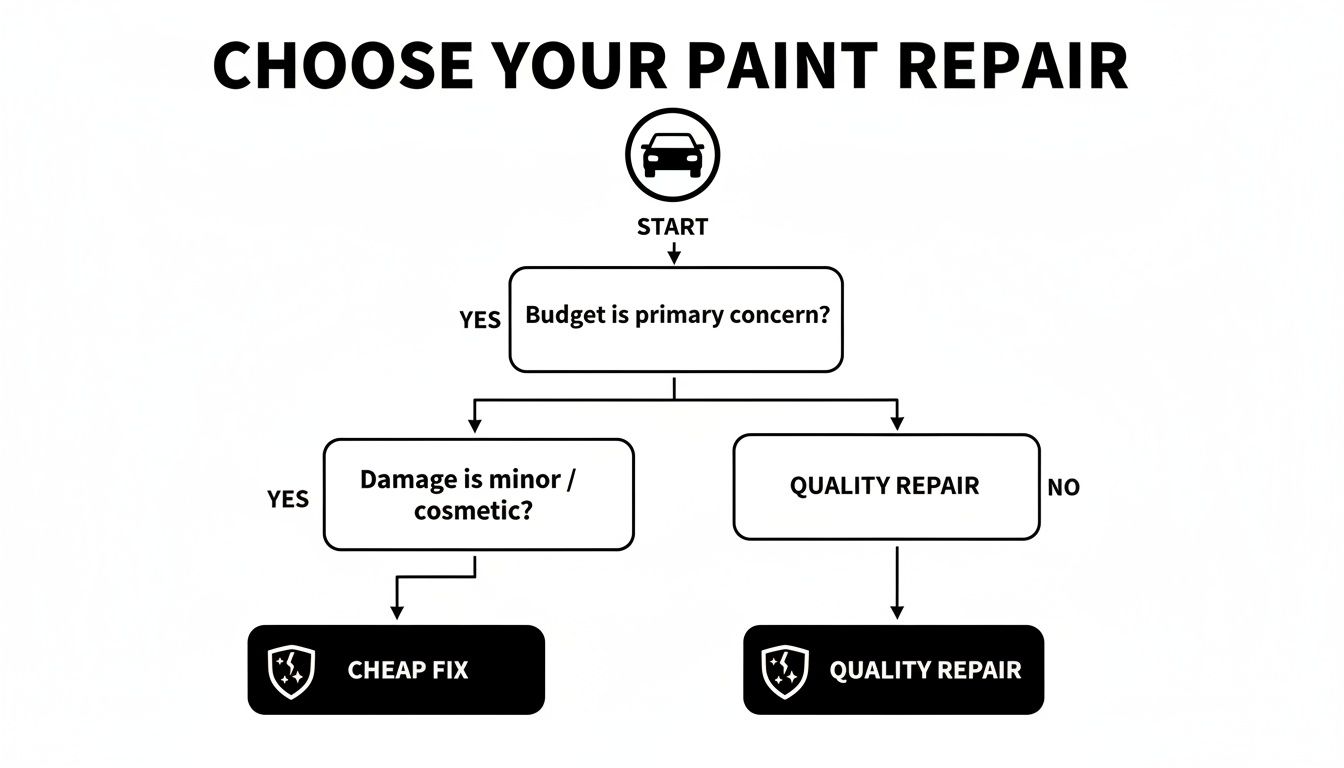
As you can see, while a cheap touch-up might look okay for a week, only a proper, professional repair delivers long-term protection and value. This is especially true for those frustrating rock chips from highway driving, which almost always need more than a simple dab of touch-up paint. Correctly identifying the damage from the start ensures you get a flawless, factory-quality finish that stands the test of time.
How To Find And Vet The Best Local Repair Shops
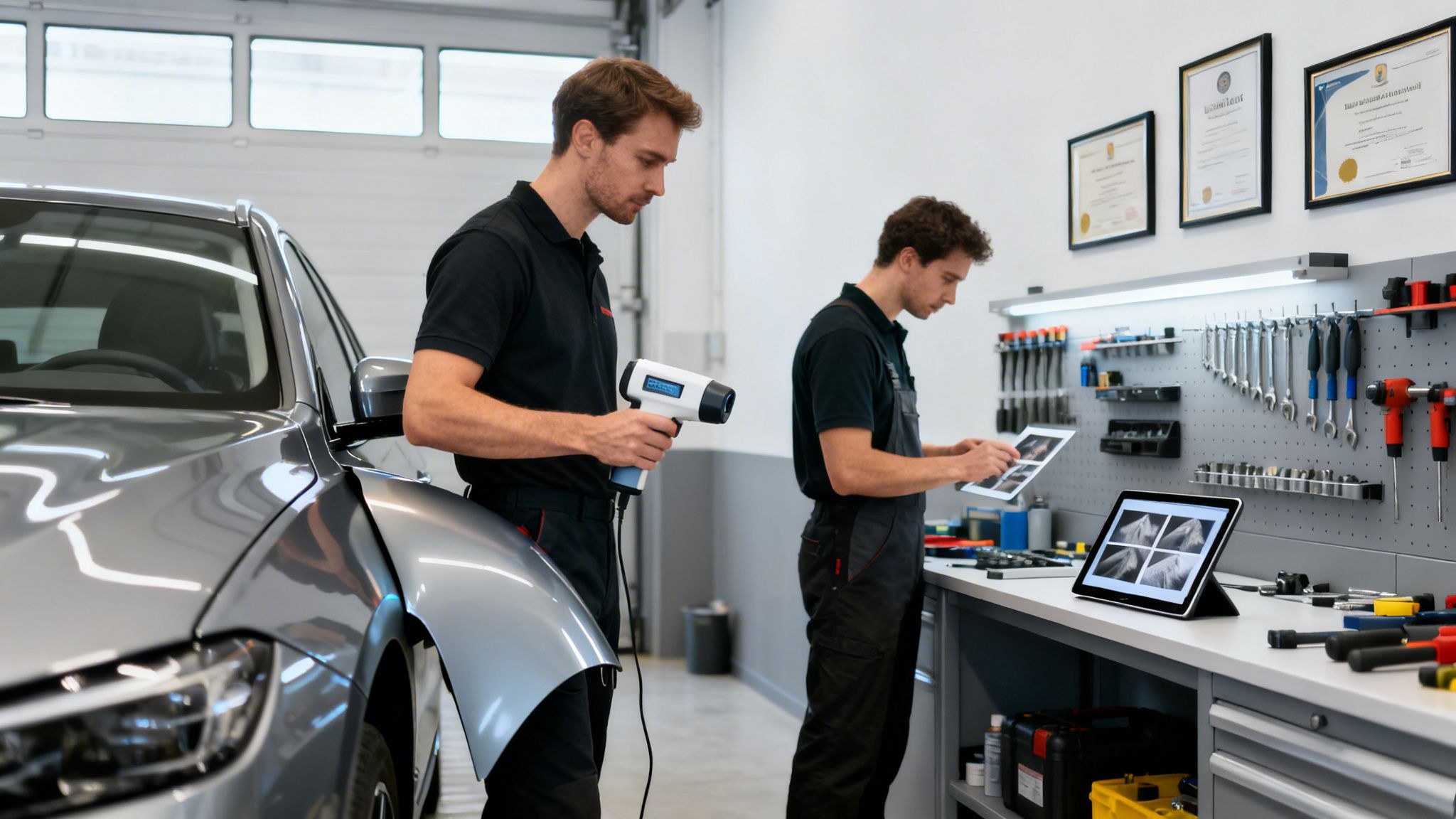
Finding the right shop to trust with your vehicle’s paint is easily the most important step in the whole process. Typing “automotive paint repair near me” into Google will flood you with options, but the real gems are rarely the first result. To separate the true artisans from the rest, you have to think like an insider.
Forget the generic searches. Get specific right away. If you own a luxury German car, for instance, searching for "certified Audi paint shop Durham" or "collision repair Whitby" is going to connect you with shops that have invested in the specialized training and equipment your vehicle demands.
Scrutinizing Their Online Presence
With a shortlist in hand, it’s time to do some digital digging. A shop’s online footprint tells you almost everything you need to know before you even pick up the phone. Don't just glance at the star rating on Google or Yelp—the real story is in the details of the reviews.
Are people leaving specific, detailed comments? Look for mentions of a perfect colour match, excellent customer service, or the professionalism of the staff. Pay close attention to how the owner or manager responds to feedback, especially the negative reviews. A calm, professional reply to a complaint is a fantastic sign of a business that cares.
Next, head over to their website and social media channels to see their work for yourself.
- Before-and-After Galleries: A confident shop will have a portfolio bursting with high-resolution photos. You want to see clear images that show off their ability to create a seamless colour blend and a flawless, factory-like finish.
- The Cars They Work On: Take note of the types of vehicles in their gallery. If you see they’re consistently trusted with brand-new, classic, or high-end cars, it’s a strong signal that they have a reputation for top-tier quality.
A shop's digital portfolio is its resume. If they don't have clear, high-quality photos of their paint work, it’s a major red flag. They should be eager to show you what they're capable of.
The In-Person Inspection
Once you’ve narrowed your list down to your top two or three choices, it’s time to pay them a visit. The vibe you get the moment you walk through the door speaks volumes. A clean, organized front office and a tidy, professional workshop show a commitment to precision and attention to detail that usually carries over into their work.
While you're there, ask them about their qualifications. An I-CAR Gold Class certification is the gold standard in our industry, proving their technicians are trained on the latest materials and repair techniques. This isn't just a plaque on the wall; it’s a serious commitment to quality.
You should also ask about their paint-matching process. Do they use modern technology like a spectrophotometer to get an exact digital reading of your car’s colour? Finally, ask about the warranty they offer on their paint repairs. Their answer will tell you how much they stand behind their own work.
Finding the right expert ensures your vehicle’s repair is a lasting investment, not just a quick fix. For more tips, check out our complete guide on what to look for when selecting a car repair shop near you.
What Separates A Good Paint Job From A Great One
Alright, so you've narrowed down your list of potential shops. Now comes the part where you separate the good from the truly great. Anyone can make a scratch disappear, but a top-tier shop delivers a repair so flawless it looks like it never happened.
The difference isn't just skill—it's a deep investment in technology, precision, and proven expertise.
A real pro shop doesn't cut corners on materials. The first question you should ask is what kind of paint they use. The best shops have moved to modern waterborne paints. Not only are they better for the environment, but they're also what most manufacturers use on the factory line. It's a huge part of the global automotive refinish coatings market, which was valued at $9.8 billion in 2023. You can see more industry stats on how technology is driving changes at Gitnux.org.
The Science Of Colour Matching
Next, dig into their colour-matching process. Here’s a pro tip: if they just ask for your factory paint code and call it a day, walk away. A great shop knows that a paint code is only a starting point.
They’ll use a handheld spectrophotometer to get a precise digital reading of your car’s actual colour. This accounts for any slight fading from sun exposure or variations from the factory batch. That data is then used to mix a custom formula for a perfect match.
Without a spectrophotometer, a technician is just guessing. An exact digital measurement is the only way to guarantee the new paint will be indistinguishable from the original, even under direct sunlight.
Proof Of Mastery
Finally, look for credentials. I’m not just talking about a business licence; I mean proof of ongoing, high-level training.
The gold standard is manufacturer certifications. When a shop is certified by brands like Audi, BMW, or Ford, it means something. These aren't easy to get—they require the shop to invest in specific, factory-mandated equipment and to pass rigorous, continuous training directly from the automaker.
This tells you the shop has been vetted to repair vehicles to the exact same standard as when they were built. A team with these credentials treats automotive paint repair as the craft it is.
Once you have that perfect repair, you'll want to keep it that way. To explore your options for protecting the new finish, check out our guide on the best car paint protection.
Now, Let’s Protect That Perfect New Paint Job
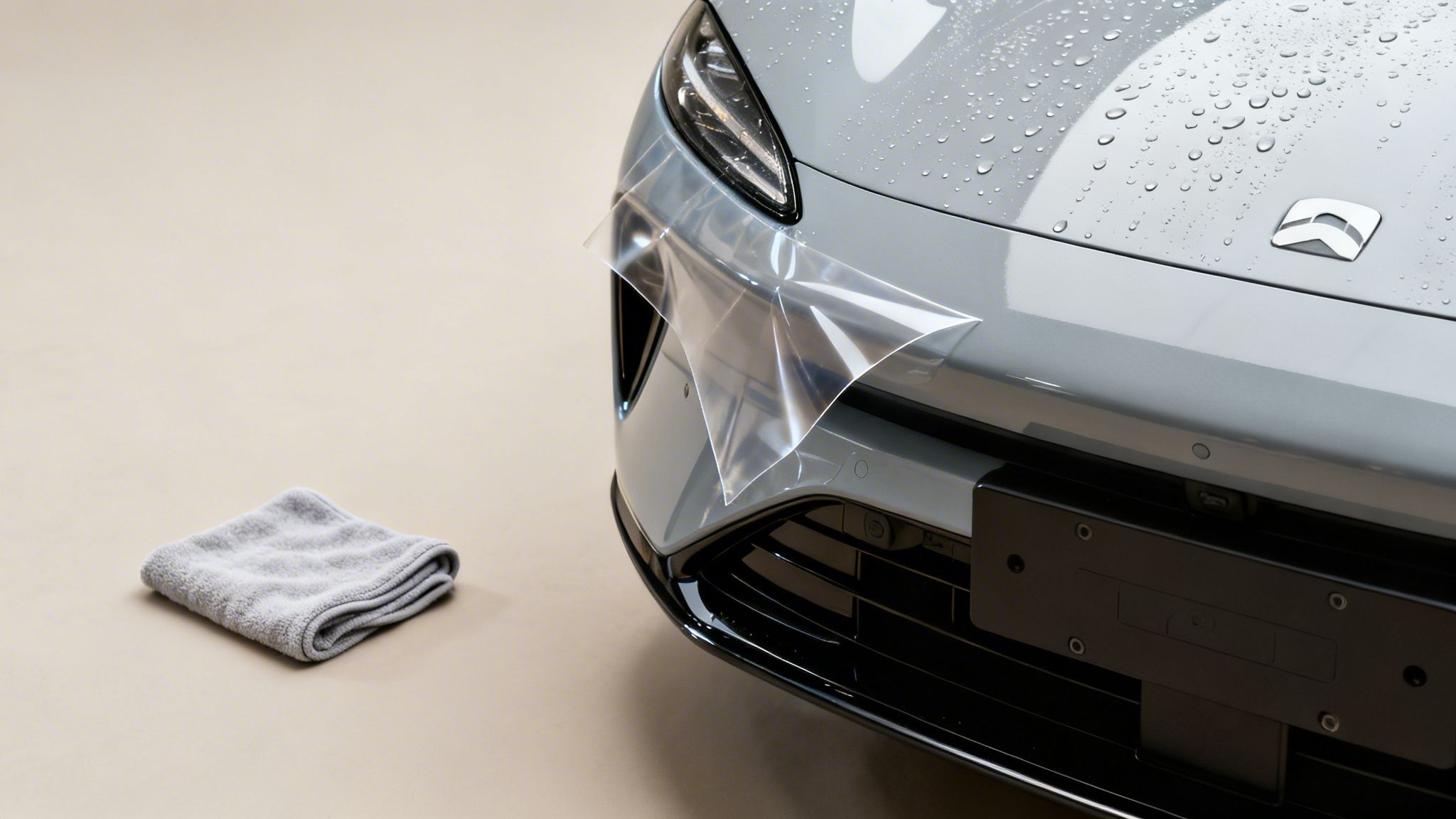
Getting that flawless finish back on your car is a great feeling. But the job isn't truly done until you have a plan to keep it that way. Instead of just waiting for the next stone chip or scuff mark, you can be proactive and shield your investment from the moment you drive away from the shop.
Modern protective solutions are the key here. They shift you from a reactive cycle of constant repairs to a proactive state of preservation, locking in that fresh-from-the-bodyshop shine long after the automotive paint repair is complete.
Defend Your High-Impact Zones
Take a look at the front of your car—the bumper, the leading edge of the hood, and your side mirrors. These areas take a beating. They’re a magnet for rock chips, bug splatter, and all sorts of road debris, especially if you spend any time on highways like the 401. This is exactly where Paint Protection Film (PPF) proves its worth.
PPF is a tough, transparent urethane film that gets applied directly over your paint. Think of it as body armour for your car. It acts as a physical shield, absorbing the impacts that would normally leave nasty chips and scratches. The best part? Many modern films even have self-healing properties, meaning minor scuffs and swirls can actually vanish with a little bit of heat from the sun.
Applying PPF to your freshly painted bumper is like putting a screen protector on a new phone. It’s an invisible shield that takes the hit so your valuable finish doesn’t have to.
Boost the Gloss and Keep It Clean
For the rest of the car, you want protection that also makes the paint pop. That's where a professional-grade ceramic coating comes in. A ceramic coating is a liquid polymer that creates a chemical bond with your vehicle's clear coat, forming a hard, glossy, and incredibly slick layer of protection.
This isn't just about looks; it offers real-world benefits:
- UV Defence: It acts like a powerful sunblock for your paint, preventing the sun’s rays from causing oxidation and fading over time.
- Serious Shine: The coating adds incredible depth and clarity, giving your paint a rich, wet look that’s hard to beat.
- Effortless Cleaning: Water beads up and rolls right off the hydrophobic surface, taking dirt and grime along for the ride. Washing your car becomes faster and easier.
For the ultimate one-two punch in paint preservation, combine PPF on the high-impact areas with a full ceramic coating over the entire vehicle. It's the best strategy out there to keep your car looking perfect.
Common Questions About Automotive Paint Repair
When your vehicle needs professional paintwork, it’s completely normal to have a few questions. In my experience, getting clear, honest answers is the most important part of finding a repair partner you can trust. Let's walk through some of the most common queries we hear from car owners every day.
So, how long will you be without your car? The timeline really comes down to the nature of the damage. For something minor, like touching up a few small rock chips or a single light scratch, we can usually have it ready in one to two days. That gives us just enough time for meticulous prep, paint application, and proper curing.
If the job is more involved—say, we're repairing a dent and then repainting an entire door or quarter panel—you should plan for a bit longer. A repair of that scale typically takes three to five days. That extra time is crucial for the bodywork, multiple stages of priming and painting, and the final polishing needed to get that seamless, factory-fresh look.
Achieving A Perfect Paint Match
This is probably the biggest concern for most people: will the new paint actually match the rest of the car? When you work with a top-tier shop, the answer is an absolute yes. Any reputable technician will be using computerized paint-matching technology to get a finish that's virtually undetectable.
This isn't just guesswork. We use a specialized device called a spectrophotometer to scan your car's exact colour and shade. A skilled painter then takes that data, mixes a custom formula, and carefully blends the new paint into the surrounding panels. This process even accounts for the subtle fading your original paint may have from sun exposure.
It's this level of detail that makes all the difference. The goal is always a flawless finish that looks perfect under any light, not an obvious patch-up job. To learn more about keeping that new finish pristine, our guide on paint protection film cost is a great resource.
The Value Of Repairing Minor Damage
Is it really worth the hassle to fix a few small scratches or chips? I get this question a lot, and my answer is always the same: absolutely. What seems like a small cosmetic flaw is actually a serious weak point in your vehicle's defenses.
- Rust Prevention: Any break in the paint exposes the metal panel underneath to moisture and air—the perfect recipe for rust. A quick touch-up is a small investment that prevents a much bigger and more expensive rust repair problem down the line.
- Maintaining Resale Value: There's no doubt about it—a car with immaculate paint commands a higher price. It sends a clear signal to potential buyers that the vehicle has been cared for properly.
Even after getting a professional repair done, you might worry about your car's value, especially if the damage was from an accident. If that's the case, you may be able to file a diminished value claim to help recover the difference in your vehicle's market worth.
At Carmedics Autowerks Inc, we bring together expert craftsmanship and state-of-the-art technology to deliver flawless paint repairs that truly last. Protect your investment and give your car the attention it deserves. Visit us at https://carmedicsautowerks.com to schedule your consultation.
When you see a car with tinted windows, the first thing you probably notice is how dark it is. That darkness is measured by a percentage, and it's the single most important factor when you're choosing a tint for your own vehicle.
This percentage is called Visible Light Transmission, or VLT. Simply put, it tells you how much light is allowed to pass through the tinted window.
What Do Window Tint Percentages Mean?
Think of window tint like a pair of sunglasses for your car. A low VLT percentage, like 5%, is like wearing a very dark pair of shades—it blocks almost all the light. On the other end of the spectrum, a high percentage like 70% is like wearing lightly shaded glasses, letting most of the light through.
A 5% VLT tint is what most people call "limo tint." It offers the ultimate in privacy because it only lets 5% of visible light inside. In contrast, a 70% VLT tint is so light that it's barely noticeable, making it a popular choice for people who want heat and UV protection without dramatically changing their car's look.
Understanding this one number is the key to getting the tint you actually want.
How VLT Affects Your Driving Experience
The tint percentage you choose does a lot more than just change how your car looks. It directly impacts your comfort, privacy, and even your safety on the road.
Here’s a quick breakdown of what that VLT number really controls:
- Privacy and Security: Lower percentages (like 5% or 20%) make it incredibly difficult for anyone to see inside your vehicle. This is great for keeping valuables out of sight and giving you a sense of personal space.
- Heat and UV Protection: While the type of film you choose (like a ceramic tint) is the biggest factor in heat rejection, darker tints naturally block more solar energy. The good news? All quality tints, regardless of how dark they are, block over 99% of harmful UV rays.
- Glare Reduction: This is a big one. A lower VLT dramatically cuts down on blinding sun during the day and the annoying glare from other cars' headlights at night. Your eyes will thank you.
- Driving Visibility: Here’s the trade-off. A super-dark tint provides amazing privacy, but it can also make it harder to see out, especially at night or in poorly lit areas like parking garages.
It's an inverse relationship: the lower the VLT number, the darker the tint. A 5% film is much darker than a 35% film. Getting this straight is the first step to making a smart choice.
Choosing the right VLT is all about finding that perfect balance. You want a look you love, the privacy you need, and the clear visibility that keeps you safe, all while staying within the legal limits here in Ontario.
To see how these different levels look on actual vehicles, our guide on automotive window tint percentages has plenty of examples to help you visualize the final result. This isn't just about aesthetics; it's a functional upgrade that can make every drive more comfortable and secure.
A Visual Guide to Common Tint Levels
Alright, you get the theory behind VLT percentages. But what do those numbers actually look like on a car? Let's bridge the gap between the technical specs and the real-world look and feel. Honestly, picking the right tint is a whole lot easier when you can picture how each level will transform your ride, both from the curb and from behind the wheel.
Think of tint film as a filter for sunlight. The VLT percentage just tells you how much light that filter lets through.
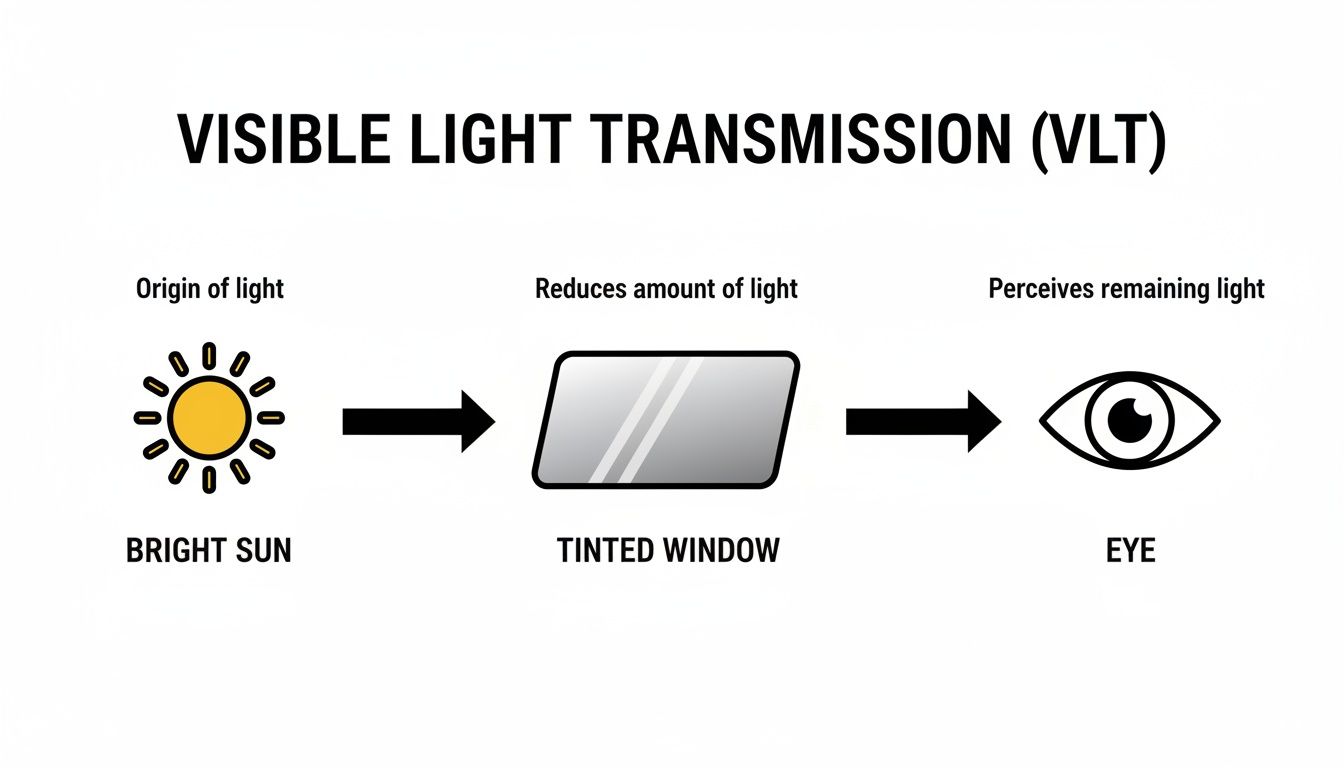
Ultimately, that percentage is what dictates how bright your cabin feels and how clear your view is. Let's walk through the most common shades we install so you can figure out what works for your style and your daily drive.
5% VLT: The Limo Tint
This is as dark as it gets. We call it "limo tint" for a reason—at 5% VLT, the film blocks out a massive 95% of visible light. The result is total privacy and that classic, blacked-out look.
From the outside, you can’t see into the vehicle at all during daylight hours. This is a huge plus if you want to keep your belongings out of sight or just create your own private space on the road.
The trade-off, of course, is visibility. Driving at night with a 5% tint can be a real challenge for most people. Your view is significantly darker, which can be a safety issue on poorly lit roads or when navigating tight parking garages.
20% VLT: Private and Aggressive
A 20% VLT tint is a favourite among car enthusiasts who want a dark, assertive look without going to the extreme of limo tint. It still offers fantastic privacy; anyone looking in will just see faint shadows inside the car during the day.
This level hits a great middle ground between a bold appearance and everyday usability. It does a phenomenal job of cutting down on harsh glare from the sun and from other cars' headlights at night.
While night driving is much clearer than with a 5% film, it still takes some getting used to. Most drivers adapt quickly, but it’s definitely something to keep in mind if you spend a lot of time on the road after sunset.
Expert Insight: Remember that the type of film matters just as much as the shade. A high-quality 20% ceramic tint will often reject more heat than a basic 5% dyed film, proving that darkness alone doesn't determine performance.
35% VLT: The Perfect Balance
For so many drivers, 35% VLT is the sweet spot. It gives the vehicle a sleek, classy look that’s clearly custom but not over-the-top.
- Aesthetics: Your car looks sharp and stylish. The tint is noticeable, giving it a sophisticated, premium feel.
- Privacy: You get a good amount of privacy. Onlookers can tell someone's in the car, but they can't make out faces or details.
- Visibility: This is where 35% really shines. Nighttime visibility is excellent for most drivers, making it a safe and practical choice for a daily driver.
This is one of our most requested shades because it delivers the perfect mix of enhanced looks, functional privacy, and uncompromised safety.
50% VLT: A Subtle Upgrade
If your main goal is blocking heat and UV rays with just a touch of added style, 50% VLT is a fantastic option. It adds a light, smoky effect that’s subtle enough that it doesn't completely change your car's factory appearance.
This tint is perfect for drivers who want to keep their interior cool and protected from sun damage but aren't looking for the privacy of a darker film. With a 50% tint, you can easily see in and out of the vehicle.
It provides good glare reduction without making the cabin feel dark, acting as a functional upgrade that puts comfort first.
70% VLT: The Clear Heat Shield
A 70% VLT tint is so light it's practically clear. You might not even realize it’s on the glass just by looking. So, what’s the point?
Performance. When you choose a 70% ceramic film, you’re getting incredible heat and UV rejection without changing the look of your windows at all. It's the ultimate stealth solution for:
- Protecting your skin and interior by blocking over 99% of harmful UV rays.
- Noticeably reducing infrared heat, keeping your car cooler and taking the strain off your A/C.
- Meeting legal requirements on front windows while still getting the high-performance benefits of ceramic film.
This option is all about function over form. It delivers top-tier comfort and protection without the bold visual statement of the darker tint levels.
Understanding Ontario Window Tinting Laws in 2026
Picking out the perfect tint for your car is one of the most satisfying upgrades you can make. But before you go all-in on that sleek, dark look, we need to talk about what’s actually legal here in Ontario. The rules are laid out in the Highway Traffic Act, and getting it wrong can mean a ticket and the headache of having to strip your brand-new tint off.
So, why are there laws about this? It really boils down to safety. Police officers need to be able to see into a vehicle during a traffic stop for their own protection. Just as important, you need to be able to make eye contact with pedestrians and other drivers—it's a fundamental part of how we communicate on the road.
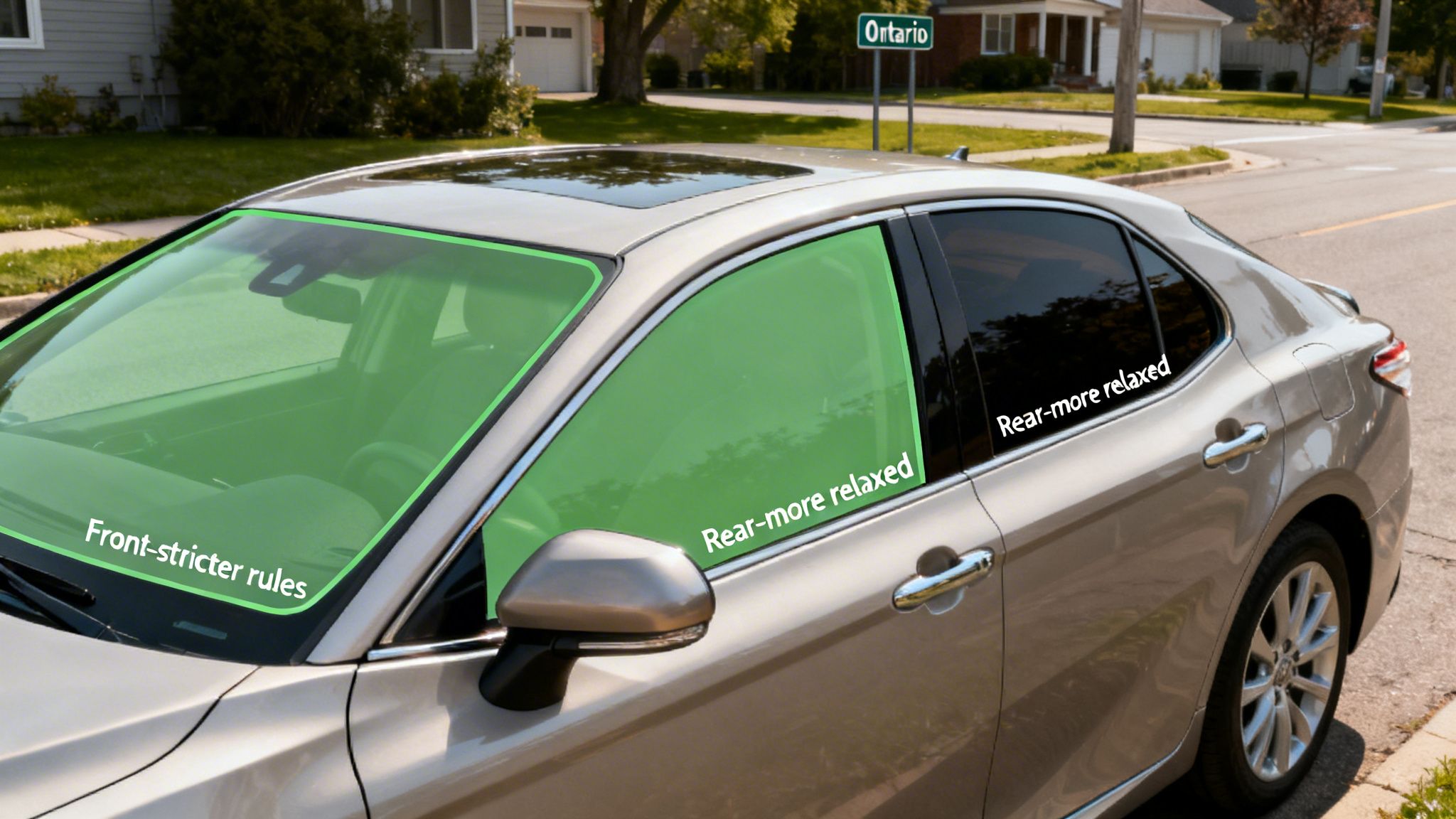
This is why the regulations are most stringent for the windows you rely on most for visibility.
Front Window Regulations
Here in Ontario, the law gets very specific about your front windshield and the two front side windows.
-
Front Windshield: You can’t put any film on the main part of your windshield. The only exception is a thin, non-reflective strip across the top, which can't be more than 15 centimetres (about 6 inches) deep. This is purely to help cut down on sun glare without blocking your view.
-
Front Side Windows: This is where things get a little subjective. The Act doesn't specify an exact VLT percentage. Instead, it says that any film you apply can't prevent someone from seeing inside. This leaves it up to an officer’s discretion. If they pull up alongside you and can't clearly see the driver, your tint is too dark. Based on our experience, sticking to 35% VLT or lighter on the front sides is the safest bet to stay compliant.
Rear Window Regulations
Once you move past the front seats, the rules open up completely. The back half of your vehicle is not considered critical for your direct line of sight or for making eye contact with others on the road.
Here's the good news: For your rear side windows and the back windshield, you’re free to go as dark as you want. Whether you love the look of 20% or want total privacy with 5% "limo tint," it’s all perfectly legal on the back half of your vehicle.
This flexibility is what allows for that popular "factory privacy glass" style, where the rear windows are much darker than the fronts. It’s a fantastic, fully legal setup that gives you a great mix of visibility where you need it and privacy where you want it.
If you want to get into all the fine details, we’ve put together a complete breakdown in our guide to the legal window tint percentage for drivers in Ontario.
The Hidden Benefits of Professional Window Tinting
Picking the right shade of tint is the fun part, but the real value of a professional tint job goes way beyond looks. It’s a high-performance upgrade that you’ll feel every time you drive. This isn't just about style; it's about making your daily drive safer, more comfortable, and a lot more private.
The first thing you’ll notice, especially during a hot Whitby summer, is just how much cooler your car stays inside.
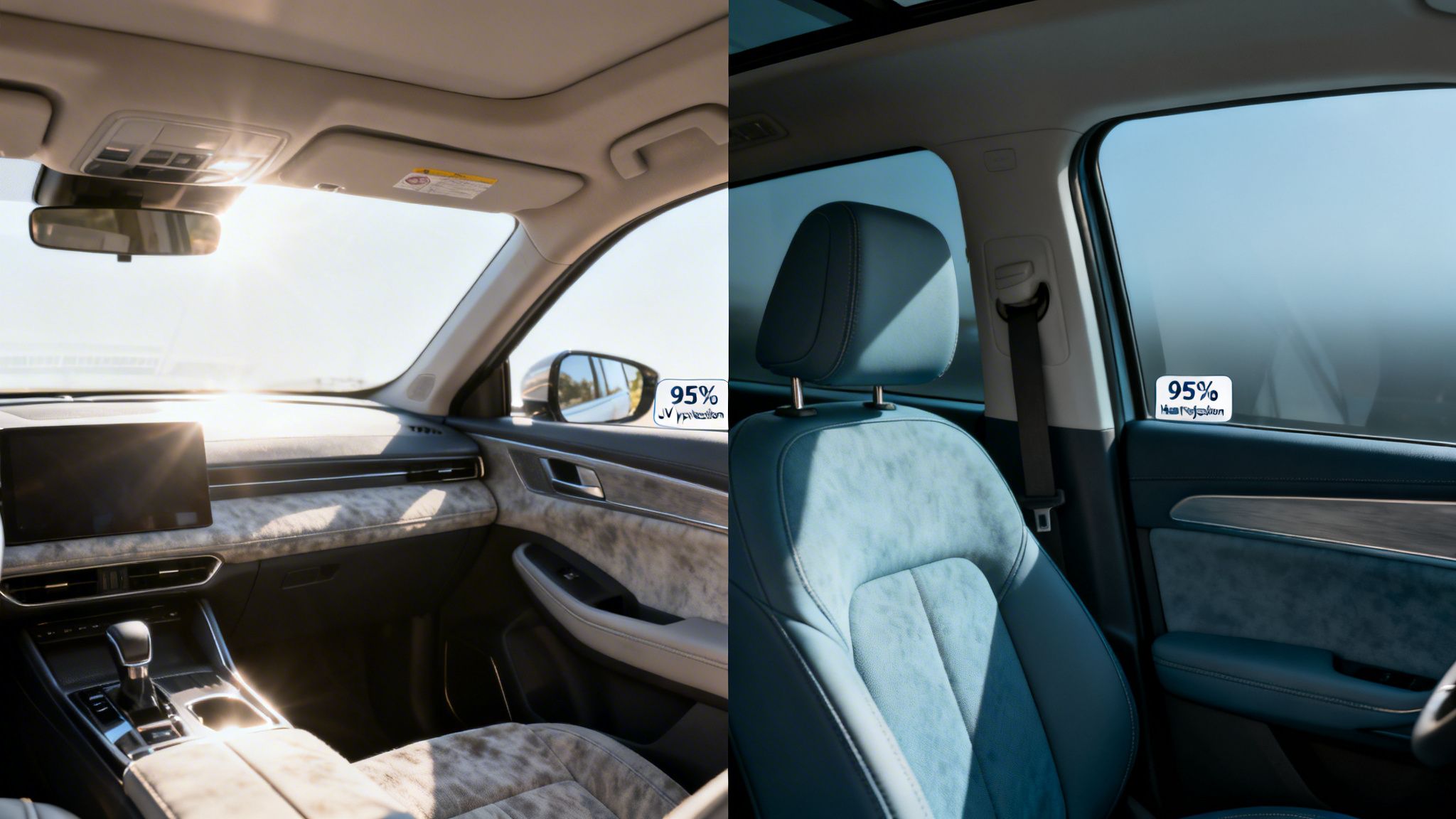
This is where the magic of modern film technology really comes into play. While any dark tint helps a bit, quality films are designed to block a specific type of solar energy that’s responsible for most of the heat.
Blocking Solar Heat
We’ve all felt it—that blast of hot air when you open your car door after it’s been parked in the sun. Much of that intense heat isn’t from the light you see, but from invisible infrared (IR) radiation.
High-quality films, particularly ceramic tints, are engineered to specifically target and reject a huge percentage of this IR energy. This means your car's interior heats up far more slowly, and your A/C doesn't have to fight nearly as hard to cool the cabin down. That can even save a little bit of fuel in the long run.
Unbeatable UV Protection
Just as important as blocking heat is stopping harmful ultraviolet rays. You can think of a good window tint as a powerful, invisible sunscreen for you and your car's interior.
Every professional-grade window film we install at Carmedics Autowerks blocks over 99% of damaging UV rays. This incredible level of protection is always there, whether you choose a dark 20% VLT or a nearly clear 70% film.
This shields your skin on every drive and, just as crucially, prevents your vehicle’s dashboard, seats, and trim from fading, cracking, and looking old before their time. It's one of the best investments you can make to preserve your car’s value. To learn more, check out our deep dive into the 7 benefits of the best window tint for your car.
Reducing Dangerous Glare
Glare isn't just annoying; it’s a real safety hazard. It could be the blinding sun low in the sky on your morning commute or the harsh headlights from oncoming traffic at night. Either way, these sudden bursts of light can leave you temporarily unsighted.
Window tint cuts that glare down dramatically. Your eyes can relax, helping you stay focused on the road ahead. This makes for a much less tiring and far safer drive, no matter the time of day.
Enhancing Privacy and Security
Finally, there’s the peace of mind that comes with privacy. Darker tint levels are a simple but effective deterrent against thieves. If a would-be thief can't easily see what’s inside your vehicle, they’re much more likely to just move on.
This added privacy keeps valuables like a work bag, recent purchases, or tools out of sight and out of mind. It’s a simple layer of security that helps protect your car and its contents wherever you park.
How to Choose the Right Tint Level for You
Okay, so you’ve seen the numbers and know the rules for tinting here in Ontario. Now comes the fun part: picking the right shade for your car. This isn't just about grabbing a number off a chart; it's about finding that sweet spot where the film's performance matches your daily driving habits and personal taste.
The best way to start is to get really clear on your "why." Ask yourself, what’s the number one reason I’m getting my windows tinted? Your answer is the key that unlocks the right choice. Is it all about privacy? Or are you chasing a specific aesthetic or just trying to beat the summer heat?
Nailing Down Your Top Priority
Let's walk through how your main goal points you toward the perfect tint level. Thinking this through helps cut through the noise and zero in on the best one or two options for you.
- If you’re all about privacy: You’ll naturally be looking at the lower VLT percentages. A 20% VLT is a fantastic choice if you want to keep prying eyes out. It gives you that near-blackout privacy without going full limo-dark.
- If you’re focused on style: Are you trying to give your car a sharp, custom look? A 35% VLT is the go-to for that classic, tasteful aftermarket vibe. It’s dark enough to make a statement but still subtle enough to look clean and sophisticated.
- If comfort is your main concern: When your goal is blocking heat and protecting your interior from UV rays, the type of film matters more than its darkness. High-quality 50% or even 70% ceramic tint can outperform a basic dark film at rejecting heat, all while keeping your cabin cool and your view crystal clear.
Once you know your main motivation, you need to be honest about one more thing: night driving. That sleek 20% tint looks incredible during the day, but it definitely cuts down on visibility once the sun goes down. If you spend a lot of time on poorly lit back roads after dark, a 35% or 50% VLT might be a much safer and more practical choice.
Key Takeaway: The perfect tint is always a trade-off between what you want most (privacy, style, or comfort) and what you need for practical, everyday driving. There’s no single "best" VLT—only the one that’s best for you.
For a deeper dive, checking out a comprehensive guide to the levels of window tinting for cars can provide even more perspective.
Ultimately, nothing beats seeing the options in person. Here at Carmedics Autowerks, we always encourage our clients to look at physical film samples held up against their own car’s windows. It takes all the guesswork out of the equation and guarantees the finished product looks exactly how you pictured it. And if you're curious about what makes for the best window tint for cars overall, we've put together a guide on that, too.
Your Window Tinting Questions Answered
Even after getting a handle on VLTs and the local laws, there are always a few lingering questions. To help you feel completely confident in your decision, we're going to tackle the most common ones we hear from drivers right here in our Whitby shop.
Think of this as the final piece of the puzzle. Here’s what people really want to know before they commit.
Is 35% Tint Hard to See Out of at Night?
This is probably the number one question we get. For most drivers, a high-quality 35% tint is the perfect balance for nighttime driving. It does a fantastic job of cutting down on that blinding glare from oncoming headlights without making you feel like you're driving in a cave.
That said, everyone's eyes are different. If you’re a bit worried about visibility or you spend a lot of time on unlit country roads, a lighter 50% VLT might give you more peace of mind. The best way to be sure is to stop by the shop and look at physical samples.
Does Darker Tint Always Block More Heat?
Here’s one of the biggest myths in the tinting world. The answer is a definite no—darker does not automatically mean cooler. A film’s power to reject heat is all about its material technology, not just how dark it looks.
For instance, a modern ceramic tint at a light 70% VLT can actually block much more infrared heat than an old-school, dark 20% dyed film. If keeping your car cool is your main goal, you need to pay more attention to the type of film you're choosing. Ceramic is king for heat rejection.
Can I Install Window Tint Myself?
While you can certainly buy DIY tinting kits, we’d strongly advise against it. Getting a flawless, bubble-free finish is a true skill. It demands a perfectly clean, dust-free space and specific tools to avoid the creases, peeling, and dirt specks that ruin the look. A bad DIY job often ends up needing professional removal, and you can see what that involves in our guide on how to remove auto window film.
A professional installation not only looks infinitely better but also comes with a warranty. It protects your investment and saves you from a really frustrating and potentially expensive weekend project.
How Long Will My New Window Tint Last?
When you have a premium film installed by a pro, your window tint should last for years—often for as long as you own the car. The secret to its long life is all about proper care right after it’s installed.
You’ll need to avoid rolling down your windows for about 3-5 days. This gives the adhesive time to fully cure to the glass. From then on, just be sure to clean your tinted windows with an ammonia-free cleaner and a soft microfibre cloth to prevent any scratches.
Ready to find the perfect tint for your ride? The expert team at Carmedics Autowerks is here to walk you through all the options and guarantee a flawless, legal installation. Visit us online or stop by our Whitby shop to get started! https://www.carmedicsautowerks.com.com
If you've been trying to find the legal window tint percentage for Ontario, you’ve probably noticed something strange: the law doesn't actually name a specific number. So, what’s the real answer? In the world of professional installers and on-the-road enforcement, the unofficial limit for front side windows is around 35% Visible Light Transmission (VLT). Go any darker, and you're not just risking your safety—you're practically asking for a fine.
The Real Answer to Ontario's Window Tint Law

Let's cut right to the chase. Unlike many other places that give you a hard number, Ontario's Highway Traffic Act is a bit more subjective. The law simply states that a driver's view can't be obstructed and that police need to be able to see into the vehicle. This creates a confusing grey area for many car owners.
This is where understanding Visible Light Transmission (VLT) is crucial. Think of VLT as a simple rating for how much light passes through your window. A lower VLT number means a darker tint. For example, a 5% VLT is what you see on limos—it's incredibly dark. On the other hand, an 80% VLT is so light you might not even notice it's there.
The Unofficial but Enforceable Standard
So, why does everyone in the know—from tint shops to traffic cops—land on 35% VLT for front windows? It all comes down to practical, real-world enforcement.
Police officers carry tint meters that provide an instant VLT reading. Through years of experience, they've found that tints darker than 35% are usually where it becomes difficult to see the driver, especially at night or in bad weather. That's the trigger for a ticket.
While the law itself is vague, enforcement isn't. If an officer can't clearly see you in the driver's seat, you can almost guarantee you'll be ticketed and ordered to remove the tint. This makes 35% VLT the widely accepted "safe" limit for your front side windows.
Where Can You Put Tint?
Knowing the VLT limit is only half the battle; you also need to know the rules for each specific window. The regulations change depending on where the glass is on your vehicle. For a deeper dive into the exact wording of the statutes, check out our comprehensive guide on Ontario's tinted windows law.
To make things simple, here’s a quick-reference table that breaks down the essential rules and practical limits you should follow.
Quick Guide to Ontario Window Tint Rules
This table summarizes the key legal requirements and our recommended VLT limits to keep your vehicle compliant and avoid any trouble on the road.
| Window Location | Legal Requirement (Highway Traffic Act) | Practical & Enforceable VLT Limit |
|---|---|---|
| Front Windshield | No aftermarket tint allowed, except for a non-reflective strip at the top (approx. 7.5 cm). | Not Applicable |
| Front Side Windows | Must not obstruct the driver's view or prevent others from seeing in. | 35% VLT is the recommended minimum. |
| Rear Side Windows | No specific VLT restriction. | Any VLT is generally acceptable. |
| Rear Windshield | No specific VLT restriction, provided the vehicle has two functional side mirrors. | Any VLT is generally acceptable. |
Following these guidelines is the best way to ensure your car not only looks fantastic but also stays on the right side of the law. It’ll save you from the headache of fines and the costly job of having illegal tint removed.
Understanding VLT Without the Technical Jargon
So, you’re looking into window tint. The first thing you'll see everywhere is a three-letter acronym that dictates all the rules: VLT. This stands for Visible Light Transmission, and it’s the single most important factor in keeping your tint legal.
Let's break it down in simple terms. Think of VLT as the brightness setting on a screen. A high VLT means the tint is light and lets a lot of visible light pass through. A low VLT means the tint is dark, blocking most of the light from getting in.
A tint labeled 35% VLT lets exactly 35% of the visible light into your vehicle, which means it blocks the other 65%. Go for a really dark film like 5% VLT (what most people call "limo tint"), and you're letting in just a sliver of light, making it nearly impossible to see inside.
How Is VLT Measured on the Road?
This isn't just an officer's best guess. If you're pulled over for suspected illegal tint, they'll use a specific tool called a tint meter. It’s a small, handheld gadget that gives a precise VLT reading on the spot.
The whole process is quick and straightforward:
- An officer will have you roll your window down just enough to fit the device.
- They'll slide the meter over the top edge of the glass.
- The meter shoots a calibrated beam of light through the window from one side to a sensor on the other.
- It instantly calculates how much light made it through both the glass and the tint film.
- That final number is your VLT percentage.
If that reading comes in under the legal limit, there's not much room for argument. It's a purely factual measurement.
The Key Takeaway: The number on the tint meter is what matters in a traffic stop. It doesn’t matter how dark the tint looks or feels to you—the meter’s reading is the final word.
The Hidden Tint You Never Knew You Had
Now, here’s a curveball that catches a lot of drivers by surprise: your car's windows aren't 100% clear right from the factory. All modern vehicle glass has a slight, built-in tint to provide a bit of UV protection and heat reduction.
This factory glass usually has a VLT of its own, somewhere between 70% and 88%. That might not sound like a lot, but it drastically changes the math when you add an aftermarket tint film. The key thing to remember is that tint percentages are cumulative.
When you apply a new film, its VLT rating combines with the glass's existing VLT. For instance, putting a 35% VLT film on a window that already has an 80% VLT from the factory doesn't result in a 35% tint. The actual VLT is calculated like this: 0.80 (factory glass) x 0.35 (film) = 0.28, which gives you a final VLT of 28%.
This is, by far, the most common reason people end up with an illegal tint. They pick a film they think is compliant, like 35%, but the combined VLT dips below the acceptable 30% threshold, putting them at risk for a ticket. You can see real-world examples in our guide to automotive window tint percentages.
This is precisely where a professional installer makes all the difference. We always measure your factory glass first before even discussing film options. That way, we can recommend a product that ensures your final, combined VLT is well within the safe and legal range for Ontario roads, saving you from a costly mistake.
Here's the rewritten section, designed to sound completely human-written and natural.
What Ontario's Highway Traffic Act Actually Says About Tint
It's a common misconception that Ontario has a specific, black-and-white number for legal tint. While we know from experience that the practical limit for front side windows is around 35% VLT, the law itself never mentions percentages. Instead, the rules are tucked away in Ontario's Highway Traffic Act (HTA), and they’re written in broad, interpretive language.
Let's cut through the legal jargon and see what Section 73(2) and Section 73(3) of the HTA mean for you and your vehicle on a day-to-day basis.
The Driver’s View Must Be Unobstructed
The heart of Ontario's tint law is found in Section 73(2). It basically says that you can't have anything on your windows that obstructs the driver’s view of the road.
So, what does "obstructs the driver's view" really mean when you're pulled over? This is where an officer's judgment call comes into play. They’re looking at it from two critical perspectives:
- Can you see out? Your tint can't be so dark that it compromises your ability to spot pedestrians, other vehicles, or road signs—especially at night or in bad weather. If your visibility is reduced, you're a safety risk.
- Can they see in? For their own safety, police officers need to be able to see the driver. If your windows are blacked out and they can't see your hands or what's happening inside, it’s an immediate red flag.
This is exactly why there isn't a hard legal window tint percentage. The law prioritizes function over a fixed number. In the real world, though, any tint darker than 35% VLT on the front side windows is almost always considered an obstruction.
The Special Rules for Your Windshield
Section 73(3) gets a bit more specific, focusing entirely on the windshield and front side windows. It prohibits driving with any "colour coating" or spray that obstructs the driver's clear view.
This section makes two things crystal clear:
- Your Windshield Stays Clear: You are not allowed to apply any aftermarket tint film across the main part of your front windshield. That entire area must be kept as transparent as the factory glass.
- The Glare Strip Exception: The only thing you can add is a small, non-reflective tint strip at the very top of the windshield. The HTA doesn't give a precise measurement, but the accepted industry standard is a strip no wider than 7.5 centimetres (or about 3 inches) from the top. This is purely to help reduce sun glare without blocking your line of sight.
Tints That Are Always Illegal
Beyond just how dark your tint is, some types of film are completely banned in Ontario, regardless of their VLT percentage. These are forbidden because they create a direct and immediate danger to others on the road.
Key Insight: The type of film you install is just as important as its darkness. Certain colours and reflective finishes are off-limits because they can blind other drivers or be confused with emergency signals.
Make sure you avoid these at all costs:
- Mirrored or Reflective Tints: Any film that creates a mirror-like finish is illegal. It can bounce sunlight or another car's headlights directly into the eyes of other drivers, causing serious glare and a major accident risk.
- Red-Coloured Tints: Films with a red hue are banned to prevent any possible confusion with the lights on emergency vehicles like police cruisers, fire trucks, or ambulances.
- Amber-Coloured Tints: Much like red tints, amber films are also prohibited so they aren't mistaken for turn signals or other official vehicle lighting.
Knowing these absolute no-go zones is half the battle. For a deeper dive into how these rules are enforced and what to expect from a roadside check, our complete guide to Ontario's window tint laws has all the details. Sticking to the practical VLT limits and avoiding these banned films will keep your car looking great while staying fully compliant with the HTA.
The True Cost of Illegal Window Tint
It’s tempting to push the limits with your window tint. That sleek, blacked-out look is popular for a reason, but going too dark on your front windows is a gamble that rarely pays off. The consequences aren't just about aesthetics—they hit you right in the wallet, and the problems can stack up fast.
Getting caught with tint that’s darker than the legal limit isn't a minor hiccup. It starts with a ticket, which in Ontario, is typically around $110. But that fine is just the beginning of your troubles.
Beyond the Initial Fine
When an officer writes you that ticket, it almost always comes with an 'order to remove.' This isn't a friendly suggestion. It's a legal directive that you must strip the illegal film from your windows, and that’s where the real costs begin to spiral.
You’re suddenly on the hook for a frustrating chain of expenses:
- The Ticket: The initial $110 fine you have to pay.
- Removal Costs: You'll need to pay a professional to properly remove the film without scratching your glass, which is a meticulous and time-consuming job.
- Re-inspection Fees: In many cases, you have to get your vehicle officially re-inspected to prove you’ve complied with the order.
All of a sudden, that style choice has become a multi-hundred-dollar headache. You've essentially paid for the tint once, paid a fine, and are now paying to have it all undone. You can see a full breakdown of how these expenses add up in our guide to car window tinting costs.
The Hidden Risk: Insurance Complications
Here’s the part most drivers never consider. If you’re in an accident and your vehicle has illegal tint, your insurance company might argue that your compromised visibility was a contributing factor.
In a worst-case scenario, an insurer could use the illegal tint as justification to deny your claim entirely. That could leave you personally liable for thousands—or even tens of thousands—in damages. A simple tint job suddenly becomes a massive financial and legal nightmare.
Even if your claim isn't denied, having an illegal modification can seriously complicate the process, causing delays or even raising your future premiums. What’s more, if an officer believes the tint was a major factor in unsafe driving, the situation could escalate into something far more severe, like a careless driving charge in Ontario.
The real cost of illegal tint is never just the price of the ticket. It's the combined weight of fines, removal fees, and the very serious risk of insurance disputes. Sticking to the accepted 35% VLT on your front side windows is, without a doubt, the smartest way to protect your finances and your driving record.
How Ontario's Tint Laws Compare on a Road Trip
It’s easy to think about your window tint just within Ontario’s borders. But that’s a bit like packing for a long road trip without ever checking the weather forecast for your destination. What’s perfectly fine for your daily commute in Whitby can suddenly become a major headache the moment you cross into another province or drive into the United States.
If you’re a driver who frequently heads to neighbouring provinces or states, you absolutely need to understand how different their rules are.
Crossing the Border into a Different Set of Rules
Ontario’s approach, which relies on an officer's discretion, is actually quite unique. Most other places, including our direct neighbours, have hard-and-fast rules based on exact VLT percentages. This means that while an Ontario officer might give your 32% VLT a pass, a state trooper in New York or an officer in Quebec won't think twice about pulling you over.
Let’s play this out. You’re heading out on a trip, and your car has a 35% VLT tint on the front side windows, which is a common and practical choice in Ontario. The second you cross into Quebec, where the law mandates 70% VLT or higher on the front, you’re officially breaking the law. The same problem arises if you drive south into New York, which also has a strict 70% VLT minimum for those same windows.
Don't mistake this for a small detail. It’s a surefire way to get an expensive ticket. Officers in these areas are often equipped with tint meters, and they know their local regulations inside and out. Claiming you didn’t know because you’re from Ontario, unfortunately, won’t get you out of a fine.
The Real Cost of an Out-of-Province Tint Ticket
Getting pulled over is frustrating enough, but the financial hit can be much bigger than you’d expect. The ticket itself is just the beginning.

As the infographic shows, you have to factor in the cost of removing the illegal tint and even potential hikes in your insurance premiums. It all adds up to a much larger expense than you might have planned for.
To really put it in perspective, let’s compare the legal window tint percentage rules side-by-side. The table below clearly shows just how much the laws can change from one place to the next.
Window Tint Law Comparison Ontario vs Neighbours
| Region | Front Side Windows VLT% | Rear Side Windows VLT% | Rear Windshield VLT% |
|---|---|---|---|
| Ontario | No specific %, officer discretion (35% practical limit) | Any darkness allowed | Any darkness allowed |
| Quebec | Must be 70% VLT or lighter | Any darkness allowed | Any darkness allowed |
| Manitoba | No tint allowed on front side windows (50% VLT with medical exemption) | 35% VLT or lighter | 35% VLT or lighter |
| New York State | Must be 70% VLT or lighter | Any darkness allowed | Any darkness allowed |
| Michigan | No tint allowed on front side windows (4-inch top strip permitted) | Any darkness allowed | Any darkness allowed |
Looking at this, you can see how an Ontario-compliant tint job can instantly become illegal in Manitoba, Michigan, Quebec, or New York.
The Road Trip Rule: If you frequently travel outside of Ontario, the smartest and safest choice is to install a lighter tint that complies with the strictest laws on your common routes—or stick to no aftermarket tint on the front side windows at all.
At the end of the day, your vehicle must obey the laws of the jurisdiction you are driving in, not where it’s registered. For frequent travellers, this means a setup that’s perfectly legal in your hometown could become a recurring problem elsewhere. Being aware of these regional differences is the key to avoiding unnecessary fines and the hassle of removing a tint you’ve already paid for.
Making the Right Choice: Smart, Legal Tints and Professional Hands

Alright, we’ve covered the rules, the risks, and what VLT actually means. Now comes the fun part: picking a tint that not only looks great and feels comfortable but keeps you on the right side of the law. This isn't just about choosing a shade of black; it's about investing in the right technology and trusting the right people to install it.
Today's window films are about so much more than just a darker look. The real magic is in their performance. For any serious car owner, there are really only two games in town: carbon and ceramic films.
It's More Than Skin Deep: Carbon vs. Ceramic Films
Picking the film itself is just as important as getting the legal window tint percentage right. You might see cheap dyed films out there, but trust me, you'll regret it. They’re notorious for fading, bubbling, and eventually turning a bizarre shade of purple. Carbon and ceramic films are in a different league entirely, offering quality that lasts.
Carbon Tint: This film is infused with microscopic carbon particles that are fantastic at blocking infrared light—the kind you feel as heat. It won’t fade like dyed film and gives you a deep, matte finish that looks sharp for years.
Ceramic Tint: This is the top-shelf stuff. Ceramic films use non-metallic, non-conductive ceramic particles to deliver the best performance possible. You get superior UV protection and the highest heat rejection available, all without interfering with your phone, GPS, or keyless entry signals.
While both are solid upgrades, ceramic is the clear winner for anyone wanting the absolute best in comfort and protection for themselves and their vehicle’s interior.
Finding the Sweet Spot for Ontario Drivers
So, what's the perfect VLT for your front side windows? If you want to stay completely clear of any legal headaches, we always recommend a film that keeps your final VLT reading between 35% and 50%.
This range gives you a clean, custom look without attracting the wrong kind of attention from police. It’s the ideal compromise—offering a real reduction in glare and heat while making sure you can see clearly, especially when driving at night. For a deeper dive into your options, check out our guide on the best window tint for cars.
Expert Recommendation: A true professional will always start by measuring the VLT of your factory glass. By knowing that number, they can help you pick a film that ensures your combined VLT stays safely above the practical 35% limit.
Why Professional Installation Is a Must
Choosing a great film is one thing, but the installation is what truly makes or breaks the entire job. A DIY kit might look like a way to save a few bucks, but it almost always ends in frustration, a shoddy finish, and wasted money.
Handing your keys to a trusted shop like Carmedics Autowerks is crucial for a few big reasons:
- A Perfect Finish: We have the proper tools and a dust-free environment to apply film without bubbles, creases, or trapped dirt. We digitally cut the film for a perfect, edge-to-edge fit on your windows.
- Top-Tier Materials: We only work with premium films from proven brands. You're getting a product that’s warrantied against peeling, bubbling, and changing colour for the life of your vehicle.
- Peace of Mind: We know Ontario's tint laws inside and out. We’ll guide you toward a choice that looks great, performs flawlessly, and is 100% street legal.
Your car is one of your biggest investments. Don't spoil its appearance or risk a ticket with a questionable tint job. Ready to do it right the first time? Talk to the pros at Carmedics Autowerks in Whitby for expert advice and an installation that’s second to none.
Your Top Questions About Window Tinting Answered
Alright, we've gone over the main rules and my top recommendations. But let's be honest, that’s when the really specific questions start popping up. Here are the answers to the most common ones I hear from customers, to help you get this done right.
Can I Get a Medical Exemption for Darker Tint in Ontario?
Yes, you can, but it’s a formal process for specific medical needs. This exemption is designed for people with conditions like photosensitivity or other serious light-sensitive health issues who genuinely need more protection from the sun.
You can't just use a simple doctor's note. You need to go through the proper channels with Ontario's Ministry of Transportation (MTO) to get official documentation from a physician. Most importantly, you must keep that paperwork in your vehicle at all times. If you're pulled over, you'll need to present it to the officer, just like your licence and insurance.
Does Factory Tint Affect My Aftermarket Tint Choice?
This is a big one, and it’s where a lot of people accidentally end up with an illegal tint job. The VLT reading an officer takes isn't just for the film you add—it measures the total amount of light passing through the entire window.
Almost every car comes with a slight tint in the glass from the factory, usually somewhere between 70% to 88% VLT. A true professional will always measure your glass first. That way, we know exactly what film to apply so that the combined VLT doesn't dip below the legal limit.
Is Ceramic Tint Really Worth the Extra Cost?
In my experience, absolutely. While it's more of an upfront investment, ceramic tint pays you back in comfort and performance every single day. It offers the best heat rejection you can get, which makes a huge difference in keeping your car cool during a summer heatwave.
Ceramic tint provides maximum UV protection, which helps prevent your car’s interior from fading and cracking over time. Crucially, its non-metallic construction means it won’t interfere with your cell phone, GPS, or radio signals, a common issue with older metallic films.
What Happens if I Get a Tint Ticket From Another Province?
If you get a ticket for illegal tint in another province or a U.S. state, you have to deal with it. You're expected to pay the fine, and depending on the jurisdiction, you could even see demerit points transferred to your Ontario driver's licence. It’s a tough lesson that your vehicle has to follow the laws of wherever you’re driving, not just where it’s registered.
Choosing the right tint and making sure it’s installed by a pro is the best way to get all the benefits without any of the legal headaches. For expert advice and a flawless, legal installation, trust the professionals at Carmedics Autowerks. Visit us online to learn more about our premium tinting services.
When you start looking into protecting your vehicle, one of the first questions is always about the price. For auto undercoating cost in Canada, you can expect to pay anywhere from $150 to $500 for a professional job in 2026. If you're more of a hands-on person, a good DIY kit will typically set you back $100 to $250.
It’s tempting to see this as just another expense, but it’s smarter to think of it as an investment. This is the winter coat for your car's underbelly, and it’s what stands between your vehicle’s metal and the harsh reality of road salt and moisture. Spending a little now can save you from a massive bill for rust repair later on.
What Is Auto Undercoating and Why It Matters
Anyone who has driven through a Canadian winter knows what happens. The moment the snow flies, the roads are covered in salt and corrosive de-icing brines. Your tires spray this gritty, wet mixture all over the most exposed parts of your vehicle—the frame, suspension, floor pans, and even your brake lines.
This isn't just dirty slush; it's a chemical cocktail designed to eat away at metal. Without a solid barrier, that constant exposure leads to rust, which can quietly compromise the safety and integrity of your vehicle. Auto undercoating is that barrier. It's a tough, durable layer applied to the undercarriage to seal out the corrosive elements before they can do any damage. It’s not about aesthetics; it's about fundamental vehicle preservation, especially in our climate.
The True Value of Undercoating
The real payoff from undercoating isn't just a rust-free appearance. It’s about protecting your car’s structural integrity and its long-term value. A vehicle with a clean, solid frame and underbody is a safer vehicle. It will last longer, and when you eventually decide to sell or trade it in, you’ll get a much better price for it. The initial auto undercoating cost is a proactive step that pays dividends.
A single professional undercoating application often costs less than repairing just one rust-damaged brake line or rocker panel. It's preventative maintenance that truly pays for itself.
More Than Just a Spray
Getting a proper undercoating isn’t as simple as just spraying something on. A reputable shop knows that preparation is everything. The process involves a deep clean of the undercarriage to remove all dirt, grime, and existing rust, ensuring the new coating sticks properly and creates a perfect seal.
While undercoating is all about functional protection, preserving your vehicle's value is a common theme with other services, too. You can see how a similar mindset applies to aesthetics in our guide on paint protection film cost.
Ultimately, viewing undercoating as a necessary defence—not an optional add-on—is the key to getting the most out of your vehicle for years to come, especially here in salt-heavy Ontario.
So, you’ve decided to undercoat your vehicle—great move. But now for the tricky part: figuring out which type of undercoating is the right fit. The reality is, not all rust-proofing is the same, and the auto undercoating cost you can expect is tied directly to the product being used.
Getting this choice right means matching the material to your car, your budget, and the kind of driving you do. Each option has a different way of tackling the same enemy: rust.

Ultimately, undercoating is all about protecting your car's frame and body, which in turn protects its value for years to come. Let's dig into the most common types you'll find on the market.
Rubberized Undercoating
Rubberized undercoating is a go-to for many drivers, and for good reason. It's a spray-on compound that cures to a soft, rubbery finish. This texture does a fantastic job of deflecting stones, gravel, and other road debris that would otherwise chip the paint and expose the metal underneath to moisture.
A welcome side effect is a quieter ride. That soft layer acts as a sound dampener, absorbing road noise and vibrations. The main watch-out is that if it's not applied perfectly, it can crack over time. Those cracks can become a big problem, trapping salt and water right against the frame—the very thing you're trying to prevent.
Asphalt-Based Undercoating
If you need maximum protection, an asphalt-based coating is the heavy-hitter. You can think of it as laying a thin, protective layer of pavement on your vehicle's undercarriage. This thick, durable material offers serious defence against salt, moisture, and hard impacts from whatever the road throws at it.
Because it’s asphalt-based, this stuff is incredibly tough. It often lasts for years, making it a favourite for trucks, SUVs, and any vehicle that has to battle through harsh Canadian winters.
These coatings also provide excellent sound-deadening. In fact, data from Ontario has shown that a quality asphalt application can cut down on road noise by up to 25%. For drivers here in Whitby, that means a much more peaceful cabin on your commute. For those interested in the technical side, detailed asphalt-based undercoating industry reports offer a deeper dive into their performance.
Wax or Paraffin-Based Undercoating
What if you need a product that can creep into every single seam, weld, and hidden crevice? That’s where wax-based undercoating shines. It’s applied as a thin, liquid spray that coats everything but never fully hardens, staying pliable for its entire life.
This flexibility is its biggest advantage. Instead of chipping or cracking, the coating remains soft and acts as a "self-healing" skin. If it gets a small nick or scrape, the surrounding wax tends to flow back over the exposed area, keeping the moisture barrier intact. The trade-off is durability; it's not as tough as asphalt and typically needs to be reapplied every year or two to stay effective.
Electronic Rust Inhibitors
A more modern—and often debated—option is the electronic rust inhibitor. It's a small module that gets wired into your vehicle's electrical system. The device sends a very weak electric current through the car's sheet metal, with the theory being that it disrupts the electrochemical process that causes rust to form.
While some car manufacturers and aftermarket companies stand by them, their true effectiveness is a hot topic among automotive pros. They give you a completely mess-free solution and don't require reapplication, but they offer zero physical protection against rock chips or abrasion. If you want to explore all the ways to fight corrosion, our guide to the best rust prevention techniques for cars is a great place to start.
Ever wonder why you can get two completely different quotes for the same undercoating job? It can be confusing, but the price isn't arbitrary. A professional quote is built on a few key factors, and understanding them helps you spot the difference between a real value and a job that's just cheap.
Think of it like getting a house painted. The final bill depends on the size of the house, how much prep is needed to scrape off old, peeling paint, and of course, the quality of paint you choose. The same logic applies directly to protecting your car's undercarriage.
Vehicle Size and Complexity
This one’s pretty straightforward. More vehicle means more work and more material.
- Cars vs. SUVs and Trucks: A Honda Civic just doesn't have the same amount of underbody real estate as a big Ford F-150 or a Toyota 4Runner. It’s simple math: a larger vehicle needs more product and takes more time to cover thoroughly, driving up the cost.
- Frame Complexity: It’s not just about size, but also about what’s under there. Some vehicle frames are packed with nooks, crannies, and components that are a real challenge to get to. A good technician has to patiently work around all these obstacles to ensure a complete, protective seal, and that extra time adds to the labour cost.
Just based on size alone, you can expect a full-sized truck to cost $100 to $200 more than a compact car for the same quality of undercoating service.
The Condition of the Undercarriage
Here’s a big one: what does the underside of your vehicle look like right now? Is it fresh off the lot, or has it seen a few harsh winters and is already showing signs of rust? The current condition is a massive factor in your final cost.
Preparation is everything. Spraying undercoating over existing rust, dirt, or flaking metal is a recipe for disaster. It will trap moisture and salt directly against the frame, making the corrosion even worse.
Any shop worth its salt will insist on proper prep work before a single drop of coating is applied. This isn't an upsell; it's a necessity. The process usually involves:
- A full degreasing and high-pressure wash to get rid of all the built-up road grime.
- Wire brushing or media blasting to physically remove any loose scale and surface rust.
- Allowing the vehicle to dry completely, which is a critical step many rush.
This prep work is labour-intensive. If you get a quote that seems too good to be true, the shop is probably cutting corners here. For anyone in the Whitby area, finding a car repair shop near me that’s transparent about their prep process is key to a job that lasts.
Your Geographic Location
Where you live makes a difference, especially here in Canada. In a place like Ontario, our heavy use of road salt during the winter creates huge demand for rust protection. According to Canadian automotive service data, a professional undercoating job at a dedicated shop in a city like Whitby typically runs between $250 and $400 CAD.
Be aware that dealerships often market their own branded coatings at a significant premium, sometimes charging $800 to $1,000. As you can see, location and the type of shop you choose play a huge role in the final price. You can discover more insights about how location and other factors influence undercoating value on newenglandrust.com.
Professional Application Versus a DIY Undercoating Kit

When you decide to undercoat your vehicle, you hit a fork in the road: do you tackle it yourself or leave it to a professional? The lower upfront auto undercoating cost of a DIY kit can look pretty tempting. But the real choice isn't just about money—it's about weighing your time, effort, and the quality of the protection you'll actually get.
Going the DIY route can definitely save you some cash initially, but be warned—it's a messy and seriously labour-intensive job. If you don't have a proper vehicle lift, you'll be on your back, crawling around and trying to aim a spray can into all the tight nooks and crannies. It's tough work, and the biggest risk is simply missing a spot. Any part of the metal you don't cover becomes a gateway for rust to take hold.
The Professional Advantage
This is where hiring a professional shop really makes a difference. It’s not just about paying someone to do the dirty work; it’s about their expertise and, just as importantly, their specialized equipment. A technician works with your car on a lift, giving them clear, easy access to every inch of the undercarriage. A set of jack stands in your driveway just can't compete.
They also use high-pressure spray systems that atomize the coating, forcing it deep into seams, corners, and hidden frame cavities. This is how you get a truly complete barrier against salt and moisture. But the real secret? Pros know the job is 90% preparation. They have the right tools and knowledge to properly clean, descale, and prep the metal, which is absolutely critical for making the coating stick and last.
A professional application isn't just a service; it's a guarantee of thoroughness. You're paying for the peace of mind that comes from knowing the job was done right, with no vulnerable spots left behind.
DIY vs. Professional Undercoating Comparison
To help you decide, let's break down exactly what you're getting with each option. The upfront savings of a DIY kit can be quickly overshadowed by the long-term benefits of a professional job.
| Factor | DIY Undercoating | Professional Service |
|---|---|---|
| Cost | $100 – $250 for a kit | $500+, depending on the vehicle and product |
| Coverage | Often uneven; high risk of missed spots | Complete, uniform coverage with specialized sprayers |
| Preparation | You handle all the messy cleaning and rust removal | Thorough surface prep with industrial tools is included |
| Tools Required | Jack stands, safety gear, spray cans/gun | Vehicle lift, high-pressure spray systems, prep tools |
| Time & Effort | Several hours (or a full weekend) of hard, messy labour | Drop off your vehicle and pick it up when it's done |
| Outcome | Inconsistent results; may not last as long | A durable, long-lasting barrier with a warranty |
As you can see, the value proposition changes when you look at the whole picture. Missing a single spot on your frame to save a few hundred dollars can lead to rust damage that costs thousands to repair, completely wiping out any initial savings.
Investing in a professional application almost always delivers better long-term value. A perfectly applied coating protects your vehicle's structural integrity and resale value far more effectively. If you're looking for more ways to fight corrosion, check out our in-depth guide on how to prevent rust on your car.
Is Auto Undercoating Really Worth the Cost?
So, after all that, we get to the bottom line: is the auto undercoating cost actually worth the money? It's easy to see it as just another expense on a long list of vehicle maintenance items. But the smart way to look at it is by weighing what you spend now against what you'll almost certainly save later.
That upfront cost is a drop in the ocean compared to the thousands you could be shelling out for rust-related repairs. A single professional application often costs less than fixing just one rusted-out rocker panel or, even worse, replacing corroded brake lines—a frighteningly common issue here in Ontario thanks to our heavily salted winter roads.
Think of it as proactive insurance against the slow, silent cancer that road salt and moisture inflict on your vehicle’s most vulnerable parts.
Beyond the Repair Bills
And it’s not just about dodging a massive repair bill down the road. The real payoff shows up in a few other key areas that protect your investment over the long haul.
- Higher Resale Value: A vehicle with a clean, rust-free undercarriage is simply worth more. Anyone who’s ever bought or sold a used car knows that a pristine frame can make or break a deal, easily earning you back your initial investment and then some.
- Enhanced Safety: Rust isn't just ugly; it's a serious safety hazard. It eats away at the structural components that are designed to protect you in a crash. Protecting your vehicle’s frame, suspension parts, and fuel lines is a direct investment in the safety of you and your family.
- Peace of Mind: Honestly, there’s a real satisfaction in knowing your car or truck is properly shielded from the elements. It’s more than just another maintenance chore—it’s a strategy to keep your ride on the road for years, not just seasons.
Undercoating isn't an expense; it's a value-preservation strategy. You're not just fighting rust; you're protecting your car's structural integrity, its resale potential, and your long-term peace of mind on the road.
This is the same mindset that leads savvy owners to look into the best car paint protection—it's about creating a complete shield for your vehicle. When you get right down to it, undercoating is a small price to pay to keep your vehicle solid, safe, and valuable for many winters to come.
Frequently Asked Questions About Undercoating
It’s completely normal to have a few questions before you invest in protecting your vehicle. Everyone wants to make the right choice, from how often you need to reapply it to whether that bit of rust on your frame is a deal-breaker. Let's clear up some of the most common things we get asked about auto undercoating.
So, how often do you need to get it done? That really comes down to what type of undercoating you go with. The softer, dripless oil or wax-based coatings are brilliant because they creep into every seam and hidden pocket, but they do need a yearly top-up to stay effective—especially after one of our tough Canadian winters. On the other hand, a hardier rubberized or asphalt-based coating can go several years before it needs to be inspected and touched up.
Can You Undercoat a Car With Existing Rust?
Yes, you can—but it has to be done the right way. This is a big one we see people worry about. You can’t just spray new undercoating over existing rust and call it a day. That’s the worst thing you could do, as it just traps the salt and moisture against the steel, letting the rust fester and spread unseen.
Any reputable shop will insist on proper prep work first. This means getting in there with wire brushes, grinders, or even media blasters to get rid of all the loose, flaky scale. The idea is to get down to a solid surface so the new coating can get a real grip and create a proper seal against the elements.
Keep in mind that the auto undercoating cost might be a bit higher for a rusty vehicle. That extra cost covers the crucial labour needed to prep the surface correctly.
Will Undercoating Void My Car’s Warranty?
This is a common myth, but the simple answer is no—a professionally applied undercoating won't void your manufacturer’s warranty. The products used by good shops are designed to be completely safe for your vehicle’s parts.
The key word here, though, is professional. A sloppy job where the coating gets blasted onto sensitive components like O2 sensors, brake lines, or specific electrical connections could cause problems. An experienced technician knows exactly which areas to protect and which to avoid, ensuring your car is shielded from rust without affecting your warranty or how it runs.
Ready to give your vehicle the best defence against rust and corrosion? At Carmedics Autowerks, we provide expert undercoating services in Whitby, ensuring your car is protected for years to come. Book your appointment online today!
The best way to get rid of old, bubbling, or faded window film usually involves a bit of heat. A good steamer or a heat gun will soften up the adhesive, letting you carefully peel the film away. After that, it’s a matter of cleaning up the sticky residue left behind with an adhesive remover and a scraper. Getting this done right restores your visibility and gets the glass ready for a fresh tint, if that's your plan.
Why Your Window Tint Needs to Go

Before we dive into the how, let's talk about the why. It’s easy to think of peeling tint as just an eyesore, but the truth is, failing window film can create real safety hazards and some frustrating legal headaches.
When window tint gets old, the materials simply start to break down. We’ve all seen it: the dyes fade, turning that once-sleek black into a hazy, distracting purple. The adhesive gives up, creating bubbles and peels that get right in your line of sight. These issues aren't just cosmetic—they're warning signs of a bigger problem.
The Safety Risks of Degraded Film
That weird purplish haze isn't just ugly; it drastically cuts down on optical clarity. This makes it much harder to see what’s going on around you, especially at night or in bad weather. The bubbles and peeling create their own kind of chaos, causing distortions and blind spots that force you to crane your neck just to see clearly. This kind of compromised visibility is a serious safety risk that can slow your reaction time when it matters most.
On top of that, old film can get incredibly brittle. Instead of coming off in one clean sheet like you hope, it can shatter into a million tiny, frustrating pieces as you try to remove it. This is a common nightmare with older, cheaper dyed films that have been baked in the sun for years.
Legal and Inspection-Related Problems
Another big reason to get that old film off is to stay on the right side of the law. Tint that’s too dark or doesn't meet local regulations can earn you fines and fix-it tickets. And if your film is visibly peeling, bubbling, or faded, you can bet it will fail a safety inspection.
A failing window tint is more than an aesthetic issue—it's a liability. Distorted visibility and non-compliant film can lead to failed inspections and unnecessary risks on the road, making removal an essential part of responsible vehicle maintenance.
Many drivers don't realize just how specific their local tint laws are. It’s always smart to know the rules to avoid any trouble down the road. For example, taking a moment to understand Ontario's window tint laws can save you a lot of hassle.
Ultimately, removing that old film is about more than just looks. It’s about making sure your car is safe, legal, and ready for whatever the road throws at you.
Gathering Your Tools for a Clean Removal
Before you even think about peeling that first corner of film, let's talk about tools. I can’t tell you how many times I’ve seen a simple tint removal job turn into a disaster because someone tried to wing it. Having the right gear ready to go is the difference between a clean, satisfying result and a sticky, frustrating mess that can actually damage your car.
The most important tool in your arsenal is your heat source. While you might be tempted to grab a heat gun, trust me on this one: don’t. A simple fabric steamer is your best friend for this job. It delivers a much gentler, dispersed heat that softens the adhesive without creating hot spots. That significantly lowers the risk of cracking your window, which is a very real possibility with an aggressive heat gun, especially on a cold day.
Essential Supplies for the Job
With your steamer ready, it's time to gather the rest of your kit. Your first priority should be protecting both yourself and your car’s interior from water and gunk.
- Safety Gear: It might seem like overkill, but always wear safety glasses. You don't want adhesive remover or a flying shard of old, brittle film in your eye. A pair of heat-resistant gloves is also a smart move when you're working with steam.
- Interior Protection: Cover everything you don’t want to get wet or sticky. Lay down tarps or big garbage bags over your door panels, seats, and dashboard. Use painter’s tape to hold them in place so nothing seeps through.
- Scraping Tools: For the side windows, a fresh 1-inch metal razor blade works wonders. But for the rear windshield, you absolutely must switch to a plastic scraper or plastic blade. A metal blade will instantly destroy the delicate defroster lines, and that’s a costly mistake to fix.
Getting a feel for the right scraper and technique is key. Some of the same principles for tasks like knowing how to remove paint from window glass apply here—it’s all about using the right tool for the surface to avoid scratches.
Cleaning and Finishing Materials
Once the film is finally off, you're only halfway there. Now you have to deal with the stubborn glue residue left behind.
You’ll need a good ammonia-free glass cleaner. This is non-negotiable. Cleaners with ammonia can wreck the plastic and vinyl trim inside your car and can also damage those rear defroster lines. While a dedicated adhesive remover is great, a spray bottle with hot water and a few drops of dish soap is a surprisingly effective alternative for breaking down the glue.
Finally, stock up on clean microfibre towels. You’ll need them for scrubbing off the last bits of residue and for the final polish to get your glass looking crystal clear and streak-free. A clean surface is crucial, and learning about the best automotive window tint films will show you why proper prep and removal are so vital before any new application.
While a DIY kit can get the job done, it's worth seeing how it stacks up against what the professionals at Carmedics Autowerks use. The right equipment doesn't just make the job easier; it makes it faster and safer for your vehicle.
DIY vs Professional Window Film Removal Tool Kit
| Tool/Supply | DIY Purpose | Professional Advantage |
|---|---|---|
| Heat Source | A fabric steamer provides gentle, safe heat for softening adhesive. | Industrial-grade steamers deliver higher, more consistent output for a much faster film release. |
| Scraper | Metal razor for side glass; a plastic one is essential for the rear. | Specialized long-reach scrapers and custom-shaped blades improve efficiency and reach. |
| Adhesive Remover | A commercial product or a soap/water solution does the trick. | Pro-grade solvents dissolve tough adhesive almost instantly with less scrubbing and no residue. |
| Protection | Tarps and painter's tape are used to cover interior surfaces. | We use custom-fit, waterproof drapes and interior shields for total, foolproof protection. |
As you can see, professional tools are all about efficiency and minimizing risk. They allow a technician to complete the job in a fraction of the time with a guaranteed perfect finish, completely protecting your car’s interior and electronics in the process.
The Professional Steam and Peel Technique
Alright, this is where your patience really starts to pay dividends. We're diving into the steam and peel method—the exact approach the pros rely on. It's hands-down the safest and most effective way to remove old window film, especially from that tricky rear window with its delicate defroster lines. This isn't about brute force; it’s all about technique.
The concept is beautifully simple: you use the gentle, consistent heat from a fabric steamer to soften the film's adhesive. When you do it right, the tint releases from the glass in big, satisfying sheets. Do it wrong, and you're left with a shattered, flaky mess that will test the limits of your sanity.
Mastering the Steam Application
First things first, fill your fabric steamer with distilled water and let it come up to full heat. You're looking for a good, steady billow of steam, not a sputtering spray of hot water. Pick a top corner of a side window to start, and hold the steamer nozzle about 2 to 3 centimetres from the glass.
Slowly and evenly, work the steamer across the top edge of the window. Your goal here is to heat the entire area, letting the steam seep in and break down the glue underneath. This part takes longer than most people expect—patience is everything. After a minute or two of steady heat, you can test a corner.
Try to gently lift the corner of the film with your fingernail or a plastic razor blade. If it peels back without tearing, you're in business. If you feel resistance or it starts to rip, it needs more heat. Don't ever force it.
The secret to a clean peel is letting the steam do the heavy lifting. If the film is fighting you, it means the adhesive hasn't released yet. More steam is always the answer—never more muscle.
Once you've got a good corner lifted, start peeling downwards at a sharp angle. As you peel, keep applying steam just ahead of where the film is separating from the glass. This continuous heat keeps the adhesive nice and soft, encouraging the film to come off in one glorious piece.
The whole process has a natural rhythm: soften, lift, peel, and then get ready to clean up the last bits of residue.

As you can see, softening the film is the critical first step. Everything else flows from there.
Protecting Your Rear Defroster Lines
Now, for the rear windshield. This is where most DIY tint removal jobs go completely sideways, almost always from damaging the defroster lines. One slip with a metal scraper, and those lines are severed for good. This is precisely why the steam method is non-negotiable back here.
The technique is the same, but you need to be extra vigilant.
- Plastic tools only: Never, ever let a metal tool touch the inside of your rear glass. A plastic scraper or even an old credit card is all you should use to get that initial edge lifted.
- Peel with the grain: When you pull the film off the rear window, peel downwards or sideways—parallel to the defroster lines. Pulling against them adds stress and massively increases the risk of damage.
- Be generous with steam: The rear glass is typically larger and more curved. Plan on spending extra time applying steam to make sure that adhesive is fully loosened across the whole surface.
Getting the steam-and-peel technique down is a core skill, but it’s just one part of the job. If you want a complete picture from start to finish, our comprehensive guide on car window tint in Whitby covers everything from professional application to removal. Taking the time to do it right means your glass will be perfectly clean and ready for whatever's next, whether that's a new high-performance film or just a crystal-clear, natural look.
Tackling That Stubborn Adhesive Residue

Pulling off that last piece of bubbling film feels great, but don't celebrate just yet. Now you’re left with the most frustrating part of the job: that sticky, messy adhesive left smeared all over your glass. This is where your patience will be tested, and the right approach is what separates a clean, professional finish from a streaky disaster.
The main goal here is to dissolve the glue completely without using aggressive chemicals that could damage your car's interior panels or door seals. While there are plenty of commercial adhesive removers on the market, you might be surprised what you can do with stuff you already have. A simple spray bottle with hot water and a few drops of dish soap is a fantastic starting point for softening up the mess.
Choosing Your Weapon for the Cleanup
After you've sprayed the glass down with your soapy water or a dedicated adhesive remover, give it a few minutes to work. This dwell time is absolutely essential for breaking down the glue's bond. Don't rush this step—let the solution do the hard work for you.
Now it's time to grab a scraper, but which one you use is critical and depends entirely on the window you’re tackling.
- For side windows: A fresh, sharp 1-inch metal razor blade is your best friend. Hold it at a low, 30-degree angle to the glass and use short, confident strokes to lift the softened adhesive. The key is to always keep the surface wet and lubricated to avoid any chance of scratching.
- For the rear windshield: Stop. Put the metal blade down. You must use a plastic razor blade or a firm plastic scraper here. Those delicate lines on your rear window are the defroster grid, and a metal blade will sever them instantly. It's a costly and irreversible mistake.
The single most common DIY disaster we see is a ruined rear defroster. It's an expensive fix that can require replacing the entire rear glass. Always use plastic on the rear windshield—no exceptions.
Even after a good scrape, you’ll probably still see a hazy film of glue. Just re-wet the area with your cleaning solution and give it a gentle scrub with a non-abrasive pad or, my personal favourite, a ball of super-fine #0000 steel wool. It's fine enough that it won't scratch automotive glass but has just enough bite to lift away those final sticky traces.
The Final Polish for a Flawless Finish
Once you're confident all the adhesive is gone, it’s time for one last clean. Spray the window with a good-quality, ammonia-free glass cleaner. Cleaners containing ammonia can dry out and damage your window seals and interior plastics over time, so they are best avoided.
Wipe everything down with a clean microfibre towel. Then, grab a second, completely dry microfibre towel for a final buff to remove any lingering streaks. It helps to step back and look at the glass from different angles to catch any hazy spots you might have missed. A perfectly clean surface is vital, especially if you plan on learning about the best window tint for cars and applying a new film.
Honestly, this adhesive removal is a tough job. It's the stage where most DIY attempts go sideways, leading to botched results and damage. In fact, DIY mistakes account for 90% of damage like etched glass or cut defroster lines. A professional removal typically costs between $100 and $250 and reduces the risk of defroster damage by 80% by using specialized tools and steam methods. It's worth considering before you find yourself in a sticky situation.
Troubleshooting Common Removal Headaches
Even if you follow all the steps perfectly, removing old window tint can sometimes throw you a curveball. You might encounter film that’s been baked onto the glass for a decade, refusing to peel and instead shattering into a million tiny, frustrating pieces. When this happens, patience and the right technique become your most important tools.
If the film starts to shatter instead of peeling off in a sheet, it’s a sure sign the tint is old and brittle. What’s happening is the layers are delaminating—the colour layer is breaking away from the adhesive. Don't get discouraged. Instead, switch up your strategy. Focus on steaming one small section at a time and use your plastic scraper to gently chip away at the fragments. It’s slow going, but trying to rip off large sections will only make a bigger mess.
Navigating Tricky Spots and Stubborn Glue
One of the most challenging spots on any car is the tight, curved corners of the rear window. Adhesive loves to build up here, and it’s almost impossible to get good leverage with a standard scraper. My go-to trick for this is to wrap a clean microfibre cloth around a plastic razor blade or even an old credit card. Spray your adhesive remover onto the cloth, not the window, and use the firm edge to work the solution right into those corners. This gives you the control you need to dissolve the glue without damaging the rubber seals.
Another common headache is what I call the "ghost glue" patch. This is an area that looks perfectly clean when it’s wet but reveals a sticky, hazy residue as soon as it dries.
The most reliable test for any lingering adhesive is simple: run the back of your dry hand over the glass. If you feel even the slightest drag or stickiness, there’s still glue on there. Don’t stop cleaning until the surface feels as smooth as a fresh pane of glass.
Dealing with these kinds of issues just requires a methodical approach. It's a common theme in car care; beyond window film, many jobs require careful removal techniques. For instance, if your car's lights are looking hazy or yellowed, you might be interested in learning how to remove oxidation from headlights. The key, as always, is matching the right tool and technique to the problem at hand.
If you find yourself spending hours on a single window or start to feel like you might be about to cause damage, it’s a good time to pause. Knowing when to stop is just as important as knowing how to start. In some cases, the age and condition of the film make a professional removal at a shop like Carmedics Autowerks the smartest, most damage-free choice.
Your Questions on Window Film Removal Answered
Even with the best guide in hand, it’s natural to have a few lingering questions. Taking on a DIY window film removal is a significant job, and we hear a lot of the same uncertainties from people deciding whether to tackle it themselves. Let's clear the air on some of the most common ones.
The first question is always about time. How long does this really take? If you're doing this for the first time, be realistic and block off a whole afternoon. We're talking anywhere from 3 to 6 hours. The final time depends on how old and brittle the film is, the quality of your tools, and frankly, your own patience. A pro can knock it out in about 1.5 to 3 hours because we’ve got the industrial-grade steamers and techniques down to a science.
Am I Going to Wreck My Rear Defroster?
This is the number one concern, and for good reason. Yes, you absolutely can damage it. This is the single most expensive risk you run with a DIY removal. If you grab a metal scraper or just get too aggressive, it's frighteningly easy to sever one of those thin, delicate grid lines. Once that connection is broken, your defroster is useless, and the only fix is often a full rear glass replacement. That’s a costly mistake.
This is exactly why we emphasize using the steam method and sticking to plastic tools only for the rear window. If you feel even slightly hesitant about this step, hiring a professional is the smart move. It’s a small price to pay for complete peace of mind.
Why Can't I Just Tint Over the Old Film?
It’s tempting, I get it. You think you can save a ton of time by just slapping new tint over the old, failing film. But trust me, this is a shortcut that guarantees a terrible result. New film is designed to adhere to perfectly clean glass, not an unstable, deteriorating surface.
Applying new tint over old film is like painting over peeling paint—it might look okay for a moment, but it's doomed to fail. Every existing bubble, speck of dust, or peeling corner will be magnified and trapped forever. The old film will just keep breaking down underneath, causing the new tint to fail in no time.
For a high-quality finish that actually lasts, starting with a pristine, clean surface is completely non-negotiable.
What Are the First Signs My Tint Is Failing?
Once you know what to look for, the warning signs are hard to miss. The classic giveaways that your film has reached the end of its life are:
- Bubbling: This is the most common sign, where the film lifts away from the glass in small pockets or massive blisters.
- Purple Hue: When the non-metallic dyes in cheap or old film break down from years of UV exposure, they often turn a distinct purplish colour.
- Peeling Edges: You'll see the corners and edges of the film start to curl up and pull away from the window frame.
- Hazy View: The film itself can become cloudy or distorted, making it harder to see out of your windows clearly.
If you're noticing any of these issues, the adhesive is officially failing, and it's time for the film to go. You can find more details in our complete guide to professional window tinting services.
When the DIY route feels like too much of a risk, or you simply want a flawless result without the headache, the experts at Carmedics Autowerks Inc are here to help. We use professional-grade equipment to strip old film safely and efficiently, guaranteeing a perfect surface every time. Contact us today to restore your car's clarity.
When you press the brake pedal, you're placing your trust in a small, often-forgotten reservoir of fluid. But this isn't just any fluid—it's the single most critical component ensuring your car stops exactly when you need it to. Think of brake fluid as the unsung hero of your vehicle's safety systems.
The Power Behind Your Pedal
Let's get one thing straight: your foot doesn't physically stop your car. When you press the brake pedal, you're actually activating a hydraulic system, and brake fluid is the essential messenger that carries your command.
This specialized fluid is designed to be incompressible. That's a fancy way of saying it can't be squeezed into a smaller space. When you apply pressure at the pedal, that exact same pressure is instantly transmitted through the brake lines to the calipers at each wheel. This hydraulic force is what clamps the brake pads against the rotors, generating the friction that brings your vehicle to a safe, controlled stop.
If that fluid is old, contaminated, or low, the entire system is compromised. Your command to stop gets weak, delayed, or lost altogether, which is a scary thought for anyone driving in Whitby.
Why Its Condition Is Non-Negotiable
Unlike engine oil, which gets dirty but still lubricates, degraded brake fluid leads directly to brake failure. Its main enemy is moisture. Brake fluid is "hygroscopic," meaning it naturally absorbs water from the surrounding air over time.
This water absorption is disastrous for two main reasons:
- It Lowers the Boiling Point: Braking generates immense heat. Clean brake fluid has a very high boiling point to handle this, but as it absorbs water, that boiling point plummets. If the fluid boils, it creates vapour bubbles in the lines. Vapour is compressible, which means your pedal will suddenly feel soft and spongy, and your stopping power will dramatically decrease. This dangerous situation is known as brake fade.
- It Causes Internal Corrosion: Water inside your sealed brake system is a recipe for rust. It corrodes your brake lines, calipers, and the complex Anti-lock Braking System (ABS) module from the inside out. This can lead to costly repairs and a system that's unreliable when you need it most.
Keeping an eye on your brake fluid isn't just a good idea; it's a core part of any solid preventive maintenance for your vehicle. Whether you're navigating daily traffic on the 401 or taking a scenic drive through the Durham Region, having confidence in your brakes gives you essential peace of mind.
Decoding DOT Ratings and Brake Fluid Types
Just like you wouldn’t put diesel in a petrol engine, using the right brake fluid is non-negotiable for your car's safety. When you grab a bottle of brake fluid, you'll see a “DOT” rating on the label. That stands for the Department of Transportation, and those numbers—DOT 3, DOT 4, and DOT 5.1—are far from random. They’re a crucial shorthand for performance standards, especially when it comes to boiling points.
Think of the DOT rating as a promise of how much heat the fluid can take before it gives up. Braking generates a massive amount of friction and heat. If that heat causes your brake fluid to boil, it turns from a non-compressible liquid into a very compressible gas. The result? A terrifyingly spongy brake pedal that sinks to the floor, leaving you with little to no stopping power.
Dry vs. Wet Boiling Points: What Really Matters
Every DOT-rated fluid comes with two key performance specs: a “dry” boiling point and a “wet” boiling point. The dry rating is for brand-new fluid, fresh out of a sealed bottle. But the wet rating is the one that truly matters out on the road.
Here’s why. Most brake fluids are hygroscopic, a fancy word that simply means they absorb moisture from the air. Over time, this water contamination lowers the fluid's boiling point. The wet boiling point measures performance after the fluid has absorbed about 3.7% water by volume, which is what we typically see after about two years of driving.
This diagram perfectly illustrates how brake fluid acts as the vital link in your braking system.

As you can see, the entire process, from your foot on the pedal to the car slowing down, depends on that fluid transmitting force without fail.
The drop-off between dry and wet performance is staggering. For instance, a standard DOT 3 fluid starts with a minimum dry boiling point of 205°C (401°F). After absorbing some moisture, its minimum wet boiling point plummets to just 140°C (284°F). This is exactly why a brake fluid change is a critical safety service, not an upsell. It’s this attention to detail that has earned us a reputation as one of the best automotive repair shops in the area.
Quick Guide to Common Brake Fluid Types
To make sense of the options, here’s a quick breakdown of the common glycol-based fluids you'll find on the shelf. While some can be mixed in a pinch, you should always stick with what your vehicle's manufacturer recommends.
| Fluid Type | Base Chemistry | Minimum Dry Boiling Point | Minimum Wet Boiling Point | Typical Use Case |
|---|---|---|---|---|
| DOT 3 | Glycol-Ether | 205°C (401°F) | 140°C (284°F) | Standard for many older passenger cars and light trucks. |
| DOT 4 | Glycol-Ether | 230°C (446°F) | 155°C (311°F) | Modern vehicles, especially those with ABS and traction control. |
| DOT 5.1 | Glycol-Ether | 260°C (500°F) | 180°C (356°F) | High-performance and heavy-duty applications (towing, racing). |
These three fluids—DOT 3, DOT 4, and DOT 5.1—are all built on a similar glycol-ether chemistry. The main difference is their ability to handle heat, both when new and after they've been in your car for a while.
A Quick Word on Silicone DOT 5 Fluid
You might also hear about DOT 5 fluid, but it’s a completely different animal. It’s silicone-based, which means it does not absorb water (it's non-hygroscopic). While that sounds great, it has a major catch: it is NOT compatible with the glycol-based systems found in almost every modern car.
Mixing DOT 5 with DOT 3, 4, or 5.1 will cause the fluid to gel up, which can trigger catastrophic brake failure. DOT 5 is really only used for specific applications, like classic cars that sit in storage for long stretches or some military vehicles. For 99% of drivers on the roads in Whitby, a glycol-based fluid is the only correct choice.
When in doubt, always check your owner’s manual or give us a call. We’ll make sure you have the right fluid to keep you stopping safely.
Warning Signs Your Brake Fluid Needs Attention
Your car is pretty good at telling you when something’s wrong, especially with a system as critical as your brakes. You don't need to be a mechanic to notice the signs—they're things you can see, feel, and hear right from the driver's seat. Learning to spot the early warnings of low or contaminated brake fluid is one of the most important things you can do for your safety on the road.
Think of it as catching a small problem before it becomes a big, expensive one. Let’s walk through the most common red flags we see here at the shop.

A Soft or Spongy Brake Pedal
This is the classic, number-one sign of a brake fluid issue. When you step on the brake pedal, it should feel firm and solid. If it feels soft, mushy, or seems to sink slowly towards the floor, you've got a problem with hydraulic pressure.
That spongy feeling almost always points to air or water getting into your brake lines. Your brake system works because fluid can't be compressed—when you push the pedal, that force is transferred directly to the brakes. Air and water, on the other hand, are very compressible. So, instead of stopping your car, your pedal pressure is just wasted squeezing the air bubbles in the line.
Here at Carmedics Autowerks in Whitby, this is a frequent complaint. A spongy pedal is a clear indicator that the fluid is contaminated and needs to be flushed and replaced.
Changes in Your Stopping Power
Another tell-tale sign is when you notice your brakes just aren't as effective as they used to be. You might find yourself having to push the pedal much harder to slow down, or maybe your vehicle is taking a few extra metres to come to a full stop. That's a dangerous game to play in Whitby traffic.
This loss of performance is a direct result of old fluid that has absorbed too much moisture from the air. As brake fluid gets saturated with water, its boiling point plummets. The intense heat generated during braking can then turn that water into steam. Since steam is a gas (and compressible), it creates pockets in your brake lines, leading to a terrifying situation called brake fade where your pedal goes soft and your stopping power disappears.
Dashboard Warning Lights
Your dashboard is designed to get your attention, and a brake-related warning light is something you can never ignore. There are two main lights to watch for:
- Brake Warning Light: This is usually a red light with an exclamation mark inside a circle. While it can mean a few things, its most common purpose is to warn you that the brake fluid level in the master cylinder is dangerously low.
- ABS Warning Light: If the amber ABS light pops on, it’s signaling a problem specifically with your Anti-lock Braking System. Old, dirty, or incorrect fluid can gunk up the sensitive valves and sensors in the ABS module, triggering this warning.
Key Takeaway: You should never just top off low brake fluid and forget about it. A sealed brake system doesn't "use up" fluid. A low level almost always means you either have a leak somewhere in the system or your brake pads are worn down to their limits. Both situations demand an immediate professional inspection.
How Professionals Test Your Brake Fluid
Glancing at the brake fluid reservoir can sometimes give you a hint. If the fluid looks dark and sludgy, you definitely have a problem. But here’s the thing many drivers don't realise: brake fluid can look perfectly clean and still be dangerously contaminated. A simple visual check just doesn't cut it.
To get the real story, professional shops like Carmedics Autowerks use specialized tools that measure what you can't see. This isn't guesswork; it's about getting hard data on the health of your braking system to keep you safe on Whitby's roads.

Let's break down the two main tests a good technician will use.
The Electronic Moisture Test
The go-to method for any good mechanic is an electronic moisture tester. Think of this handheld tool like a thermometer, but instead of checking for a fever, it's checking for water contamination.
The principle is straightforward. Pure, fresh brake fluid is a terrible conductor of electricity. Water, on the other hand, conducts electricity very well. Because brake fluid is hygroscopic (meaning it absorbs moisture from the air), its electrical conductivity goes up as it gets waterlogged.
A technician simply dips the tester's probes into the master cylinder reservoir. In seconds, the device reads the water content as a percentage, giving us a clear, undeniable number.
- 0-1% Water Content: Your fluid is in excellent condition. Nothing to worry about.
- 1-2% Water Content: The fluid is starting to get old. It's not an emergency, but you should plan for a brake fluid flush in the near future.
- 3% or Higher Water Content: This is the danger zone. At 3% moisture, your fluid's boiling point has plummeted, creating a serious risk of brake failure under hard use. We'd strongly recommend a complete flush right away.
An electronic test is the gold standard because it replaces subjective opinion with objective data. It ensures you only service your brakes when it’s genuinely needed for safety—a level of precision that’s a key part of any comprehensive vehicle check, like the one needed for an annual safety inspection sticker in Ontario.
The Copper Content Test
Another revealing test checks for copper contamination. This might sound strange, but it's a brilliant way to see what's happening deep inside your brake lines. Over time, the fluid slowly leaches microscopic copper particles from the metal components of the brake system, especially the ABS module.
A high copper level is one of the earliest signs that corrosion has begun.
For this test, we use special chemical strips dipped directly into the fluid. The strip changes colour depending on the concentration of dissolved copper, measured in parts per million (PPM).
- 0-100 PPM: This is a low reading. It means your fluid’s anti-corrosion additives are still doing their job.
- 100-200 PPM: This is a yellow flag. The protective additives are starting to break down, and corrosion is beginning.
- 200+ PPM: A reading this high is a major red flag. It tells us that active corrosion is taking place inside your braking system, which can damage expensive parts like your ABS pump and calipers over the long run.
By combining the results from both the moisture and copper tests, a technician gets a complete picture of your brake fluid's health. It’s a fast, scientific process that gives you invaluable peace of mind, confirming your car's most important safety system is ready for anything.
Brake Fluid and Its Environmental Responsibility
Thinking about your car's environmental impact usually brings emissions and fuel economy to mind. But what about the fluids that keep it running safely? Proper handling of used brake fluid is a small but critical part of being a responsible car owner, especially once you know what’s actually in it.
The reason used brake fluid is classified as hazardous waste is simple: it’s toxic. Most brake fluids are glycol-based, but the real trouble starts once it's been circulating in your car. Over time, it absorbs moisture and leaches tiny particles of heavy metals like copper from your brake lines and components. Pouring this contaminated cocktail down the drain or onto the ground allows it to seep into the local water table, threatening the entire ecosystem here in the Durham Region.
Environmental Impact: It’s a sobering thought, but just one gallon of improperly disposed automotive fluid can contaminate a million gallons of fresh water. This is why professional disposal isn’t just a good idea—it’s essential for protecting our community’s resources.
The Link Between Clean Fluid and a Lighter Footprint
Keeping your brake fluid fresh doesn’t just make your car safer; it also makes it a little greener. A well-maintained brake system with clean fluid is a highly efficient one. When your brakes respond exactly when and how they’re supposed to, you naturally brake with more precision and less force.
This has an interesting knock-on effect: it helps reduce brake dust. Brake wear is a surprisingly significant source of airborne particulate matter, contributing anywhere from 3.3 to 13.6 mg/mile. The metallic pads common in performance cars can be even bigger culprits. Because these emissions are tied directly to how hard and how often you brake, a system struggling with old, contaminated fluid can indirectly lead to more pollution. If you're curious about the science, you can read the full research from the California Air Resources Board.
How to Properly Dispose of Brake Fluid in the Durham Region
So, what’s the right way to get rid of old brake fluid? The answer is straightforward: never, ever pour it out or toss it in the regular garbage. It must be collected and taken to a facility authorized to handle hazardous waste.
For drivers in Whitby and the rest of the Durham Region, you have a couple of safe and easy options:
- Municipal Waste Management Facilities: The region has designated drop-off sites specifically for household hazardous waste. You can visit the Durham Region waste management website to find the nearest location and check its hours.
- Professional Service Centres: Any reputable auto shop, including our team here at Carmedics Autowerks, is set up to manage hazardous fluids. When we perform a brake fluid flush, we ensure every drop of the old fluid is captured and sent for proper, environmentally compliant disposal.
Taking this extra step ensures this toxic material is managed safely and stays out of our environment. True vehicle ownership is about taking care of the whole car, right down to what happens to its fluids when their job is done.
The Carmedics Autowerks Brake Fluid Service
Knowing something feels off with your brakes is one thing, but restoring them to the crisp, responsive feel they had when new? That’s where professional expertise comes in. Here at Carmedics Autowerks, we’ve perfected a brake fluid service that’s all about transparency and thoroughness for our fellow Whitby drivers. This isn’t a simple top-off; it’s a complete renewal of your vehicle’s most important safety feature.
We take a meticulous approach because we know that modern cars, with their complex Anti-lock Braking System (ABS) and stability control modules, can't be treated with old-school methods. A sloppy flush can easily trap air in the system, which leads to that dreaded spongy pedal feel or, even worse, damage to expensive electronic components. We do it right to protect your car and your safety.
Our Step-By-Step Brake Fluid Flush
When you trust your vehicle to us, we want you to understand exactly what’s happening and why it matters. There are no secrets behind our garage doors.
Here’s what our detailed process looks like:
- A Full System Inspection: Before we touch the fluid, we start with a complete health check of your braking system. We’re looking for any leaks, checking the condition of your brake hoses, and getting a clear picture of your brake pad and rotor life.
- Removing the Old, Contaminated Fluid: We start by safely evacuating all the old, dark, and moisture-filled fluid from the master cylinder reservoir.
- The Complete System Bleed and Flush: This is the critical step. We hook up specialized pressure-bleeding equipment that pushes brand-new, manufacturer-approved brake fluid through every single line, caliper, and cylinder. This process forces every last drop of the old stuff, along with any trapped air bubbles or debris, out of the system.
- Careful Attention to Electronics: Our technicians are trained to properly cycle the ABS module during the flush. This is a crucial detail that ensures no air gets trapped in these sensitive and expensive electronic controllers.
- Final Checks and Testing: Once the system is full of fresh, clean fluid, we double-check the level, test the brake pedal to ensure it’s firm and responsive, and perform a final inspection to guarantee everything is working perfectly.
A professional brake fluid flush isn’t just about replacing a fluid—it’s about safeguarding the sophisticated electronics that keep you in control. It's a small investment in your safety and the longevity of your vehicle’s braking components.
Recommended Intervals and Estimated Costs
For most vehicles navigating the roads here in the Durham Region, we stand by the recommendation for a complete brake fluid flush every two years or 48,000 kilometres—whichever comes first. This schedule is in line with what most automakers suggest and is perfectly suited to our local climate, where humidity can speed up moisture contamination.
We believe in straightforward pricing. The cost for a professional brake fluid service at Carmedics Autowerks typically falls between $120 to $180, depending on your vehicle’s make and the specific fluid it requires. It's a genuinely small price for the confidence of knowing your brakes will be there for you when it counts. If you’re feeling any issues, learning more about professional brake repair in Whitby can help you understand all your options.
Don't wait for a soft pedal or a warning light to tell you there’s a problem. Book your brake fluid service with Carmedics Autowerks today and get back on the road with total peace of mind.
Frequently Asked Questions About Brake Fluid
To wrap things up, let's tackle some of the most common questions we hear from drivers in Whitby and across the Durham Region. We get these all the time at the shop, so here are some straight answers to give you confidence in your car's maintenance.
Can I Just Top Off My Brake Fluid If It's Low?
While you might be tempted to just top it off and call it a day, that's really just a band-aid on a potentially serious problem. A modern brake system is a sealed hydraulic circuit—if the fluid is low, it’s going somewhere it shouldn't be.
A dropping fluid level almost always signals one of two things:
- A Leak in the System: This is a major safety hazard. A leak from a brake line, caliper, or the master cylinder means you're losing hydraulic pressure. That loss of pressure can lead directly to sudden and complete brake failure.
- Worn Brake Pads: As your brake pads wear thin, the caliper pistons have to push out further to clamp down on the rotors. This action draws more fluid from the reservoir to fill that extra space, making the level in the reservoir drop.
Simply adding new fluid just masks the real issue. You need a professional to find out why it's low to make sure your vehicle is truly safe to drive.
What Happens If I Use the Wrong Type of Brake Fluid?
Using the wrong kind of brake fluid can cause catastrophic damage to your braking system. It’s like getting a transfusion with the wrong blood type—the results are disastrous. The absolute worst mistake is mixing glycol-based fluids (DOT 3, DOT 4, 5.1) with a silicone-based fluid (DOT 5).
When these two types mix, they don't just blend; they react and turn into a thick gel. This sludge can completely clog your brake lines and seize your calipers, which will lead to total brake failure. Even mixing different glycol-based fluids isn’t a great idea, as it can lower the overall boiling point and potentially damage the rubber seals in the system. Your best bet is to always stick to the exact DOT rating your manufacturer recommends.
Expert Tip: Not sure which fluid to use? The correct DOT rating is usually printed right on the cap of the brake fluid reservoir. If it’s not there or is unreadable, your owner’s manual is the next best place to look.
Why Does Clear Brake Fluid Turn Dark?
Brand new brake fluid is almost always a clear or light amber colour. Over many months and thousands of kilometres, it's perfectly normal for it to get darker. That colour change is your most obvious clue that the fluid is getting old and losing its ability to protect your brakes.
The fluid darkens for two main reasons:
- Moisture Absorption: Brake fluid is hygroscopic, meaning it pulls moisture right out of the air. As it becomes saturated with water, the fluid itself starts to break down and change colour.
- Particulate Contamination: The fluid is constantly circulating and picking up tiny particles of debris. Microscopic bits of rubber from hoses and seals, along with metal fragments from other components, get suspended in the fluid, turning it a murky brown or even black.
When your fluid looks dark, it’s a sure sign that its protective additives are spent and its boiling point has dropped significantly. It's telling you it's time for a brake fluid flush.
Your braking system is the single most important safety feature on your vehicle, and it's not something to leave to chance. For a professional inspection and expert service you can trust, you can always count on the team at Carmedics Autowerks. Don't wait for a warning light—book your service at https://www.carmedicsautowerks.com.com today and drive with complete peace of mind.