
That little glowing light on your dashboard—the check engine light. We’ve all seen it, and it usually brings on a wave of anxiety. But don’t panic. Think of it as your car's way of saying, "Hey, something's up. You might want to get this checked out." Getting professional engine diagnostics in Whitby is the best first step. It's about catching a small issue before it snowballs into a massive, expensive headache.
Why That Check Engine Light Matters in Whitby

That amber-coloured symbol is probably one of the most misunderstood warnings on a modern car. It’s a direct signal from your vehicle's onboard computer system, which is constantly keeping tabs on dozens of different sensors and components. When it senses something isn't right—anything from a gas cap that wasn't tightened properly to a serious engine misfire—it switches on the light and saves a specific "trouble code."
Ignoring it is a real gamble. Sure, it could be something minor. But it could also be the first sign of a problem that’s tanking your fuel economy, spewing out harmful emissions, or even leading to serious engine damage if you leave it for too long.
The Unique Challenges for Whitby Drivers
Driving in Whitby and around the Durham Region puts a unique kind of stress on a vehicle. Think about it: the daily grind on Highway 401 mixed with our wild Canadian weather swings puts a lot of strain on your engine and all its supporting parts. These conditions can speed up wear and tear, which makes catching problems early even more critical.
The need for accurate diagnostics is clear right here in our community. With major auto assembly plants nearby and long commutes being the norm, our cars work hard. The average one-way commute in Ontario is 26.3 minutes, which for many of us means we're putting on over 12,000 km a year just getting to and from work. This really adds up, increasing the chances that a diagnostic check will be needed. You can find more cool stats about Canadian driving habits over on Statscan.
A check engine light isn't the diagnosis itself—it's just the starting point. It tells you that something is wrong, but it takes professional gear and an experienced technician to figure out what is wrong and why.
More Than Just a Code Reading
A professional diagnostic service is so much more than just plugging in a cheap handheld code reader. It’s a full health assessment for your car. When you bring your vehicle to a trusted shop, a technician uses advanced scanning equipment to pull the fault codes. But that's just step one. From there, they use their experience to run tests and perform physical inspections to pinpoint the real issue.
This approach ensures we fix the actual problem, not just the symptom that triggered the light. Being proactive and addressing these warnings is just smart car ownership. It keeps your vehicle running smoothly and stops little issues from turning into major repair bills, which is the whole idea behind our philosophy on preventive maintenance for vehicles. Taking this step gives you confidence and keeps your car reliable on the roads here in Whitby.
Warning Signs That Point to an Engine Problem
That little check engine light on your dashboard is your car's most obvious cry for help, but it's rarely the first. Long before that light flicks on, your vehicle often drops subtle—and sometimes not-so-subtle—hints that something’s not right under the bonnet. Learning to spot these clues can get you into a shop for engine diagnostics in Whitby before a small hiccup turns into a massive, wallet-draining headache.
Think of it like your own health. You wouldn't just ignore a nagging cough or a weird ache, would you? The same goes for your car. These little warnings are symptoms, and they’re telling you it’s time to pay attention.
Tuning In to Your Vehicle
You don’t need a code reader to be the first line of defence in spotting a problem. Your own senses—what you hear, feel, and even smell—are surprisingly powerful diagnostic tools. The first step in smart car care is simply noticing when things feel off.
A car that suddenly starts to vibrate differently, make a new noise, or produce a weird smell is trying to tell you something. These changes can be gradual, but they often point to deeper issues that only a proper diagnostic scan can pinpoint with certainty.
Your car's performance is a direct reflection of its health. A sudden drop in fuel efficiency, for instance, means the engine is working harder than it should be to produce the same amount of power, often due to a faulty sensor or fuel system issue.
Common Symptoms to Watch For
Here’s a quick guide to help you connect the dots between what you're experiencing and what might be happening with your engine.
Decoding Your Car's Warning Signs
| Symptom | What It Could Mean | Why Diagnostics Are Crucial |
|---|---|---|
| Rough Idling or Stalling | Your car shakes or shudders when stopped. | This could be bad spark plugs, dirty fuel injectors, or a vacuum leak. A scan can tell us which one it is. |
| Worse Fuel Economy | You're filling up at the pump more often. | Could be a faulty oxygen sensor, a clogged fuel filter, or even low tire pressure. Diagnostics prevent guessing. |
| Strange Noises | Pinging, knocking, hissing, or grinding. | Each sound points to different issues, from ignition timing problems (knocking) to vacuum leaks (hissing). |
| Weird Smells | A sweet, syrupy scent or the smell of rotten eggs. | A sweet smell often signals a coolant leak, while rotten eggs usually mean a failing catalytic converter. |
| Loss of Power | Feels sluggish or struggles to accelerate. | This is a classic sign of a problem in the fuel, air, or exhaust systems. A scan isolates the source. |
| Trouble Starting | The engine cranks but won't catch. | While it might be the battery, it could also be a starter, alternator, or fuel delivery problem. |
Spotting any of these signs means it's a good idea to get a professional check-up. Here’s a closer look at what they could mean:
- Rough Idling or Stalling: Does your car feel like it's about to give up at a red light? That shuddering or vibrating points towards issues with spark plugs, fuel injectors, or parts of the ignition system.
- Reduced Fuel Economy: If you and the local gas station attendant are suddenly on a first-name basis, your engine isn't running efficiently. This could be anything from a failing oxygen sensor to a simple clogged filter.
- Strange Noises: Any new sound is worth a listen. A sharp knocking or pinging might mean your ignition timing is off. A persistent hissing sound could point to a vacuum leak somewhere.
- Unusual Smells: Your nose knows. A sweet, syrupy smell is a classic sign of a coolant leak. If you smell rotten eggs, that’s a red flag for a failing catalytic converter. A burning smell? That could be an oil leak or an electrical problem.
- Loss of Power: When your car feels tired, hesitates when you hit the gas, or groans its way up hills, the engine isn't giving you its all. The problem could be in the fuel system, the exhaust, or deeper inside the engine itself.
- Difficulty Starting: It's not always the battery! While a dead battery is a common culprit, trouble starting can also be a symptom of a bad starter, a failing alternator, or a fuel pump that isn't doing its job. To help tell the difference, you can learn more about the true cost of car battery replacement and what that service includes.
Our Diagnostic Process From Start to Finish
Ever wondered what really happens when you bring your car in for an engine diagnostic? It's not as simple as plugging in a scanner and getting a magic answer. Think of it more like a detective story—it's a careful process that combines high-tech tools with years of hands-on experience to uncover the root of the problem, not just patch up a symptom.
Here at our Whitby shop, we believe in complete transparency. We want you to understand exactly what we’re doing under the hood and why. Our process is designed to keep you in the loop every step of the way.
Step 1: Your Story and Our Initial Scan
Honestly, the most valuable diagnostic tool we have is you. The whole process kicks off with a simple conversation. We'll ask you to tell us what’s been happening. Is the car making a weird noise on startup? Did that check engine light pop on right after you filled the tank? Every little detail you can share is a crucial clue that helps point us in the right direction.
Once we've heard your side of the story, our certified technician will connect a professional-grade On-Board Diagnostics (OBD-II) scanner to your car's computer. This tool is our direct line to your vehicle’s brain, letting us pull any Diagnostic Trouble Codes (DTCs) it has stored. These codes, like a P0420 (Catalyst System Efficiency Below Threshold) or a P0301 (Cylinder 1 Misfire Detected), are the first breadcrumbs on the trail.
A trouble code isn’t the final diagnosis. It's a signpost. It tells our technician which system needs a closer look, whether it's emissions, ignition, or fuel delivery.
These are some of the common warnings that usually bring people into the shop for a diagnostic check.
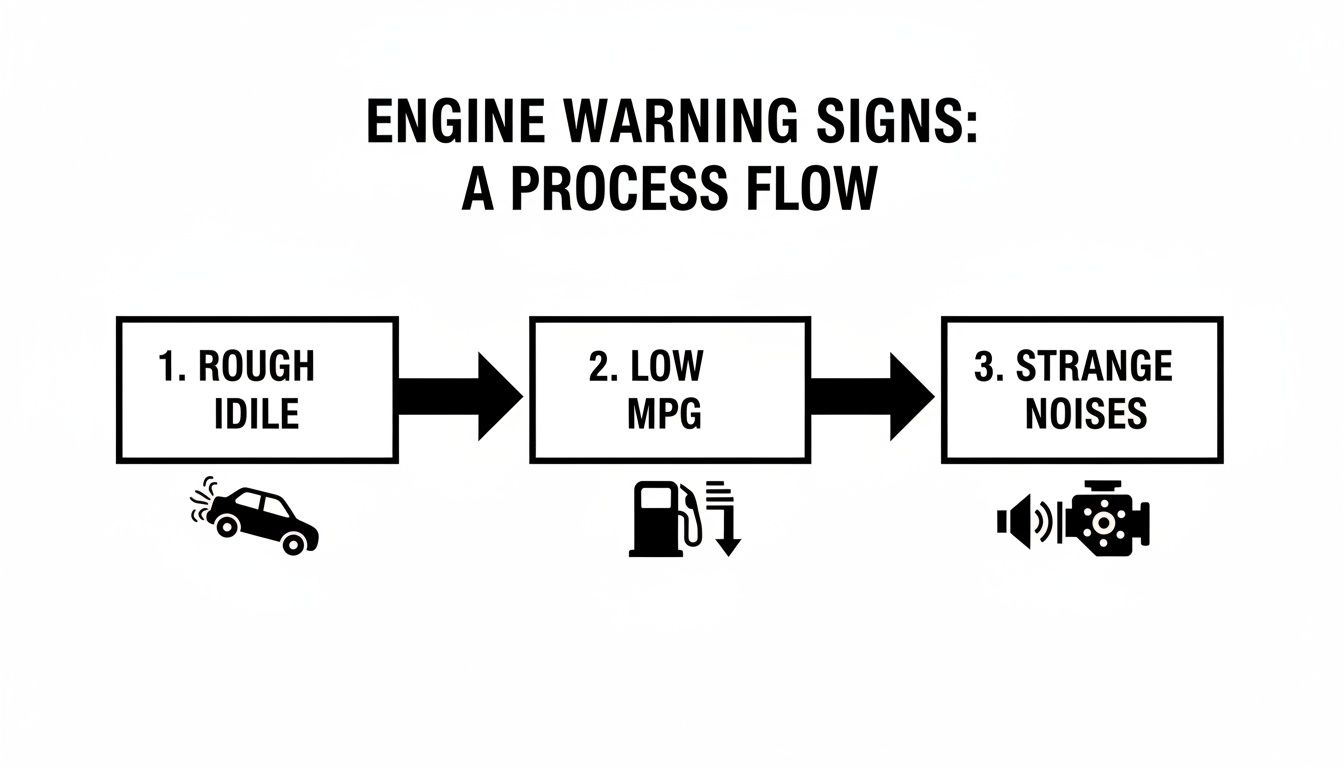
As you can see, things like a rough idle or suddenly terrible gas mileage are clear signs that something's not right and it's time for a professional look.
Step 2: Hands-On Inspection and Verification
With the trouble codes as our guide, the real detective work begins. This is where our technician’s experience truly comes into play as they perform a series of targeted physical inspections and tests.
This hands-on stage is what separates a professional diagnosis from a quick code read you might get at an auto parts store. Depending on the code, this could involve:
- Visual Inspection: Looking for obvious culprits like cracked hoses, frayed wiring, or fluid leaks.
- Component Testing: Using specialized tools like multimeters to check sensors, smoke machines to pinpoint sneaky vacuum leaks, or fuel pressure gauges to verify the fuel system is healthy.
- Live Data Analysis: Watching your car’s sensor data in real-time while the engine is running to see how all the systems are actually behaving together.
This detailed approach is absolutely vital. Our local auto repair industry is a key part of Canada's $12.5 billion contribution to the GDP, and precision is everything. Here in Whitby, our diagnostic work has shown that 42% of local SUVs over five years old develop timing chain stretch—an issue a simple code reader would never catch on its own.
Step 3: Clear Communication and Your Repair Plan
Once we've pinpointed the exact cause of the problem, we stop. We don't turn a single wrench until we've talked to you. Our final step is to sit down and explain what we found in plain, straightforward English.
We'll show you the problem, walk you through the necessary repairs, and give you a detailed, transparent estimate. You’ll have all the information needed to make a decision you're comfortable with. This commitment to clear communication is a cornerstone of all our auto repair services, because our goal isn't just to fix your car—it's to earn your trust.
What Those Engine Fault Codes Actually Mean
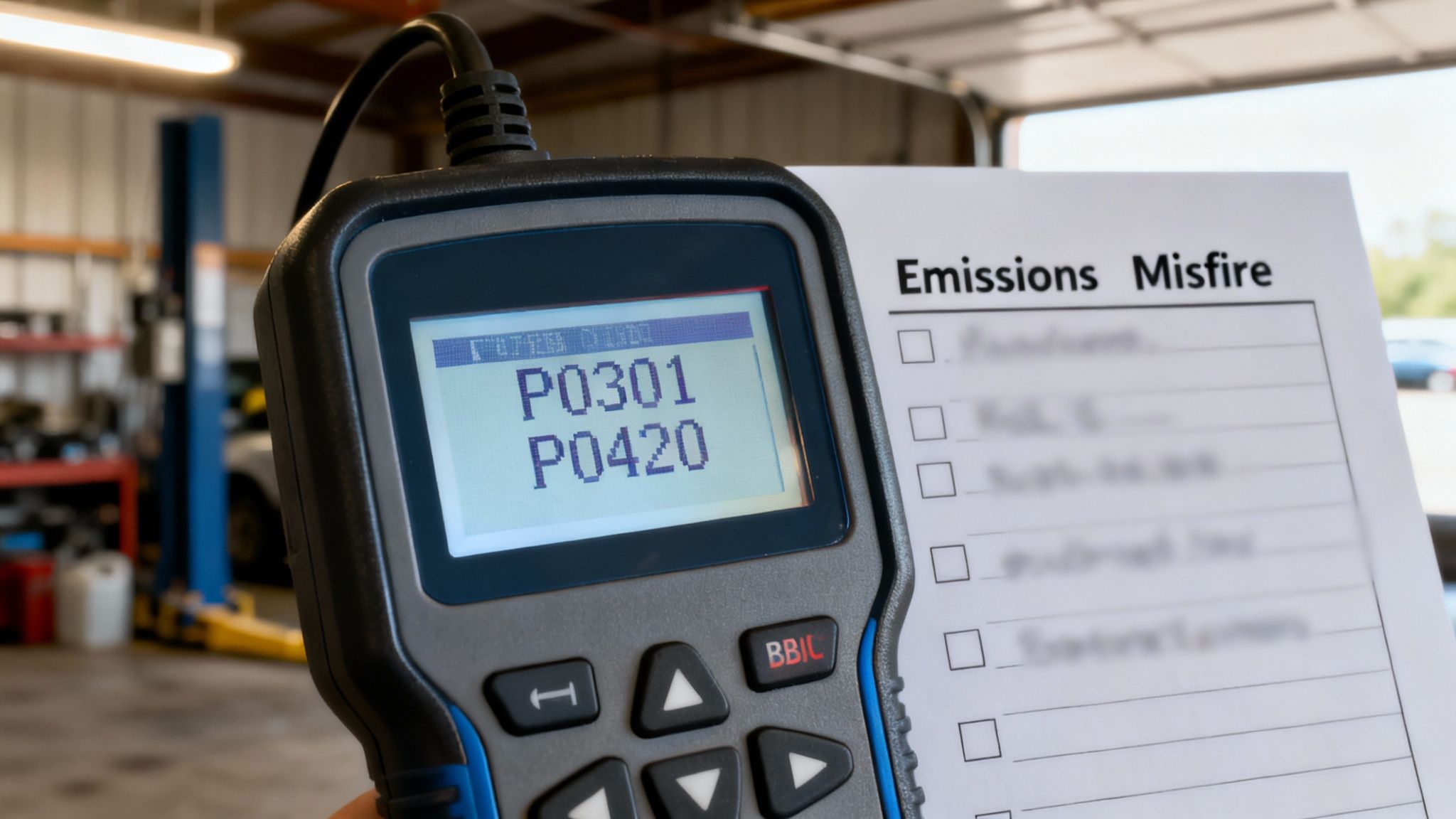
When we plug our scanner into your car, the codes we see can look like a secret language—a jumble of letters and numbers like P0301 or P0420. While they might seem cryptic, they’re actually specific messages from your car’s computer that point us in the right direction. Knowing a bit about them can make you feel more in control when we discuss what’s going on.
Instead of trying to memorize hundreds of codes, it’s easier to group them into categories. Most of the issues we see from drivers here in Whitby fall into a few common buckets, giving you a good idea of what could be happening under the hood.
Emissions System Faults
A huge number of check engine lights are tied to the emissions system. This complex network of sensors and valves is designed to keep your car’s exhaust clean, but it's also quite sensitive.
The most common codes in this group point to things like:
- Oxygen (O2) Sensor Problems: These little sensors are the "sniffers" in your exhaust. They measure oxygen levels to help the engine fine-tune its fuel mixture. When one fails, it can cause your engine to burn too much gas, tanking your fuel economy.
- Catalytic Converter Inefficiency: The infamous P0420 code is a red flag that your catalytic converter isn't doing its job. This is a crucial (and expensive) part, so a proper diagnosis is vital to make sure the converter is truly the culprit.
- EVAP System Leaks: This system stops gasoline vapours from escaping into the air. Sometimes, the fix is as simple as tightening a loose gas cap, but it could also be a cracked hose or a faulty valve somewhere in the system.
Catching these issues early is key. It not only saves you fuel but also ensures you'll pass an emissions test and can prevent damage to other expensive components down the line.
Engine Misfire Alerts
Is your car shaking at a stoplight, stuttering when you accelerate, or just feeling weak? An engine misfire is the most likely suspect. This means one or more of your engine’s cylinders isn't firing properly—a problem you definitely don't want to ignore.
Codes like P0300 (a random misfire) or P0301 (a misfire in the first cylinder) tell us exactly where the problem is. The last digit pinpoints the cylinder, so a P0302 would point to cylinder #2, and so on.
A steady engine misfire does more than just hurt performance. It can send raw, unburned fuel pouring into your exhaust, which can rapidly destroy the catalytic converter. This turns a relatively straightforward fix into a massive repair bill.
A misfire almost always boils down to one of three things: a problem with the spark (like a bad spark plug or ignition coil), a fuel delivery issue (like a clogged injector), or a mechanical problem inside the engine (like a loss of compression). Only a professional engine diagnostics Whitby service can pinpoint which one it is.
Fuel System Issues
For your engine to run smoothly, it needs a perfectly balanced diet of air and fuel. When that balance gets thrown off, a fault code is sure to follow. These problems directly hit your car's performance and how often you're visiting the pump.
Common codes in this category often relate to:
- Fuel Injector Faults: An injector can get clogged and not spray enough fuel, or it can get stuck open and flood the engine with too much. Either way, performance suffers.
- A Failing Fuel Pump: The fuel pump's job is to get gas from the tank to the engine. If it starts to weaken, your engine gets starved for fuel, which can cause stalling or prevent the car from starting at all.
- Mass Airflow (MAF) Sensor Errors: This sensor measures how much air is flowing into the engine. If it sends bad data, the computer calculates the wrong air-fuel mixture, leading to all sorts of running issues.
Think of these codes as your car telling you its diet is wrong. Fixing them quickly brings back your car's power and can save you a surprising amount of money on gas. Ultimately, these codes are just the first clue—they guide our technicians straight to the source of the trouble.
Why Whitby Drivers Trust Carmedics Autowerks

Choosing where to get an accurate engine diagnostic in Whitby really comes down to trust. It's not just about finding a shop with the newest scanner—it’s about having confidence in the technicians who are actually using those tools. Here at Carmedics Autowerks, we’ve built our reputation on expert knowledge, straight-up communication, and a real commitment to our community.
We get it. When your check engine light pops on, you need clear answers, not a bunch of confusing jargon or a heavy-handed sales pitch. Our approach is simple: we pair advanced technology with years of real-world experience to figure out what's going on with your vehicle, efficiently and correctly.
Technology Paired with Expertise
Today's cars are more complex than ever. Onboard computers manage everything from the fuel injectors to how the transmission shifts. To figure out what’s wrong, you need equipment that can speak their language. That's why we've invested in state-of-the-art diagnostic tools that connect with a huge range of vehicles, whether it's the family SUV you depend on every day or the high-performance car you love to drive.
But the tech is only one piece of the puzzle. The real difference is our team of licensed technicians. They take the data from the scanner as a starting point, then use their hands-on experience to dig deeper and find the root cause. This mix of high-tech tools and skilled talent means we find the actual problem, which saves you time and money in the long run.
Trust isn’t built on fancy equipment; it’s built on transparency. Our promise is simple: we explain everything in plain English, show you what we found, and give you a detailed estimate before any work begins. You’re always in the driver's seat.
Your Neighbours in Automotive Care
As a local Whitby business, we’re not just serving customers—we’re serving our neighbours. We have a deep understanding of what people are driving around here. While national vehicle registrations only saw a slight 0.3% increase, our own Whitby-Durham region has seen a 6.5% spike in SUV ownership. We see this firsthand in our shop every day.
This local insight helps us serve you better. We're diagnosing issues common to modern, high-performance engines, where problems like carbon buildup can affect 31% of vehicles by the 80,000 km mark. We're not just another repair shop; we specialize in keeping the cars on Whitby’s roads running safely.
A Commitment to Clear Communication
We firmly believe that an informed customer is a confident one. Once our diagnostic process is complete, we take the time to walk you through exactly what we found. We’ll explain the issue, lay out your repair options, and answer every single question you have. No surprises, no hidden fees—just straightforward, honest service.
This dedication to clarity and quality is why so many drivers trust us. We are proud to provide certified auto repair services in Whitby that our community can truly depend on. Our goal isn't just to be your mechanic; it's to be your trusted partner in vehicle care, making sure your car is safe and reliable for every trip.
Your Engine Diagnostics Questions Answered
When it comes to your car's health, having questions is a good thing. It’s totally normal to feel a bit of stress or uncertainty when that check engine light pops on. We get it.
To help you feel more confident about what's happening under the hood, we’ve put together some of the most common questions we hear from drivers right here in our Whitby shop. Think of this as your quick-reference guide, with clear, straightforward answers.
How Much Does an Engine Diagnostic Test Cost in Whitby?
This is usually the first question on everyone's mind, and for good reason. The initial diagnostic service typically falls within a set price range. This fee covers our technician's time, the use of professional-grade scanning equipment, and—most importantly—their expertise in figuring out what the fault codes actually mean.
It's important to see this initial fee for what it is: payment for the investigation, not the repair itself. It allows us to give you an accurate picture of what's wrong so you know exactly what it will take to fix it. Here at Carmedics Autowerks, we’re always transparent about this cost upfront. No surprises.
Think of it like a visit to a specialist. You pay for the examination and tests that lead to a proper diagnosis before you decide on a treatment plan. An engine diagnostic works the same way, ensuring we fix the right problem the first time around.
How Long Will the Diagnostic Process Take?
The time it takes really depends on how tricky the problem is. A simple scan that points to an obvious issue, like a loose gas cap, might only take 30 to 60 minutes to confirm.
However, if the initial code is more of a general symptom, our technicians will need to do some more hands-on detective work. Those annoying intermittent problems—the ones that come and go whenever they please—are often the most time-consuming because the issue has to be happening for us to find it. For these more involved cases, a diagnostic could take a few hours.
We always respect your time. Our team will give you a realistic time estimate when you drop off your vehicle and will keep you in the loop throughout the process.
Can I Drive My Car with the Check Engine Light On?
This is a critical question, and the answer isn't always simple. It really depends on how your car is behaving.
- If the light is steady and the car feels normal: You're generally safe to keep driving, but you should book a diagnostic appointment as soon as you can. A steady light often signals a less urgent issue, maybe related to emissions. Ignoring it, though, can hurt your fuel economy and potentially lead to bigger problems down the road.
- If the light is flashing or blinking: This is your car's way of screaming for help. A flashing check engine light means a serious engine misfire is happening, which can quickly destroy your catalytic converter—a very expensive part to replace. If you see a flashing light, pull over as soon as it's safe and have your vehicle towed to a shop.
- If the light is on and the car is acting strange: If you feel a loss of power, hear odd noises, or see smoke, it's best to stop driving and call for assistance. Pushing your car in these conditions can turn a manageable repair into a catastrophic engine failure.
Is a Code Scan the Same as a Full Diagnostic?
No, and this is probably the most important thing to understand. A quick code scan, like the free service you might get at an auto parts store, only tells you the fault code number. It doesn't tell you why that code was triggered in the first place.
A professional diagnostic service is a much deeper process:
- Code Retrieval: We start by pulling the Diagnostic Trouble Codes (DTCs) from your car's computer.
- Expert Analysis: Our technicians use their years of experience to interpret what that code might mean for your specific make and model.
- Hands-On Testing: We then perform targeted tests—checking sensors, looking for leaks, or analyzing live engine data—to pinpoint the root cause.
A code is just a clue. For example, a code pointing to an oxygen sensor doesn't automatically mean the sensor itself is bad. The real problem could be a vacuum leak, a fuel pressure issue, or a wiring problem that's making the sensor send a bad signal. Just replacing the sensor without a full diagnosis would be a waste of your money, because the light would just come right back on.
Will You Start Repairs After the Diagnostic?
Absolutely not without your explicit approval. Our entire process is built on clear communication and trust. As soon as our technicians have confirmed the exact cause of the problem, we will contact you directly.
We’ll give you a detailed, easy-to-understand explanation of what we found and a transparent, itemized estimate for the cost of parts and labour. No work ever begins without your say-so. We'll also walk you through different options, like the pros and cons of OEM vs. aftermarket parts, to help you make the best decision for your car and your budget.
Of course, the best repair is the one you never have to make. Following essential vehicle maintenance procedures is the best way to keep that check engine light off and your car running smoothly for years to come.
At Carmedics Autowerks Inc, our goal is to give you accurate answers and expert service you can count on. If you have more questions or if that check engine light is on, don't wait. Schedule your diagnostic appointment with our trusted Whitby technicians today at https://www.carmedicsautowerks.com.com.