


When your car's AC decides to quit on a scorching hot Ontario summer day, the first thought that pops into your head is probably, “Okay, how much is this going to set me back?” The truth is, car air conditioning repair costs can swing wildly, from around $150 for a simple recharge to over $2,000 if a major part has failed. Knowing the typical price points for common jobs can help you budget and avoid any nasty surprises.
Breaking Down Your Estimated Car AC Repair Costs

Trying to figure out AC repair costs can feel a bit like guesswork. The final bill really comes down to what part of the system has gone wrong. Think of it this way: fixing a dripping tap in your kitchen is one thing, but replacing all the pipes under the house is a completely different project. It’s the same with your car—a minor refrigerant top-up is a quick fix, whereas replacing the compressor, the heart of the whole cooling system, is a much bigger job.
To help you get a better handle on what to expect, we’ve put together a quick look at the most common AC repairs and their typical costs here in Ontario. This isn't a firm quote, but it's a solid guide to help you walk into the shop feeling more prepared.
Car AC Repair Services At A Glance
This table provides a summary of common car air conditioning repairs and their typical cost ranges in Ontario, helping you budget for potential expenses.
| AC Repair Service | Estimated Cost Range (CAD) |
|---|---|
| Refrigerant Recharge (Regas) | $150 – $300 |
| Leak Detection and Repair | $200 – $600 |
| AC Condenser Replacement | $450 – $900 |
| AC Compressor Replacement | $800 – $2,000+ |
| AC Evaporator Replacement | $900 – $2,200+ |
| Blower Motor Replacement | $250 – $650 |
Keep in mind, these numbers are a general guide. The final price tag will always be influenced by your car's make, model, age, and even the type of refrigerant it requires.
Why Transparent Diagnostics Matter
Getting an accurate diagnosis is, without a doubt, the most important first step. Without it, you could end up paying for repairs that don't actually fix the root problem. For instance, a shop might just recharge the system when you have a slow leak. Sure, the AC will work for a bit, but you'll be right back where you started in a few weeks when the refrigerant has escaped again.
A proper AC service begins with identifying the root cause, not just treating the symptom. This ensures the repair is effective, saving you time, money, and frustration in the long run.
At Carmedics Autowerks, we’re firm believers in honest, thorough diagnostics. Our experienced technicians in Whitby won't just guess; they'll take the time to pinpoint the exact point of failure, whether it's a cracked hose, a bad compressor clutch, or an electrical fault. We'll show you what's wrong, explain it in plain English, and give you a detailed estimate before we pick up a single tool.
This commitment to clarity ensures you get a solution that lasts. If you want to know more about how we handle vehicle care, you can explore our complete list of professional auto repair services in Whitby, Ontario. Our number one goal is to get you back on the road with ice-cold air, feeling confident in the work we've done.
What Really Drives Your AC Repair Bill
Ever wonder why your friend got their car's AC fixed for a couple of hundred bucks, but your quote looks more like a down payment on a jet ski? There’s no mystery pricing formula—the final number on that repair bill is a direct result of a few key factors.
Getting a handle on these variables is the best way to feel confident when you see an estimate. It helps you ask the right questions and understand why one job might be a quick $200 fix while another spirals past $2,000. Let's pull back the curtain on what really determines the cost.
The Specific Part That Failed
By far, the biggest factor is which part of the AC system gave up. Your car's air conditioning is a complex network, and the components have wildly different price tags. The labour needed to get to them varies just as much.
Think of it like a plumbing system in a house. A leaky O-ring is like a dripping faucet washer—a simple, cheap fix. But a dead AC compressor? That's the equivalent of your main water pump failing. The compressor is the heart of the system, and replacing it is one of the most expensive jobs you can run into.
Your AC is a closed-loop system, which means one failure can poison the well for everything else. When a compressor grenades, it can spew tiny metal shavings throughout the lines, turning a single part replacement into a full system flush. That's when costs really climb.
For instance, swapping out a faulty pressure switch might only set you back a few hundred dollars. A brand-new compressor, on the other hand, can easily run from $800 to over $2,000, and that’s often just for the part itself.
Your Vehicle's Make and Model
What you drive makes a huge difference. Parts for premium European brands like BMW, Audi, or Mercedes-Benz are almost always pricier than for a common Honda or Ford. It comes down to more complex engineering, smaller production runs, and plain old brand pricing.
It’s not just about the parts, either. The vehicle's design dictates how much work it takes to get to the problem. In some trucks, the AC condenser sits right behind the grille, easy to access. In a tightly packed sedan, a mechanic might have to pull off the entire front bumper to reach the same part, adding hours of labour to the bill. The evaporator core is the classic example—it often lives deep inside the dashboard, requiring a massive 8-10 hour job to remove and replace it.
The Type of Refrigerant Required
Believe it or not, the gas that makes your AC cold isn't all the same. For years, the industry standard was a refrigerant called R-134a. But with growing environmental concerns, cars built since about 2015 now use a much greener alternative, R-1234yf.
While it’s better for the ozone layer, it’s not so friendly to your wallet. The price difference is staggering.
- R-134a: Typically costs around $10-$20 per pound.
- R-1234yf: Can be anywhere from $70 to $150 per pound, sometimes even more.
A full AC recharge usually takes about two pounds of refrigerant, so the cost of the gas alone can make a huge difference in the final bill. This is a big reason why AC service on a newer car can feel surprisingly expensive.
Local Labour Rates
Just like with housing, auto repair costs are all about location, location, location. A skilled technician's hourly rate varies quite a bit depending on the region, province, and even the city. A shop in downtown Toronto has higher overhead costs than a garage in a smaller town like Whitby, and their labour rates will reflect that. That hourly rate gets multiplied across every repair, directly impacting your bill.
The Extent of Collateral Damage
Finally, sometimes the problem isn't just one broken part. A small, undetected leak can cause the compressor to run low on lubricating oil, eventually seizing it up. Now, you’re not just fixing the original leak; you're also replacing a fried compressor.
These factors create a wide range of potential costs across North America. To give you a real-world idea, replacing an AC compressor typically falls somewhere between $1,300 and $2,600 on average. Just diagnosing the problem often starts at $100-$200 but can go up if a technician has to spend time chasing a tricky leak. You can see how these costs stack up nationally by reviewing some in-depth car maintenance cost analyses.
Once you understand what's driving the cost, you're in a much better position to have a clear conversation with your mechanic about what your car needs.
Common AC Problems And What They Cost To Fix
When your AC dies, knowing what went wrong is the first step to understanding the final bill. The cost to get your car's air conditioning back in working order is tied directly to which part decided to call it quits.
Let's walk through some of the most common AC failures, the tell-tale signs to watch for, and a realistic look at what you can expect to pay.
Breakdown Of Common Car AC Repair Costs And Symptoms
Every AC problem has its own unique fingerprint—from strange noises to a gradual loss of cooling. The table below breaks down the most frequent issues we see in the shop, connecting the symptoms you experience to the likely culprit and its repair cost.
| Common AC Problem | Typical Symptoms | Estimated Parts Cost (CAD) | Estimated Labour Cost (CAD) | Total Estimated Cost (CAD) |
|---|---|---|---|---|
| Refrigerant Leak | Gradual loss of cold air, hissing noise, oily residue around hoses. | $50 – $300+ | $150 – $400 | $200 – $700+ |
| Compressor Failure | Loud grinding/squealing when AC is on, intermittent cooling, no cold air at all. | $400 – $1,200+ | $400 – $800 | $800 – $2,000+ |
| Condenser Damage | AC works on the highway but not in traffic, visible damage to front grille area. | $200 – $500 | $250 – $400 | $450 – $900 |
| Electrical Fault | AC won't turn on, fan doesn't blow, system acts erratically. | $20 – $150 | $150 – $400+ | $150 – $500+ |
This chart gives you a solid ballpark, but remember these are estimates. The final cost always depends on your specific vehicle and the extent of the problem. Now, let’s dig a little deeper into each of these common headaches.
Refrigerant Leaks: The Slow And Silent Killer
One of the most frequent reasons an AC system gives up is a refrigerant leak. Think of refrigerant as the lifeblood of your AC; without the right amount, it simply can't move heat out of your car.
Leaks are sneaky. They're often caused by tiny cracks in old rubber hoses or deteriorating seals, letting the refrigerant escape over weeks or even months.
Symptoms to Watch For:
- Gradual Loss of Cooling: Your AC just doesn't feel as icy as it used to, and it seems to get worse over time.
- Hissing Sounds: You might hear a faint, consistent hiss from under the hood or dash.
- Visible Oily Residue: The refrigerant is mixed with a special lubricant. If you see a greasy film on AC lines or fittings, you've found your leak.
To fix this, a technician will first have to play detective to find the leak's source, often using a UV dye or an electronic "sniffer." The actual repair could be as simple as replacing a $10 O-ring or as complex as swapping out a corroded line buried deep in the engine bay.
The cost for a leak repair is all over the map. It’s not about the leak itself, but where it is. A quick valve fix is one thing, but getting to a buried hose means a lot more labour time.
Compressor Failure: The Heart Attack Of Your AC
If the refrigerant is the blood, the compressor is the heart of your AC system. It’s a powerful pump that pressurizes and circulates refrigerant, and when it fails, it’s almost always the most expensive single repair you'll face.
Compressors are hard-working parts, and they can fail from old age, a lack of lubrication (often due to a refrigerant leak), or an internal mechanical meltdown. They usually give you some warning signs before they completely seize up.
Symptoms to Watch For:
- Loud Grinding or Squealing Noises: A nasty mechanical sound from the engine bay the second you turn on the AC is a huge red flag.
- AC Works Intermittently: The clutch on the compressor might be struggling to engage, making the cool air cut in and out.
- No Cold Air At All: A fully seized compressor means the system is dead in the water.
Replacing a compressor isn't a simple swap. If the old one grenaded itself, it spewed tiny metal shavings throughout the entire system. A proper repair means flushing all the lines, replacing other contaminated parts like the receiver/drier, and then installing the new compressor. This is why the car air conditioning repair costs for a compressor job can easily run from $800 to over $2,000.
Condenser Issues: Your AC’s Radiator
Right at the front of your car, usually sitting in front of the radiator, is the condenser. Its job is to get rid of all the heat the refrigerant pulled from inside your cabin.
Because of its prime location, it’s a magnet for rocks, road debris, and other hazards that can cause damage.
Symptoms to Watch For:
- AC Stops Working at Low Speeds: If your AC is great on the highway but blows warm in city traffic, the condenser or its cooling fan is likely the problem.
- Visible Damage: Peek through your car's front grille. You might see bent or smashed fins.
- Sudden Loss of Cooling: A direct hit from a rock can puncture the condenser, causing a massive and immediate refrigerant leak.
Replacing a condenser will typically set you back between $450 and $900. While the part itself isn’t as pricey as a compressor, the labour adds up because the technician often has to remove the whole front bumper cover to get to it. To see what this kind of work involves, getting familiar with professional air conditioning repair for your car can give you a much clearer picture.
Electrical Gremlins: The Tricky Problems
Sometimes, all the heavy-duty mechanical parts are fine, but an electrical gremlin is preventing them from talking to each other. This could be anything from a simple blown fuse or a bad relay to a faulty pressure switch or a hidden break in a wire.
These can be the most frustrating problems to pinpoint because the symptoms can be all over the place.
Symptoms to Watch For:
- AC Won't Turn On At All: The lights on your dash work, but the AC system is completely unresponsive.
- Blower Fan Isn't Working: You can hear the compressor click on, but zero air is coming from your vents.
- System Behaves Erratically: The AC might turn on and off by itself for no apparent reason.
Hunting down these electrical faults takes skill and the right tools. A technician will use a multimeter and follow wiring diagrams to trace the circuit and find the failure. The repair cost here is almost entirely based on labour time. A $2 fuse takes seconds to fix, but finding a short in a wiring harness could take hours, putting costs anywhere from $150 to $500 or more.
The AC Repair Process: From Diagnosis To Cold Air
Taking your car to a shop for an AC problem can feel a bit like a black box. You know it’s not working, but what actually happens behind the garage door? It’s not just about plugging in a machine; it's a careful, step-by-step investigation to find the real problem and make sure the fix holds up.
A good technician doesn't guess. They follow a logical path from finding the fault to confirming the repair, ensuring nothing gets missed. Think of it like a doctor diagnosing an illness before writing a prescription—jumping to conclusions often leads to the wrong treatment.
This visual guide breaks down the typical paths a technician takes when figuring out what’s wrong with a faulty AC system, whether it’s a leak, a bad part, or something else entirely.
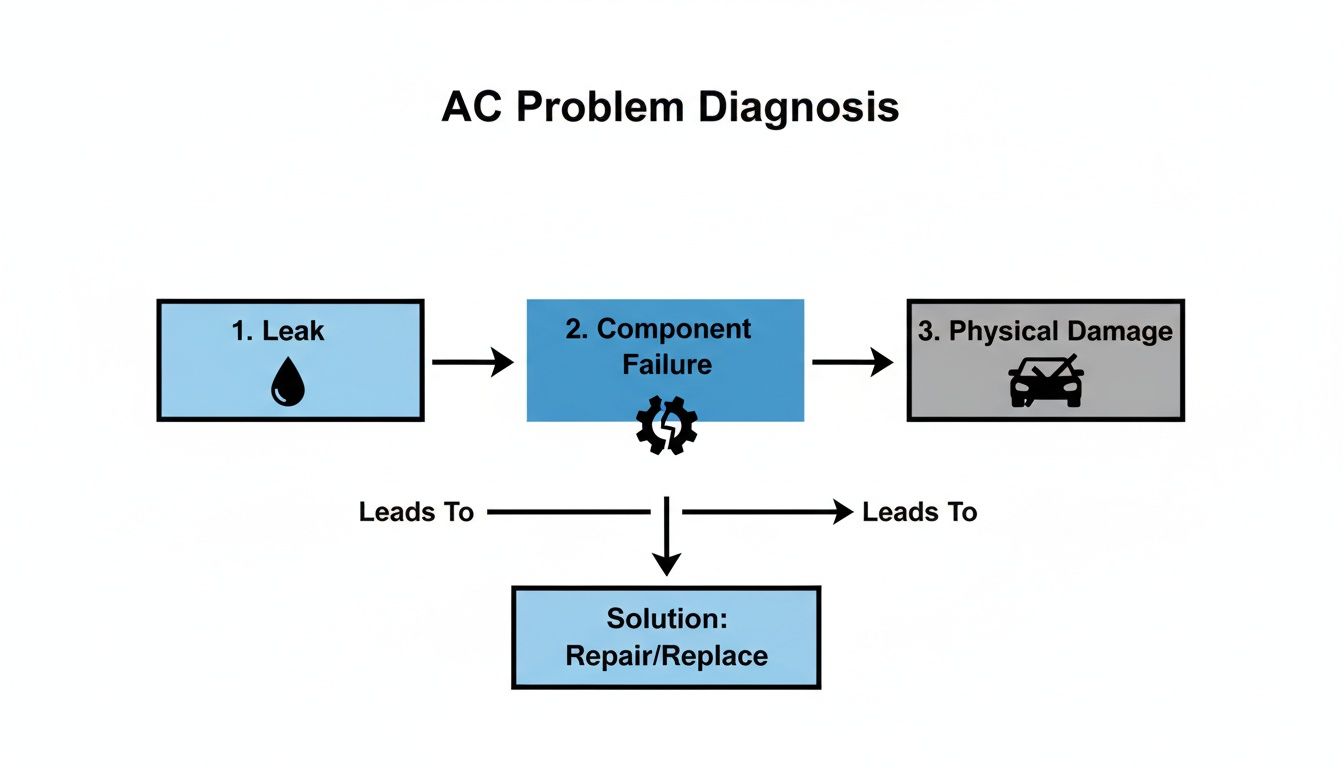
As you can see, a single symptom like weak cooling can point to several different issues. That’s exactly why a thorough diagnostic is the non-negotiable first step.
The Initial Diagnostic Phase
First things first, a technician will run a performance check. They'll measure the temperature of the air blowing from your vents and compare it to the air temperature outside. This gives them a clear baseline of how poorly the system is actually performing.
Next, they’ll hook up a manifold gauge set to your AC system's high- and low-side service ports. These gauges are like a vital signs monitor for your car's AC, revealing the internal pressures. To an experienced pro, those numbers tell a story.
Strange pressure readings are a technician's roadmap. If one side is really high and the other is low, it might point to a blockage. If both sides are equally low, it's almost always a sign of a refrigerant leak.
These initial readings help the technician form a solid theory about the problem, which dictates where they look next.
Hunting Down The Elusive Leak
If the gauges point to a refrigerant leak—the most common AC problem by far—the hunt is on. Just dumping more refrigerant in without fixing the source is a total waste of money and time. Technicians have a couple of trusty tools for this detective work:
- UV Dye Detection: A special fluorescent dye is injected into the AC system. After you drive around for a day or two, the dye will have circulated and seeped out through any cracks or failing seals. Back at the shop, the technician scans all the AC components with a UV light, and any leak will glow a bright, impossible-to-miss green.
- Electronic Leak Detector: This tool, often called a "sniffer," has a sensitive probe that detects refrigerant chemicals. The technician traces the probe along all the AC lines, hoses, and connections. When it gets near a leak, it starts beeping or flashing, zeroing in on the exact location.
Reviewing The Estimate And Approving The Repair
Once the problem is pinpointed, you'll get a detailed estimate. This is your guide to the car air conditioning repair costs. It should clearly break down the necessary parts, the cost for each one, and the estimated labour time for the job.
Never be afraid to ask questions. A good shop will gladly walk you through the estimate, explaining why each part and procedure is needed to get the job done right.
The Repair And Recharge Process
Once you give the green light, the real work begins. The process follows a strict set of steps:
- Evacuation: First, a recovery machine is used to safely and completely remove all the old refrigerant and oil from the system.
- Component Replacement: The bad part—whether it's a cracked hose, a failed compressor, or a damaged condenser—is taken out and the new one is installed.
- Vacuum: The system is then placed under a deep vacuum for at least 30 minutes. This is a critical step that boils off any moisture, which is the mortal enemy of AC components. It also serves as one last check for any leaks.
- Recharge and Test: Finally, the precise amount of the correct type of refrigerant and oil, specified by your car’s manufacturer, is carefully measured and added back. The tech will then start the car, blast the AC, and double-check the pressures and vent temperatures to confirm a successful repair.
This meticulous process ensures that when you pick up your car, the AC isn't just working—it's restored to peak performance. To see how we put this expertise to work, learn more about our professional air conditioning service for your car and how we help drivers in Whitby stay cool.
DIY AC Recharge Kits Versus Professional Service

When your car’s air conditioning starts blowing lukewarm air on a sweltering day, those DIY recharge cans at the auto parts store can seem like a lifesaver. For under $100, they promise a quick and easy fix. But is it really that simple? Let’s be honest, that quick fix could end up costing you a whole lot more down the road.
The appeal is totally understandable. Why pay for a professional service when you can seemingly solve the problem yourself in 15 minutes? Before you grab that can, though, it’s crucial to understand what these kits actually do—and more importantly, what they don't do.
The Temptation of the Quick Fix
A DIY recharge kit is basically a can of refrigerant blended with a bit of oil and, usually, a "stop-leak" additive. It comes with a simple hose and a low-pressure gauge that guides you to add refrigerant until the needle hits the "green zone."
In the absolute best-case scenario—where your system is just a tiny bit low on refrigerant and has no major leaks—a recharge can might bring back the cold air. For a little while. It feels like a win, but often this temporary success just puts a band-aid on a much bigger problem.
Think of it like a tire with a slow leak. You can keep adding air to it, and it will get you around for a bit. But you haven't fixed the nail that's causing the leak. A DIY recharge kit is just like adding air without finding and patching the hole.
The Hidden Dangers of DIY Recharging
While they look straightforward, these kits can turn a minor AC issue into a massive, expensive headache. An improper DIY job can cause your car air conditioning repair costs to skyrocket.
Here’s a look at what can, and often does, go wrong:
- Overcharging the System: Let's be blunt: the gauges on these DIY cans are cheap and notoriously inaccurate. Putting too much refrigerant into the system is just as bad as having too little. The excessive pressure puts a huge strain on your AC compressor, which can damage or completely destroy it—and that’s the most expensive component in the whole system.
- Introducing Contaminants: A professional service uses a vacuum pump to suck all the air and moisture out before adding new refrigerant. A DIY can forces refrigerant in, pushing air and moisture from the atmosphere right along with it. This moisture can mix with refrigerant to form corrosive acids that eat away at your AC system from the inside out.
- Masking the Real Problem: Your AC is a sealed system. If it's low on refrigerant, it means there's a leak somewhere. Period. Just topping it off ignores the root cause, letting the leak continue and allowing precious lubricating oil to escape with the refrigerant, starving other components.
- Using the Wrong Stuff: Some kits contain "universal" refrigerants or additives that might not be compatible with your car's specific system. This can lead to poor performance at best, and serious damage at worst.
Why Professional Service is a Smarter Investment
When you take your car to a qualified technician, you're not just buying a can of refrigerant. You’re investing in a proper diagnosis and a lasting repair that protects your entire AC system.
Here’s what a certified technician will do:
- Perform a Full Evacuation: They’ll start by safely and completely removing all the old refrigerant and oil from the system.
- Conduct a Vacuum Test: Next, they'll pull the system into a deep vacuum. This boils off any hidden moisture and also helps confirm if there are any major leaks.
- Find and Fix the Leak: Using tools like UV dye or electronic "sniffers," they will pinpoint the exact source of the leak and repair it correctly.
- Recharge by Weight: This is key. They add the precise amount of the correct type of refrigerant and oil, measured by weight, just as the manufacturer specifies.
This meticulous process doesn't just treat the symptom; it cures the underlying problem. While the upfront cost is higher than a DIY kit, it prevents catastrophic failures and ensures your AC runs efficiently for years to come, saving you from much bigger repair bills later.
How To Save Money On Your Next AC Repair

Keeping your vehicle's air conditioning in top shape doesn't have to end with a shocking bill. With a bit of foresight and proactive care, you can seriously cut down your long-term car air conditioning repair costs and dodge those sweaty, uncomfortable drives.
The easiest trick in the book is preventative maintenance. It might sound a bit backward, but one of the best things you can do for your AC is to run it every so often during the winter. Firing it up for just 10-15 minutes every few weeks keeps the refrigerant and oil circulating, which in turn keeps the seals lubricated. This simple step helps prevent them from drying out and cracking—a very common cause of leaks.
Be Proactive, Not Reactive
Tackling small issues the moment you notice them is your best defence against a catastrophic failure down the road. If you feel your AC isn't blowing as cold as it used to, don't just crank it up and hope for the best.
A small refrigerant leak today can easily lead to a seized compressor tomorrow. By catching and fixing a minor problem early, you can often sidestep a repair bill that’s ten times higher.
Here are a few practical tips to keep your costs in check:
- Schedule Regular Checks: Having your AC system inspected every couple of years allows a technician to spot potential trouble, like worn belts or low refrigerant, before they snowball into real damage.
- Don't Delay Repairs: Is the cooling getting weak? Hearing strange noises when the AC kicks on? These are warning signs. The sooner you get it looked at, the cheaper the fix will likely be.
- Choose a Trusted Shop: Find a local garage with a solid reputation for honest work. A good technician will diagnose the actual problem instead of upselling you on parts you don't need, making sure the job is done right the first time.
For a bigger picture on vehicle expenses, it's interesting to see how your choice of car affects overall maintenance, AC included. You can get a sense of this by understanding the real cost of owning an EV compared to petrol cars. In the end, smart maintenance and a reliable mechanic are your best allies in saving money.
Answering Your Car AC Repair Questions
When your car's air conditioning decides to take an unscheduled vacation, a flood of questions usually follows. That’s perfectly normal. Getting a handle on how the system works and what can go wrong will make you feel a lot more in control when it's time for a repair.
Let's walk through some of the most common questions we hear from drivers every day.
How Often Should I Get My Car's AC System Serviced?
Think of your AC system like any other critical part of your car—it needs a check-up now and then. We generally recommend having it professionally inspected every two years. This isn't just about "gassing it up"; it's about staying ahead of problems.
A proper service involves a technician looking for the earliest signs of trouble, like tiny leaks or worn seals. They'll also check the refrigerant and lubricant levels to ensure everything is running smoothly. This simple, proactive step can catch a small issue before it snowballs into a massive failure with a much higher car air conditioning repair cost.
Why Does My Car AC Smell So Bad?
If you're hit with a musty, old-gym-sock smell the second you turn on your AC, you’re not alone. That unpleasant odour is almost always from mould and bacteria that have set up camp on your evaporator core. It’s a dark, damp, and cool environment in there—the perfect breeding ground.
Don't just ignore it; that smell is a sign you're breathing in poor-quality air. A professional cleaning service can get deep into the system to safely sanitize the evaporator and knock out the source of the odour for good.
Pro Tip: A simple habit can make a huge difference. Try turning the AC button off but leaving the fan running for a few minutes before you park. This helps dry everything out and makes it much harder for mould to grow.
My AC Is Blowing Warm Air Again, But I Just Got It Recharged. What Gives?
This is a classic sign of a leak, plain and simple. If you recharge the system and it's blowing warm air again a short time later, that new refrigerant has already found a way out.
Topping up the refrigerant without fixing the leak is like pouring water into a bucket with a hole in it—a waste of time and money. What you really need is a proper leak detection service. A technician will use tools like a special UV dye to pinpoint exactly where the breach is, repair it, and then recharge the sealed system so it actually lasts.
Are Those "Stop Leak" Refrigerant Cans A Good Idea?
Honestly, we strongly advise against using them. It's tempting, I know—a quick, cheap fix in a can. The problem is that the additives designed to plug small leaks can't tell the difference between a hole and a crucial, narrow passageway.
These products can end up clogging vital components like the expansion valve or orifice tube, and can even destroy the compressor. You could easily turn a minor leak into a catastrophic system failure that costs thousands to fix. It's always, always better to have a professional find and fix the leak the right way.
When you need straight answers and reliable AC repairs, the team at Carmedics Autowerks is here to help. Visit us online to book your appointment and get back to driving cool and comfortable.