


When it comes to getting reliable brake repair in Whitby, your best bet is always a certified shop that truly gets the local driving conditions. Here at Carmedics Autowerks, we specialize in expert brake services that keep you safe, whether you’re merging onto the 401 or just navigating a busy parking lot.
Why Your Brakes Need an Expert Eye in Whitby
Let's be honest, driving around Whitby puts your vehicle through a unique kind of stress. One minute you're dealing with the high speeds and sudden stops of the Highway 401, which really puts the pressure on your brake pads and rotors. The next, you're in stop-and-go traffic on Taunton Road or creeping through a packed shopping centre, generating a ton of heat in your braking system.
This mix of intense highway driving and city crawling wears out your brakes much faster than you might think. A generic, one-size-fits-all brake job just doesn't work for our roads. Your vehicle needs a specific approach that takes these local challenges into account.
The Real Dangers of Putting Off Brake Repairs
Ignoring those first warning signs—a little squeak here, a soft pedal there—is a gamble you don't want to take. It's a massive safety risk, and brake problems are a consistent factor in serious accidents right here in Ontario.
Transport Canada collision statistics show that about 5–7% of police-reported collisions in the country each year involve a vehicle with a known mechanical problem. Of those issues, faulty brakes are consistently in the top three.
This really drives home why getting professional brake repair in Whitby is so important. It’s not just about keeping your car running well; it's about protecting yourself, your passengers, and everyone else on the road. You can learn more about how our certified auto repair services meet these critical safety standards.
Specialized Service for a Confident Drive
At Carmedics Autowerks, we know your brakes are the most important safety feature on your vehicle. That’s why we perform incredibly thorough inspections and only use top-quality parts built to handle our local driving demands.
This means your car won't just stop safely—it will handle with the responsiveness and control you count on every single time you hit the pedal. When it comes to something this vital, you shouldn't have to settle for anything less.
Learning to Read the Signs of Brake Trouble
Your car has its own way of telling you something's wrong, and the brakes are usually the first to speak up. Getting familiar with these warning signs is the best way to keep yourself safe and sidestep a much bigger repair bill down the line.
Think of it like this: a strange noise from your brakes is like the first chirp of a smoke detector. You wouldn’t ignore that, would you? Ignoring these signals only raises the stakes, turning a minor fix into a major problem. That’s why paying attention and seeking a professional brake repair in Whitby is so important for getting around town safely.
Brake Problem Symptom Checker for Whitby Drivers
Sometimes it’s hard to put your finger on exactly what’s wrong. Is that noise a squeal or a grind? Does the pedal feel soft or is it just me? This quick reference table can help you connect what you’re hearing and feeling to a potential issue with your brakes.
| Symptom | What It Sounds/Feels Like | Potential Problem |
|---|---|---|
| High-Pitched Squeal | A sharp, screeching noise when you first press the brake pedal, which may go away as you brake harder. | The brake pad wear indicators are telling you the pads are getting thin and need replacing soon. |
| Deep Grinding Noise | A loud, harsh, metallic grinding or growling sound that’s impossible to ignore. | Your brake pads are likely completely worn out. This is metal-on-metal contact, which can ruin your rotors. Stop driving and get it checked immediately. |
| Vibration or Shuddering | You feel a shaking or pulsing through the steering wheel or brake pedal when you slow down. | This almost always points to warped or unevenly worn brake rotors. |
| Spongy or Soft Pedal | The brake pedal feels mushy and goes down further than usual before the brakes engage. | Air has probably gotten into the brake fluid lines, or there could be a leak in the system. |
| Car Pulls to One Side | When you brake, the car veers or pulls to the left or right on its own. | This often means a brake caliper is "stuck" or not applying pressure evenly on both sides. |
| Clicking or Rattling | You hear a distinct clicking or rattling sound when you press or release the brake pedal. | The brake pads might be loose, or the hardware holding them in place could be worn or broken. |
This isn't a substitute for a professional diagnosis, of course, but it's a great starting point for understanding what your car is trying to tell you.
Translating Your Car's Brake Noises
Let's dive a little deeper into those sounds. The noises your brakes make are direct clues about their health, each telling a story about what’s happening when your foot hits the pedal.
- High-Pitched Squeal: This is the most common early warning. It’s caused by a tiny metal tab, called a wear indicator, built right into your brake pads. When the pads wear down to a certain point, this tab scrapes against the rotor, creating that tell-tale squeal. It’s your car’s polite way of saying, “Hey, time to book a check-up!”
- Loud Grinding Noise: This is the one you can’t ignore. If a squeal is a polite request, a grind is a full-blown emergency siren. It means the brake pads are gone, and now the metal backing plate of the pad is grinding directly against the metal rotor. This causes serious damage, fast.
- Clicking or Rattling: A clicking noise when braking often points to loose-fitting brake pads or worn-out hardware that's supposed to hold everything snugly in place.
Driving in stop-and-go traffic on Dundas Street is a lot different than cruising down the 401. Your braking habits directly impact how quickly your brakes wear out.
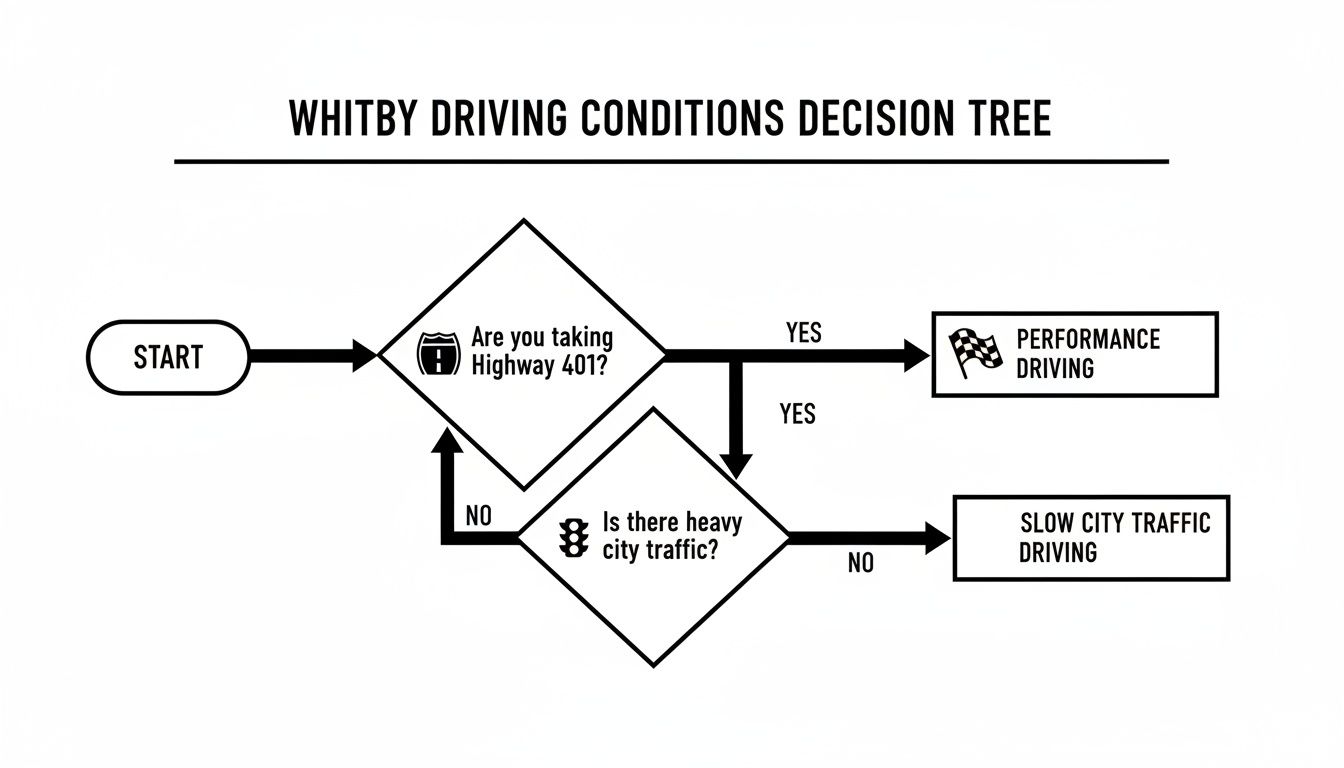
As you can see, your daily commute plays a huge role in your brake maintenance schedule.
What You Feel Through the Brake Pedal
It’s not just about what you hear—it’s also about what you feel. Your feet can detect some of the most serious brake problems, so pay attention to how things feel when you need to slow down.
Any change in how the pedal feels under your foot is a major red flag. If it suddenly feels soft, spongy, or sinks slowly toward the floor, you might have air or moisture in the brake lines or an issue with the master cylinder.
A healthy brake pedal should feel firm and responsive, not like stepping on a soft marshmallow. This change in resistance indicates that the hydraulic system responsible for applying pressure to your brakes is compromised and needs immediate professional diagnosis.
If your steering wheel shudders or the whole car vibrates when you brake, it's a classic sign of warped rotors. And if the car pulls to one side? That could be a stuck caliper that isn’t applying pressure correctly.
Catching these signs early is the key to a safe drive. To get a better sense of the lifespan of these parts, you can learn more about how often to change brake pads in our detailed guide.
Understanding Your Car's Brake System
To really get why professional brake repair is so important, it helps to know what’s actually happening every time you step on that pedal. It’s not just one simple part at work; it's a sophisticated system of components working in perfect harmony to bring a massive, fast-moving vehicle to a safe, controlled stop. It's a brilliant piece of engineering, really.
Think of it like the handbrake on a bicycle, but on a much more powerful scale. When you squeeze the lever on your bike, a cable pulls a clamp, which presses rubber pads against the wheel rim. Your car does the same thing, but instead of a simple cable, it uses hydraulic fluid to generate immense force.
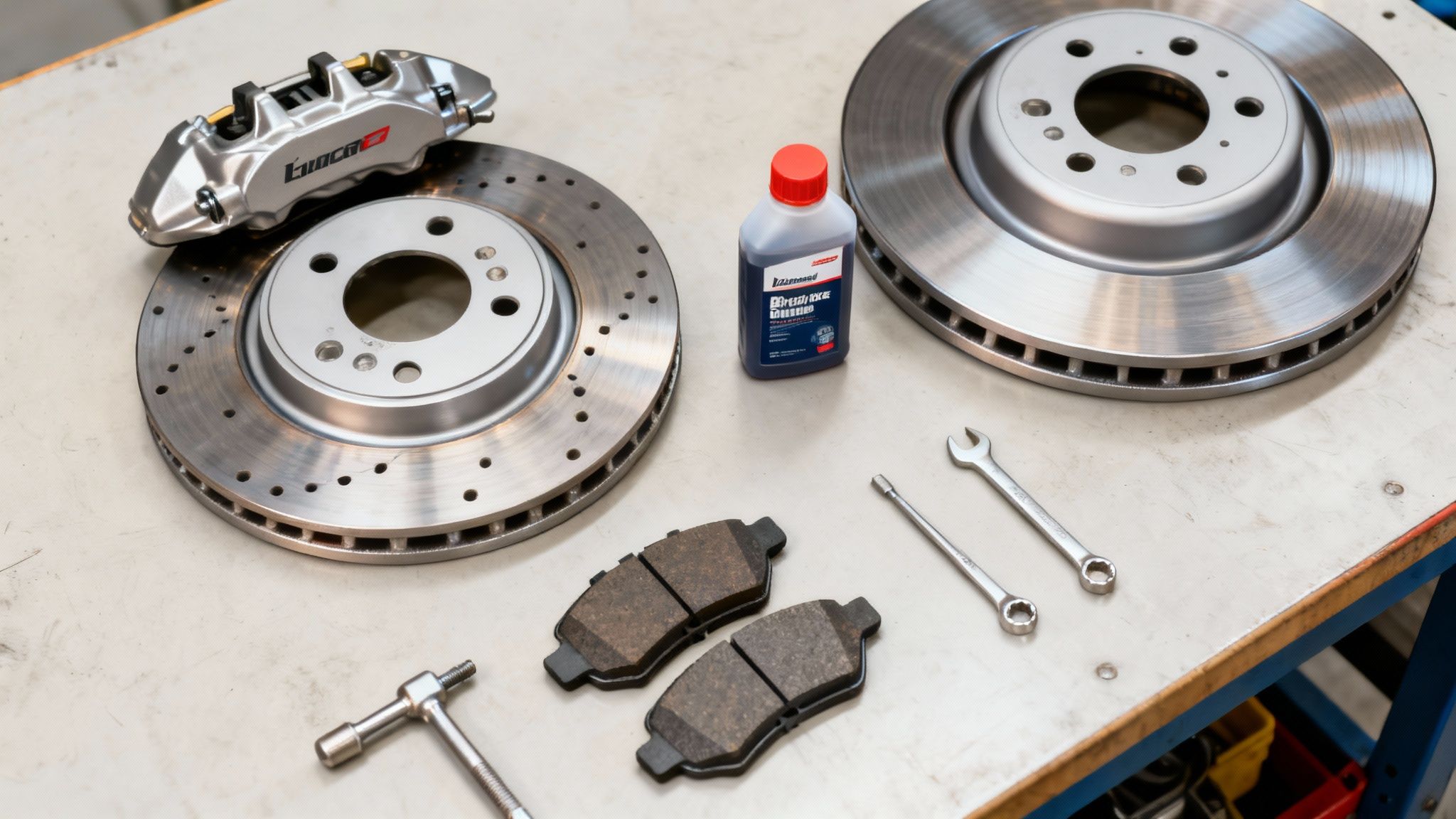
The Core Components and Their Roles
Your car's brake system has four main players. When you need brake repair in Whitby, it's almost always one of these parts that needs a bit of attention.
- Brake Pads: These are the tough, friction-generating surfaces. In our bike analogy, they're the little rubber blocks. Made of high-friction materials, their whole job is to press against the rotors and create the friction that stops your car.
- Brake Rotors: These are the big metal discs you can sometimes spot behind your wheels. They're the equivalent of the bike's wheel rim. The pads squeeze against these rotors, and that's what physically slows your wheels down.
- Brake Calipers: Think of the caliper as the hydraulic clamp that holds the brake pads. When you hit the brakes, fluid pressure forces pistons inside the caliper to squeeze the pads against the rotor. It's the "hand" doing all the work.
- Brake Fluid: This is the lifeblood of the whole operation. It’s a special hydraulic fluid that transmits the force from your foot on the pedal all the way to the calipers. Because it doesn't compress, it can transfer that force instantly and powerfully.
Over time, brake fluid can absorb moisture from the air, which is bad news. It lowers the fluid's boiling point, leading to a "spongy" or soft brake pedal. Worse, that moisture causes corrosion from the inside out, which is why changing the fluid regularly is so critical for safety.
Once you see how these parts rely on each other, it's easy to understand why keeping them in top shape is absolutely essential for staying safe on Whitby's roads.
Why Different Vehicles Have Different Brake Needs
Not all brakes are built the same, because not all vehicles are the same. A hefty pickup truck or a family SUV needs a lot more stopping power than a small hatchback. That’s why car manufacturers design braking systems specifically for a vehicle's weight, size, and what it’s built to do.
A high-performance car, for example, is going to generate a massive amount of heat when braking hard. It needs special rotors and pads that won't fade or fail under those extreme temperatures. On the other hand, an SUV doing the daily grind in stop-and-go traffic on Taunton Road needs brakes designed for durability and consistent performance.
Our guide on how often brake fluid should be changed dives deeper into how your specific vehicle and driving style affect maintenance. This kind of tailored approach is key to making sure your vehicle has the exact stopping power it needs, when it needs it most.
Our Professional Brake Service Process at Carmedics Autowerks
When you bring your vehicle to Carmedics Autowerks for a brake repair in Whitby, you’re getting more than just new parts. We follow a careful, transparent process from start to finish to guarantee your safety and give you total confidence on the road. We want you to know exactly what’s happening with your car every step of the way.
It all starts with a detailed, multi-point inspection. This isn’t just a quick peek; we do a deep dive into the health of your entire braking system. Our certified technicians don’t believe in guesswork.
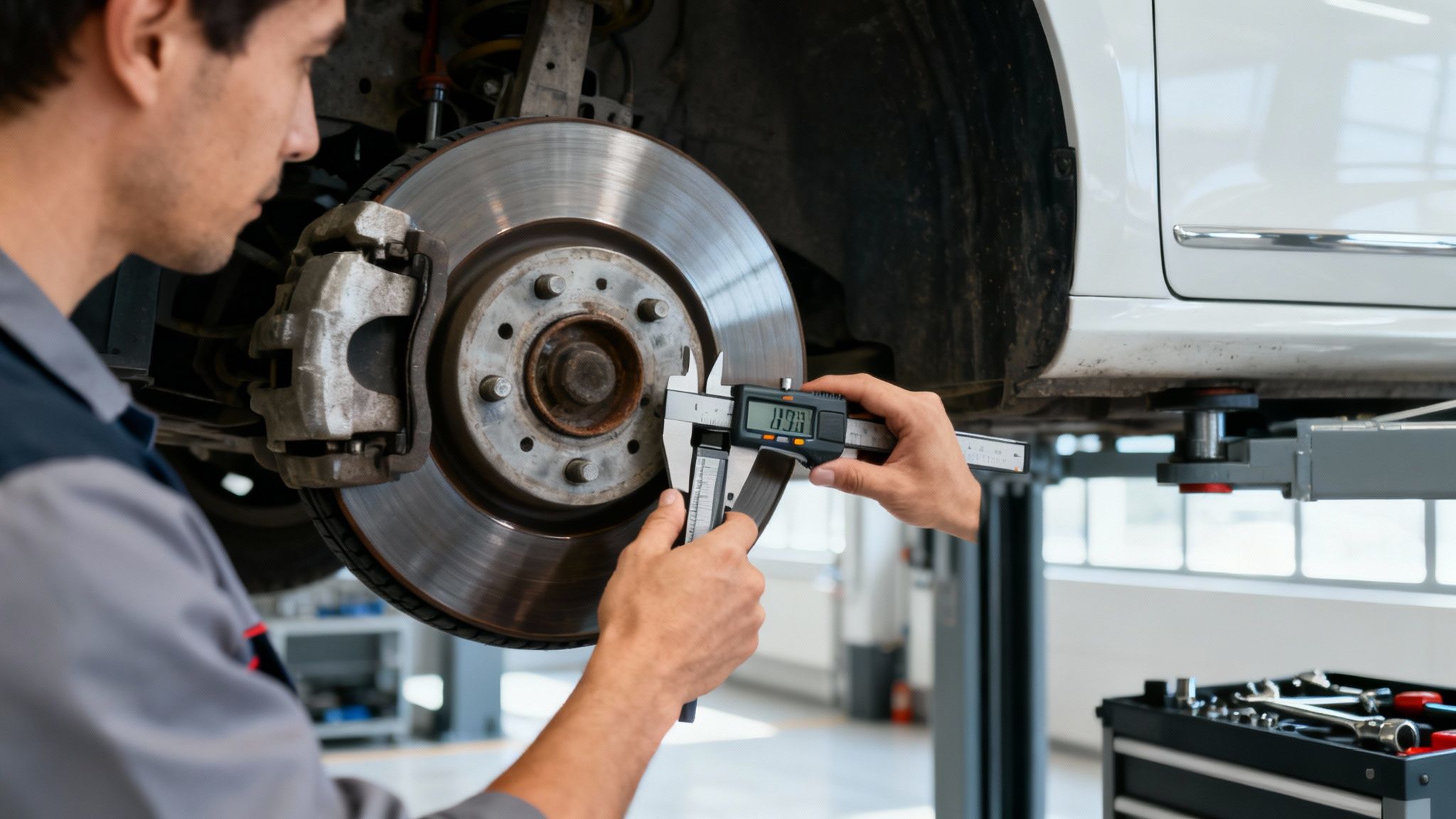
We use precision tools, like digital calipers and micrometres, to get exact measurements of your brake pads and rotors. This tells us precisely how much life they have left—right down to the millimetre.
Diagnosis and Consultation
Once we have all the data, we can accurately diagnose the root cause of any issue you’re feeling. A spongy pedal, for instance, isn't just a weird feeling; it points directly to a problem in the hydraulic system. That annoying vibration you feel when braking? It’s a classic sign of warped rotors. We pinpoint the "why" behind the problem, not just the symptom.
This is where we bring you into the loop. We’ll walk you through everything we found, explaining it in plain English. You’ll see the measurements, understand the diagnosis, and get a clear picture of your options.
We’ll talk about different paths forward, which might include:
- OEM (Original Equipment Manufacturer) Parts: These are the exact same parts your vehicle had when it rolled off the assembly line, guaranteeing a perfect fit and factory performance.
- High-Performance Upgrades: If you're an enthusiast or just tough on your brakes, we can install upgraded pads and rotors that offer better stopping power and handle heat more effectively.
We believe an informed driver is a safe driver. Our goal is simple: give you all the information you need to make the right choice for your car and your budget, with absolutely no pressure.
Our Commitment to Quality Craftsmanship
After you give us the go-ahead, our technicians get to work with a sharp focus on precision. Every single component is installed to meet or even exceed the manufacturer's standards. This includes properly cleaning and lubricating all contact points and hardware, which is key to preventing future squeaks and ensuring everything moves smoothly.
One of the most crucial final steps is torquing the wheel lug nuts to the exact factory specification. We use a calibrated torque wrench for this—no guesswork with an impact gun. This simple step is vital for preventing your new rotors from warping and making sure your wheels are on securely. Over-tightening is a common mistake that can cause expensive damage.
Finally, no brake job is truly finished without a thorough road test. One of our technicians will take your car for a drive to make sure the brakes feel firm, responsive, and quiet. We double-check that the car stops straight and true, so you can have complete peace of mind when you get back behind the wheel. That’s what a professional brake service is all about.
What to Expect for Brake Repair Costs in Whitby
Let’s get right to it. The first question on everyone's mind is, "How much is this going to set me back?" We get it, and we believe in being completely upfront about costs. When it comes to professional brake repair in Whitby, it helps to see it as an investment in your safety, not just another bill.
The final price depends on a few key things. First, your vehicle's make and model matter a lot. A heavy-duty truck or a high-performance car with specialized brakes will naturally have higher service costs than a standard family sedan. The level of wear and tear is also a big factor—swapping out just the brake pads is a much different job than a complete overhaul of pads, rotors, and calipers.
Understanding the Cost Breakdown
So, what are you actually paying for? The total cost of any brake repair is a mix of two main things: the parts themselves and the skilled labour required to install them correctly.
This is where you have some choices to make. For parts, you can go with budget-friendly aftermarket options or choose premium OEM (Original Equipment Manufacturer) components. Aftermarket parts can certainly save you some money upfront, but OEM parts are engineered to be a perfect match for your vehicle, ensuring the performance and fit the factory intended. We can walk you through the pros and cons of each to help you decide what’s right for your car and your budget. You can dig deeper into this topic in our guide to OEM vs. aftermarket parts.
Your vehicle's braking system is its most critical safety feature. Opting for the cheapest parts available can compromise stopping distance and reliability, turning a small saving into a significant risk on the road.
Here in Ontario, a standard front brake pad and rotor replacement on a typical car usually falls into a predictable range. Based on local data, you can expect a quote between $350 and $600 per axle from an independent shop. If you drive an SUV, a luxury vehicle, or a performance model, that figure could be 15–30% higher due to more complex and expensive parts. And remember, Ontario’s 13% HST will be added to the final total.
Typical Service Timelines
We know you’re busy and need your car back on the road. For a straightforward brake pad and rotor replacement on a single axle (just the front or just the back), you can generally expect the job to take between 1.5 to 2.5 hours.
If the work is more extensive—like replacing pads and rotors on all four wheels or dealing with a seized caliper—the timeline will be a bit longer. In those situations, the service might take 3 to 4 hours. We always give you a clear time estimate after our initial inspection so there are no surprises and you can plan your day.
How Proactive Maintenance Protects Your Brakes
The best kind of brake repair in Whitby is the one you never have to do. A little proactive care goes a long way in extending the life of your brake system, saving you money on major repairs down the road, and giving you total confidence every time you get behind the wheel.
It's all about thinking ahead. Instead of waiting for that awful squealing or grinding noise, regular checks can catch small issues before they snowball into big, expensive problems. Even simple habits can make a huge difference.
For instance, just being mindful of how you brake in heavy traffic on roads like Taunton or Thickson can help. Smooth, gradual stops generate less intense heat and friction, which is exactly what wears down brake pads and rotors. This small change in driving style can add significant life to your brake components.
Essential Maintenance for Whitby Drivers
Living in Ontario means our cars face unique challenges. The humidity and road salt we deal with every year are particularly tough on braking systems, which is why a few key maintenance tasks are so important.
One of the most critical steps is a regular brake fluid change. Brake fluid is "hygroscopic," which is just a fancy way of saying it loves to absorb moisture right out of the air. Over time, that water content can cause rust and corrosion from the inside out.
A professional brake fluid flush every two to three years is a small investment that protects the expensive parts of your hydraulic system, like calipers and master cylinders, from internal failure. It’s a simple service that ensures you have solid stopping power when you need it most.
Spotting Problems Before They Start
The easiest way to stay on top of brake wear is to have them looked at by a professional regularly. When you bring your vehicle in for service at Carmedics Autowerks, our technicians will measure your brake pads and rotors, check for any fluid leaks, and make sure all the hardware is in good shape.
This allows us to spot things like thinning pads or the early signs of a warped rotor long before you’d ever notice a change in performance. Our complete guide on preventive maintenance for vehicles shows how these checks are part of a smart overall strategy for keeping your car healthy.
Don't wait for a warning light to tell you something's wrong. Schedule a professional brake inspection with Carmedics Autowerks today and drive with the peace of mind that comes from knowing your car's most important safety system is in expert hands.
Got Questions About Brake Repair? We’ve Got Answers.
Even after laying it all out, you might still have a few questions buzzing around. That's perfectly normal. Here are some of the things we hear most often from drivers here in Whitby, along with some straight-to-the-point answers.
How Often Should I Get My Brakes Checked?
A good rule of thumb is to have your brakes professionally inspected at least once a year or every 20,000 kilometres. That said, if your daily commute involves a lot of stop-and-go traffic or you start hearing strange noises, don't wait. A quick look-over can spot a small issue before it turns into a big, expensive headache.
Is It Safe to Drive if My Brake Warning Light Is On?
Absolutely not. That little red light on your dash isn't a suggestion—it's a serious warning. It means there’s a problem with the hydraulic system, like low fluid or a pressure leak. The safest thing to do is pull over as soon as you can and call for a tow. Driving with that light on is a gamble you don't want to take.
Think of the brake light on your dashboard as your car’s emergency signal. It points to a critical failure that could prevent you from stopping when you need to most, and it means you need immediate brake repair in Whitby.
My New Brakes Are Squeaking. Is That Normal?
Sometimes, yes. A bit of a squeak from brand-new pads is often just part of the "bedding-in" process. It's the sound of the new pads getting acquainted with the rotors, creating a perfect friction surface. This usually goes away after a few hundred kilometres. But if the noise is loud, grinding, or just won't quit after a week, bring it back in. It could be a sign of a problem with the installation or hardware.
When you need a brake inspection you can count on, our team at Carmedics Autowerks Inc. is ready to help. We'll make sure your vehicle is safe and sound for every trip around Whitby. Schedule your visit today at https://www.carmedicsautowerks.com.com and drive with confidence.