

When you're searching for "auto remote starter installers near me," you're really looking for a trusted expert, not just a general mechanic. The smart money is on finding a specialized auto electronics shop or an authorized dealer. These pros have the specific, nuanced skills needed for a perfect installation that won’t mess with your car’s warranty.
Once you have a few names, vetting them through online reviews and confirming their experience with your specific make and model is the crucial next step.
How to Find Qualified Remote Starter Installers
Finding the right person for the job is far more important than just snagging the lowest price. A bad installation can cause a whole host of problems, from frustrating electrical glitches and a voided vehicle warranty to serious security risks. You want a technician with a proven history of working on vehicles just like yours.
Luckily, finding that expert is pretty straightforward when you know what to look for.
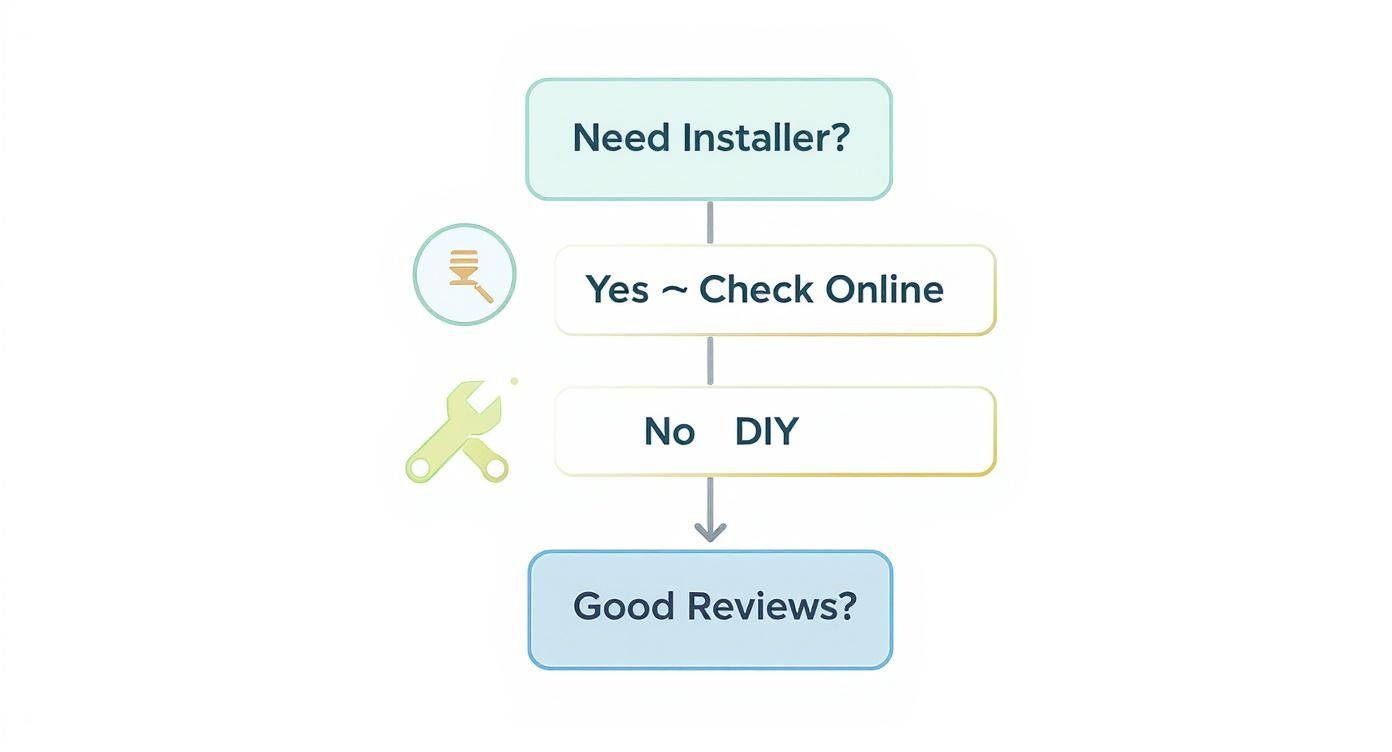
The biggest takeaway here? Real customer feedback is your best filter for finding reliable local pros.
Starting Your Search the Right Way
A great place to start is often with the manufacturers themselves. Big brands like Compustar or Viper usually have dealer locators on their websites that will point you straight to certified professionals in your area. The benefit here is that these shops are specifically trained on the products they sell and are held accountable for their work.
Another excellent route is to look for specialized automotive electronics stores. These places live and breathe complex installations like alarms, custom audio systems, and, of course, remote starters. Their technicians know the intricate wiring of modern vehicles inside and out, which gives them a huge leg up on a general repair shop that might only tackle a few of these installations a year.
When you need a specialist's touch, it always pays to go with a team that does this kind of work day in and day out, like the professionals who provide our auto repair services near you.
You have a few solid options when it comes to getting a remote starter installed. Each has its own set of pros and cons, depending on what you value most—whether it's cost, expertise, or convenience.
Quick Comparison of Installer Types
| Installer Type | Pros | Cons | Best For |
|---|---|---|---|
| Specialized Electronics Shop | High level of expertise, up-to-date training, wide product selection. | Can be more expensive than general shops. | Owners of newer or complex vehicles who want the job done right the first time. |
| Authorized Brand Dealer | Trained specifically on the brand's products, direct manufacturer support. | Limited to one brand, may not be the most cost-effective. | People who have already chosen a specific brand like Viper or Compustar. |
| General Auto Repair Shop | May offer competitive pricing, convenient if they are your regular mechanic. | Experience can be hit-or-miss, may not have specialized tools. | Simple installations on older, less complex vehicles. |
| Car Dealership | Can sometimes be bundled with a vehicle purchase, OEM-approved parts. | Often the most expensive option, may outsource the work anyway. | New car buyers who want to roll the cost into their financing. |
Ultimately, a specialized shop often provides the best balance of deep expertise and product knowledge, ensuring a reliable and safe installation for almost any vehicle.
Why Local Regulations Matter
Depending on where you live, your search might be influenced by local laws. California, for instance, has some of the strictest regulations in the country. Any company selling or installing remote starter systems there must be licensed by the DMV.
This adds a layer of consumer protection and ensures a higher standard of service and accountability. It's always a good idea to check for any similar requirements in your own province or territory to make sure you're working with a legitimate, qualified professional.
Confirming Your Vehicle's Compatibility
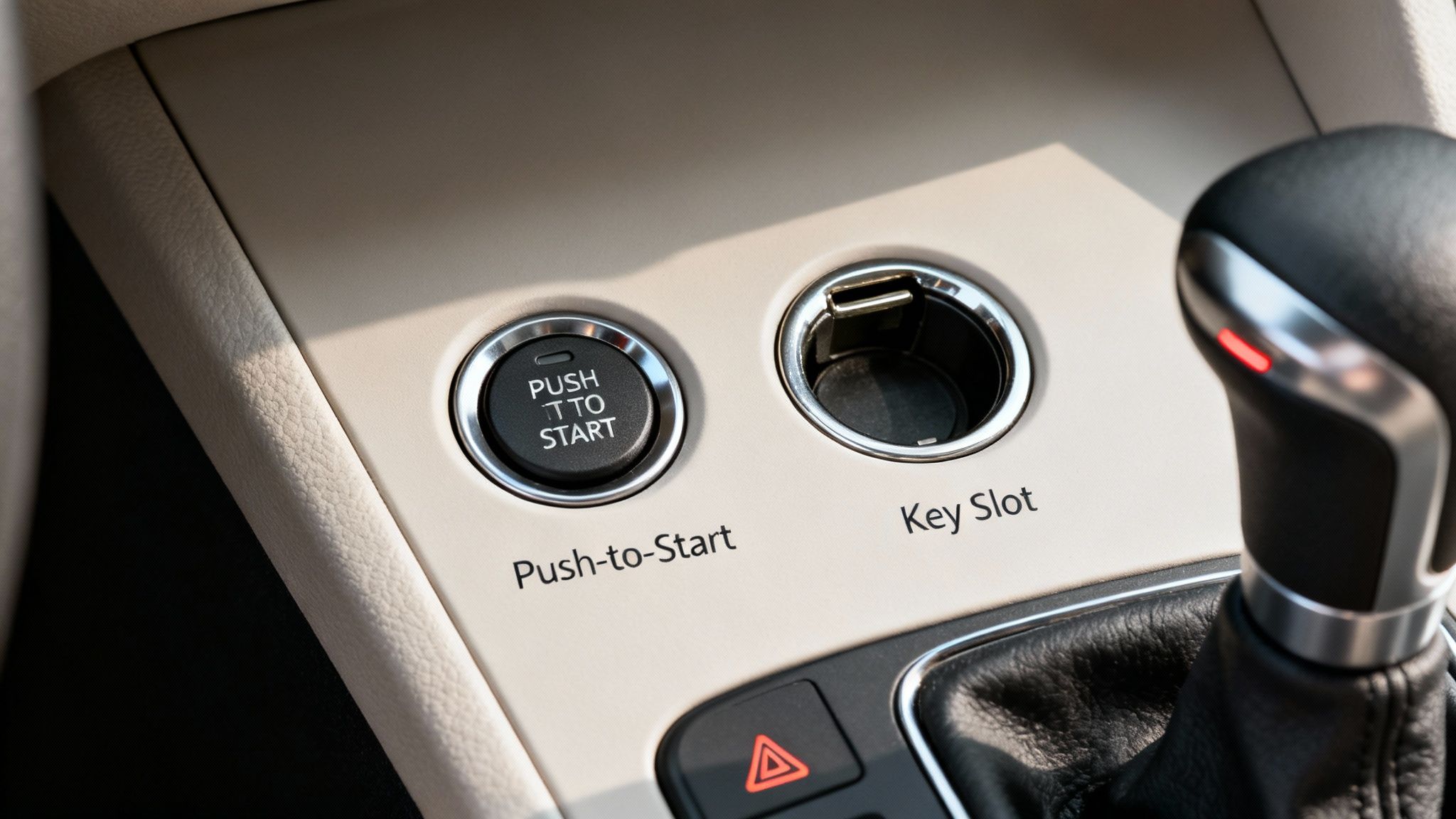
Before you even start Googling "auto remote starter installers near me," the first question you should ask is: "Will this even work with my car?" While most modern vehicles are compatible, the path to getting a remote starter installed isn't one-size-fits-all. The complexity, cost, and components can vary wildly depending on what you drive.
It all starts with your car's ignition system. A vehicle with a traditional metal key is a completely different beast than one with a push-to-start button. Those push-to-start systems are far more intricate because the remote starter has to perfectly and safely mimic the encrypted signal from your factory key fob to get the engine going.
Key Takeaway: A professional installer isn't just connecting a few wires. They’re integrating a sophisticated piece of hardware into your car's complex computer network. This takes specialized tools and vehicle-specific programming to make sure everything communicates seamlessly without creating electrical gremlins or security loopholes.
This is where you’ll hear an installer talk about a bypass module. Think of this small device as a high-tech translator. It’s programmed to speak your car's language, telling its anti-theft system that the remote start command is legitimate and not a threat. A new Audi, for example, needs a very advanced bypass module, while an older Toyota might only require a straightforward connection.
Transmission and Powertrain Differences
Your car's transmission is another huge piece of the puzzle. Automatics are pretty simple, but manuals? That's a whole other ball game.
- Manual Transmissions: These are the tricky ones. They require extra safety sensors and a specific "reservation mode." This is a sequence the driver performs before leaving the car to confirm it's in neutral with the parking brake on. It’s a critical step to prevent the car from lunging forward when you start it remotely.
- Automatic Transmissions: The installation is much more direct here. The vehicle is inherently safer because it can't be started while in drive or reverse.
On top of that, the mix of cars on the road today adds another layer. In a market like California, recent new vehicle registrations hit 944,834 units. Gasoline-powered cars accounted for 55.3% of that, but electrified vehicles—hybrids, plug-ins, and full EVs—made up a massive 42.5%. This trend just underscores why you need an installer who knows the unique wiring of both old-school and new-age powertrains. You can explore more about these automotive market trends to see just how fast things are changing.
Special Vehicle Considerations
Some vehicles just come with their own set of quirks that only a seasoned technician will know how to handle.
Take European luxury cars, for instance. A Mercedes-Benz or Porsche has an incredibly complex CAN bus network—it's like the car's central nervous system. A clumsy installation can set off a frustrating cascade of error codes.
Then you have diesel engines, which need a "glow plug delay" feature to warm up properly before starting. Hybrids are different, too; they need a system smart enough to run the climate control without necessarily firing up the gasoline engine. Knowing these little details about your own vehicle will help you ask the right questions and find an installer who truly knows their stuff.
Questions to Ask Before You Hire Anyone
https://www.youtube.com/embed/PiLX6qCK1qc
You’ve done your homework and have a shortlist of local installers. Now comes the most important part: vetting them. This is where you separate the true professionals from the rest.
Asking the right questions does more than just get you a price—it reveals an installer's expertise, their standards, and their commitment to quality. A botched installation isn't just an inconvenience; it can lead to some serious electrical headaches and might even void your vehicle’s warranty. A few smart questions upfront can save you a world of trouble down the road.
Installation Methods and Best Practices
This is where the rubber meets the road. The single most telling question you can ask is about their wiring techniques.
Lead with this: "Do you use vehicle-specific T-harnesses, or do you cut and splice the factory wires?"
A T-harness is a plug-and-play adapter designed for your specific car, which means minimal to no cutting of your vehicle's original wiring. It's the cleanest and safest way to do the job. While they aren't available for every single make and model, a top-notch installer will always use them when they can.
If they say they have to splice, that's not necessarily a deal-breaker. Your follow-up question is key: "How do you secure your spliced connections?"
Pro Tip: The only answer you want to hear is "soldering and heat-shrinking." This method creates a permanent, moisture-proof, and corrosion-resistant connection that’s as good as factory. Be very cautious if they mention using T-taps or simple crimp connectors. These are notorious for vibrating loose over time, which can cause all sorts of frustrating and hard-to-diagnose electrical gremlins.
Warranty and Post-Installation Support
A confident installer will always stand behind their work. Don't just ask "is there a warranty?" Get specific. You need to ask two separate questions here:
- What is the manufacturer's warranty on the remote starter hardware?
- What is your shop's warranty on the installation labour?
A lifetime warranty on labour is the gold standard in this industry. It’s a clear sign that the shop is confident their connections won't fail and that they'll be there for you if an installation-related issue ever pops up. An installer who only covers the part but not their own work is a huge red flag. This kind of detailed vetting when finding the best aftermarket auto parts and technicians is what guarantees you get a reliable result.
Finally, ask about their experience with your car's specific make and model. An experienced tech should be able to tell you about any quirks or special considerations for your vehicle right off the bat. It shows they've been there before. This is also a good time to mention if you're thinking about adding an anti-theft system for your car, as they should know how to integrate the two systems seamlessly.
These questions will help you find a true craftsman who takes pride in their work, not just a person who installs parts.
Understanding the True Cost of Installation
When you start searching for "auto remote starter installers near me," the quotes will start rolling in. It’s tempting to jump on the lowest price, but a cheap quote isn't always the best deal. I’ve seen it time and time again: the real cost of a remote starter installation is a sum of its parts, and understanding what you're paying for is the only way to avoid nasty surprises.
A professional quote should be clear and transparent, breaking down every component. Think of it less as a single price tag and more as a reflection of the quality of the hardware and the skill of the person doing the work.
Deconstructing the Quote: What You're Really Paying For
Every installation involves a few key cost components. Once you know what they are, you can compare quotes much more intelligently. Here’s what you should be looking for:
- The Remote Starter Kit: This is the core hardware itself. A basic, one-way system just sends a signal to your car. It’s the most affordable option. Stepping up to a two-way system costs more, but it confirms the command was received—giving you peace of mind and usually much better range. The top-tier systems even add smartphone app control, which naturally adds to the price.
- The Bypass/Interface Module: This little computer is the unsung hero of the installation. It’s the brain that lets the aftermarket remote starter talk securely to your vehicle's factory anti-theft system. The price for this can vary wildly depending on your car's complexity. A newer push-to-start vehicle will need a more advanced (and expensive) module than a ten-year-old car with a standard key.
- Labour Charges: This is where the difference between a budget job and a professional installation really shows. You’re not just paying for time; you’re paying for expertise. Experienced, certified technicians charge for their precision and the 2 to 5 hours it takes to do the job right. A suspiciously low labour cost is a huge red flag—it often means rushed work, skipped safety steps, or poor connection methods.
A lowball quote often hides its true cost in what it lacks. It might mean the installer is using cheap T-taps instead of soldering connections, skipping protective wire looming, or using a generic, less reliable bypass module. These shortcuts save them time and money upfront but can cost you a fortune in electrical repairs down the road.
To give you a clearer picture, here’s a sample breakdown of what you might see in a detailed quote.
Sample Remote Starter Installation Cost Breakdown
| Cost Component | Typical Price Range (USD) | Description |
|---|---|---|
| Remote Starter Kit | $100 – $400+ | Varies based on one-way, two-way, or smartphone control features and brand quality. |
| Bypass/Interface Module | $80 – $250 | Depends entirely on the vehicle's make, model, year, and anti-theft system complexity. |
| Labour | $200 – $500 | Based on 2-5 hours of work. Higher costs reflect certified technicians and complex vehicles. |
| Shop Supplies | $15 – $30 | Covers essentials like solder, tape, wire loom, zip ties, and other consumables. |
| T-Harness (if applicable) | $50 – $150 | A vehicle-specific harness that reduces wire splicing. Not available for all cars. |
This table illustrates how different elements contribute to the final price. A quality installer will have no problem explaining each line item to you.
Scenario: The Budget Quote vs. The Professional Quote
Let's put this into a real-world context. Imagine you get two quotes to install a remote starter on your push-to-start SUV. One is for $350, the other for $600.
The $350 quote is tempting, but a closer look reveals why it’s so low. The installer is using a basic one-way remote with very limited range. They plan to cut and splice wires using quick, unreliable connectors because it’s faster. There’s no mention of a vehicle-specific T-harness, which would be the proper way to do it.
The $600 quote, however, includes a two-way system with a one-mile range and a top-tier bypass module programmed specifically for your SUV. Crucially, it comes with a lifetime warranty on the installation labour. The technician explicitly states they will use soldered connections for maximum reliability. This is a vital distinction, as the quality of the work and the components matters immensely. Learning more about the difference between OEM versus aftermarket parts can really open your eyes to why quality is worth paying for.
In the end, the professional quote isn't just higher; it represents a more reliable, secure, and durable installation. That cheaper job? It risks intermittent failures and could even damage your car’s sensitive electronics, turning a small saving into a massive future expense. Investing in quality from the start ensures your remote starter is a convenience, not a liability.
What to Expect on Installation Day
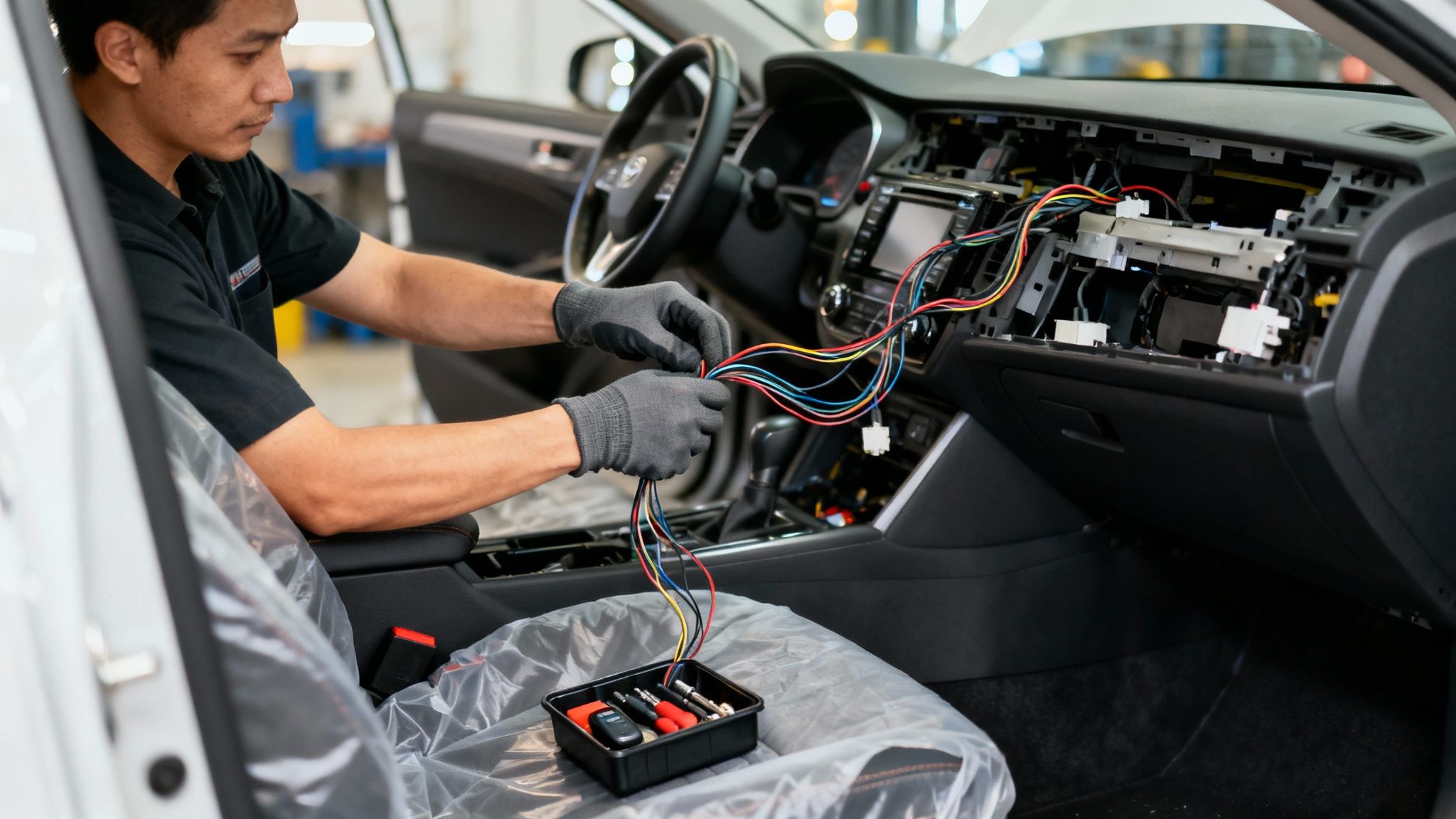
Handing over your keys can be a little stressful, especially when a technician is about to dive into your car's complex electrical system. Knowing what a proper, professional installation looks like can really set your mind at ease. A quality job isn't a 30-minute rush; it's a methodical and careful process that takes hours, and understanding the steps helps you appreciate the skill involved.
The moment you drop off your vehicle, a good technician’s first move is to protect your car. They’ll cover your seats, lay down floor mats, and often cover the steering wheel. This isn’t just a nice gesture—it’s the mark of a true professional who respects your property.
Getting to Your Vehicle's Brain
With the interior protected, the technician starts the careful process of disassembly. This usually means removing certain dashboard panels and trim to get to the main wiring hubs, like the ignition harness and the Body Control Module (BCM). This is where experience really shows. A pro knows exactly which clips to release and which screws to turn, preventing any nicks, scratches, or broken plastic.
Now for the main event: integrating the new remote starter module with your car’s factory systems.
- Rock-Solid Connections: Whenever possible, an installer will use vehicle-specific T-harnesses for clean, plug-and-play connections. If a wire must be spliced, every connection is meticulously soldered and then protected with heat-shrink tubing. This creates a permanent, corrosion-proof bond that's as good as—or better than—the factory wiring.
- Tidy Wire Management: All new wiring is carefully routed alongside the existing factory harnesses and secured with zip ties. This simple step is critical for preventing rattles, chafing, and interference with moving parts like the steering column or pedals. A messy "rat's nest" of wires is a major red flag and the signature of a rushed, amateur job.
The goal of a professional auto remote starter installer is for their work to look like it came from the factory. The integration should be so clean that, unless you knew exactly where to look, you'd never know anything was added.
Programming and The Final Walk-Through
Once the hardware is buttoned up and all the panels are snapped back into place, the job moves to the programming and testing phase. The technician connects the remote starter module to a computer and loads the specific firmware for your vehicle's make and model. This is a crucial step that ensures the new system speaks the same language as your car's computer, properly interpreting commands and monitoring all safety interlocks.
Finally, they run the whole system through its paces. They’ll test every single function: remote start, shutdown, door locks, trunk release, and any other features you’ve added. They also confirm that all the original factory systems—like your lights, horn, and security indicators—work exactly as they should.
The job isn’t done until they hand you the keys and give you a full demonstration. They’ll show you how to use your new remote and answer any questions you have. This attention to detail from start to finish is what separates the experts at Carmedics Autowerks from the rest.
Post-Installation Care and Troubleshooting
Alright, so the installation is done, and you're enjoying that first taste of starting your car from the comfort of your home. It's a great feeling, but your relationship with the installer shouldn't end the moment you drive off the lot. A bit of know-how will keep your remote starter working flawlessly for years.
This is where a quality shop like Carmedics Autowerks really shows its value. A professional job should come with two key guarantees. You’ll have the manufacturer’s warranty on the hardware itself, which is standard. But what you really want to see is a lifetime warranty on the installation labour. That’s the shop standing behind their own work—the wiring, the connections, everything. It’s your peace of mind.
A Few Quick Troubleshooting Tips
Before you pick up the phone and head back to the shop, there are a handful of common, easy-to-fix issues that might pop up. More often than not, it’s something simple.
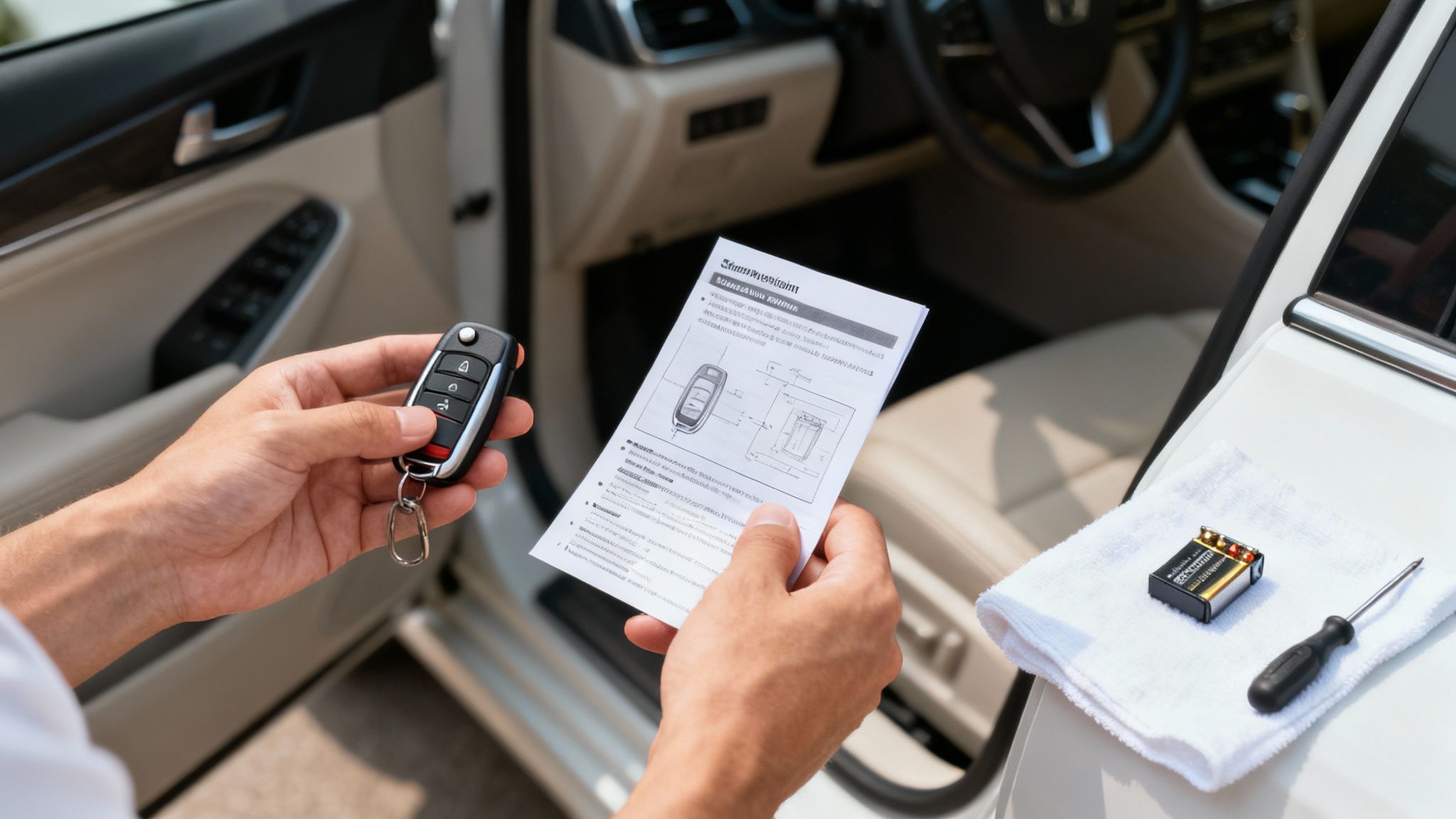
- Dead Fob Battery? This is, by far, the most common reason a remote starter suddenly stops working or loses range. Most fobs take a simple coin battery you can swap out in a minute.
- Is It in Valet Mode? This feature disables the remote start for when your car is being serviced. Sometimes it gets activated by accident. Your user manual will show you the specific button sequence to turn it off.
- Are All the Doors Actually Closed? As a safety feature, the system won't start if the hood, trunk, or any door is ajar. Give them all a firm push to make sure they're latched properly.
A professional installation is built for reliability. If you’ve run through these checks and it’s still not working, that’s when it’s time to call the experts who put it in. Don't start pulling on wires yourself—let them diagnose it safely.
Long-Term Care and Working with Other Mechanics
Keeping your remote starter in top shape is less about maintenance and more about communication.
Anytime you take your car to another mechanic for an oil change, tire rotation, or any other service, make it a habit to tell them, "Just so you know, it has an aftermarket remote starter."
They should immediately put the system into valet mode before popping the hood or putting it on a lift. It's a critical safety step that prevents the engine from starting unexpectedly while they're working. This simple heads-up protects the technician and ensures your starter system stays in perfect condition.
Still Have Questions? We’ve Got Answers
It’s completely normal to have a few lingering questions before you commit to an installation. After all, you want to be sure you're making the right call for your vehicle. Here are a few of the most common queries we get from drivers just like you.
Will a Remote Starter Void My Car’s Warranty?
This is probably the biggest concern we hear, and the answer is a clear no—as long as the installation is done professionally. Consumer protection laws ensure that adding an aftermarket product doesn't automatically void your factory warranty.
The crucial part is the quality of the installation. If a shoddy job causes an electrical issue, the dealership might not cover that specific repair. That’s precisely why going with a certified, experienced installer isn't just a good idea; it’s your best protection.
How Long Does a Proper Installation Actually Take?
A quality, professional installation isn't a rush job. You should expect it to take anywhere from 2 to 5 hours, depending on the make and model of your vehicle. Modern cars have incredibly complex wiring, and a technician needs time to do the job right.
If a shop quotes you an hour, that should be a major red flag. Cutting corners to save time is a recipe for future electrical headaches.
Is a Two-Way Remote Really Worth the Extra Cost?
In our experience, absolutely. A standard one-way remote sends a signal to your car, and you just have to hope it worked.
A two-way system, on the other hand, gives you confirmation. Your remote will light up, beep, or vibrate to let you know your car is running. They also offer a significantly longer range, which is a game-changer on those frigid winter mornings when your car is parked down the street.
For an installation that’s done right the first time, trust the experts at Carmedics autowerks inc. Get in touch with us today for a professional consultation