


It's that moment every driver dreads: you're expecting a blast of cold air on a humid Ontario day, and instead, you get a puff of warm, stuffy air. Your car's air conditioning isn't just about luxury; it's a critical part of your comfort and safety behind the wheel.
This guide will demystify your vehicle's complex AC system, breaking it down into simple, easy-to-understand terms.
Your Guide to a Cooler, More Comfortable Drive

When your car's AC starts to fail, it affects more than just your comfort level. A sweltering cabin can mess with your focus on the road, and a faulty system can’t properly defog your windows in tricky weather. Many drivers in Whitby and across Durham Region assume an AC failure is a sudden catastrophe, but it's usually the final result of small, overlooked issues that have been building up for a while.
Think of this guide as your roadmap to understanding what's happening under the hood to keep your car cool. We'll explore the subtle warning signs your AC system gives you long before it quits entirely. It’s like learning your vehicle's language—catching a faint hiss or noticing weaker airflow early on can save you from a major, expensive repair down the road.
Why Proactive AC Care Matters
Treating your vehicle's climate control system with a bit of proactive care is a smart move. It's not just about dodging discomfort during a summer heatwave; it's about preserving the function and value of a surprisingly complex system.
A professional air conditioning service auto check-up is much more than a simple refrigerant top-off. It's a detailed inspection to ensure every single component, from the hardworking compressor to the tiniest seals, is in peak condition.
A well-maintained air conditioning system isn't just a feature; it's a critical component for driver alertness and vehicle longevity. Ignoring early signs can turn a simple fix into a system-wide failure.
The need for reliable automotive HVAC care is clearly growing. In fact, the national HVAC maintenance services market hit USD 1,708.9 million in 2024 and is expected to keep climbing. For drivers in Whitby, this trend just underscores how important it is to maintain the sophisticated, sensor-driven systems in modern vehicles. You can dig into more data on the Canadian automotive HVAC market to see how things are evolving.
Here at Carmedics Autowerks, we want to be your trusted local guide. We'll walk you through exactly what a professional service involves, what to expect for costs, and some simple maintenance tips to keep your AC running cold.
Identifying Early Warning Signs of AC Trouble
Your car’s air conditioning rarely just quits on you out of the blue. Long before it starts pumping warm air on a sweltering July afternoon, it usually sends out little hints that something’s wrong. Learning to spot these early warnings lets you get an air conditioning service auto check-up before a small issue becomes a massive, expensive headache.
Think of it as your car trying to tell you something. The most obvious sign, of course, is that the air just isn't as cold as it used to be. But the clues can be more subtle than that. Maybe you've noticed the airflow from your vents seems weak, even when you've got the fan cranked to the max. That could point to anything from a failing blower motor to a cabin air filter that’s completely choked with dust and debris.
Listening for Clues
What you feel is important, but what you hear can tell you just as much. A properly running AC system is nearly silent, but failing parts often make their presence known with some pretty distinct noises.
Keep an ear out for these tell-tale sounds:
- A Rattling or Banging Noise: This often points a finger directly at the compressor, which is the heart of the whole system. If the compressor's clutch is worn out, you'll often hear a rattling sound whenever the AC kicks in.
- A Hissing Sound: Hearing a steady hiss, especially for a bit after you've shut the engine off? That's the classic calling card of a refrigerant leak. Just like a tire with a slow leak, the pressurized refrigerant is seeping out from a crack in a hose or a bad seal.
Smells and Other Sensory Signals
Don't forget your sense of smell. If you get a musty, damp odour from the vents—like a wet basement—it’s a good sign that mould or mildew is growing on the evaporator core. It’s dark and damp in there, making it the perfect breeding ground for gunk you don't want to be breathing.
A sweet, chemical-like smell is another red flag. This could mean you have an ethylene glycol leak from your heater core, a component that’s tied into your climate control system.
Catching these things early isn't just about staying comfortable; it's a matter of safety. For drivers of newer cars or big SUVs, a dead AC can cause cabin temperatures to spike by 15-20°C, which significantly increases the risk of driver fatigue. We know that precise climate control is crucial for staying focused, especially for Whitby drivers navigating humid summer traffic. If you're curious, you can learn more about the growing demand for automotive AC market upgrades in modern vehicles.
An unusual noise or smell from your AC is more than an annoyance—it's a direct message from your vehicle that a component is failing or a leak has started. Addressing it promptly is the key to preventing a system-wide breakdown.
Sometimes, it’s hard to put your finger on exactly what’s wrong. This quick-reference table can help you match what you're sensing to what might be happening under the hood.
Common AC Problems and What They Mean
| Symptom | What It Sounds Or Feels Like | Potential Cause |
|---|---|---|
| Weak Airflow | The fan is on high, but very little air is coming out of the vents. | Clogged cabin air filter, failing blower motor, or a blockage in the system. |
| No Cold Air | The air coming out is room temperature or even warm. | Low refrigerant (leak), failed compressor, or an electrical issue. |
| Strange Noises | A rattling, banging, or squealing sound when the AC is turned on. | Worn-out compressor clutch, failing compressor, or a loose belt. |
| Musty Smell | A damp, mouldy odour coming from the vents. | Mould or mildew growth on the evaporator core. |
| Water Leaks | Puddles of water forming inside the car on the passenger side floor. | A clogged evaporator drain hose, which is causing condensation to back up. |
Remember, this table is just a guide. A professional diagnosis is the only way to know for sure what's going on and get it fixed right the first time.
What Happens During a Professional Auto AC Service
So, you've brought your car in for an air conditioning service. It can feel a bit like a mystery box—you know it's not blowing cold, but what exactly goes on behind the garage door? A proper, professional service is a careful, step-by-step process. We’re not just treating the symptom; we're hunting down the root cause of the problem.
This is a world away from just topping it off with a can of refrigerant from the auto parts store, a "fix" that often creates bigger, more expensive issues down the road. The first thing a good technician does is hook up a specialized set of gauges to your AC system's high and low-pressure service ports. Think of it like taking your car's blood pressure—it gives us an instant snapshot of the system's overall health.
The Diagnostic Deep Dive
With those initial pressure readings in hand, the real detective work begins. Our goal is to figure out why the system isn't performing. More often than not, the culprit is a refrigerant leak, and these can be surprisingly tricky to find.
To pinpoint the source, technicians rely on a couple of trusted methods:
- UV Dye Injection: We'll add a special fluorescent dye to your AC system. After you run the AC for a bit, we use a blacklight to meticulously inspect every hose, seal, and component. Any escaping dye will glow brightly, showing us exactly where the leak is.
- Electronic Leak Detection: This involves a highly sensitive "sniffer" tool that we trace along all the refrigerant lines. The device sounds an alarm when it detects refrigerant vapour, helping us zero in on even the tiniest pinhole leaks.
This diagnostic phase is absolutely critical. Just refilling a system that has a leak means you'll be right back in the shop with the same issue in a few weeks or months. Finding and fixing the leak is the only way to guarantee a lasting repair. You can learn more about the complete process of an air conditioning service for your car and see why these steps are so vital for long-term performance.
A professional AC service isn't about guesswork. It’s a systematic process of testing, recovering, and recharging that protects your vehicle's sensitive components and ensures the job is done right the first time.
Below is a quick look at some of the key indicators a technician watches for during the initial assessment.
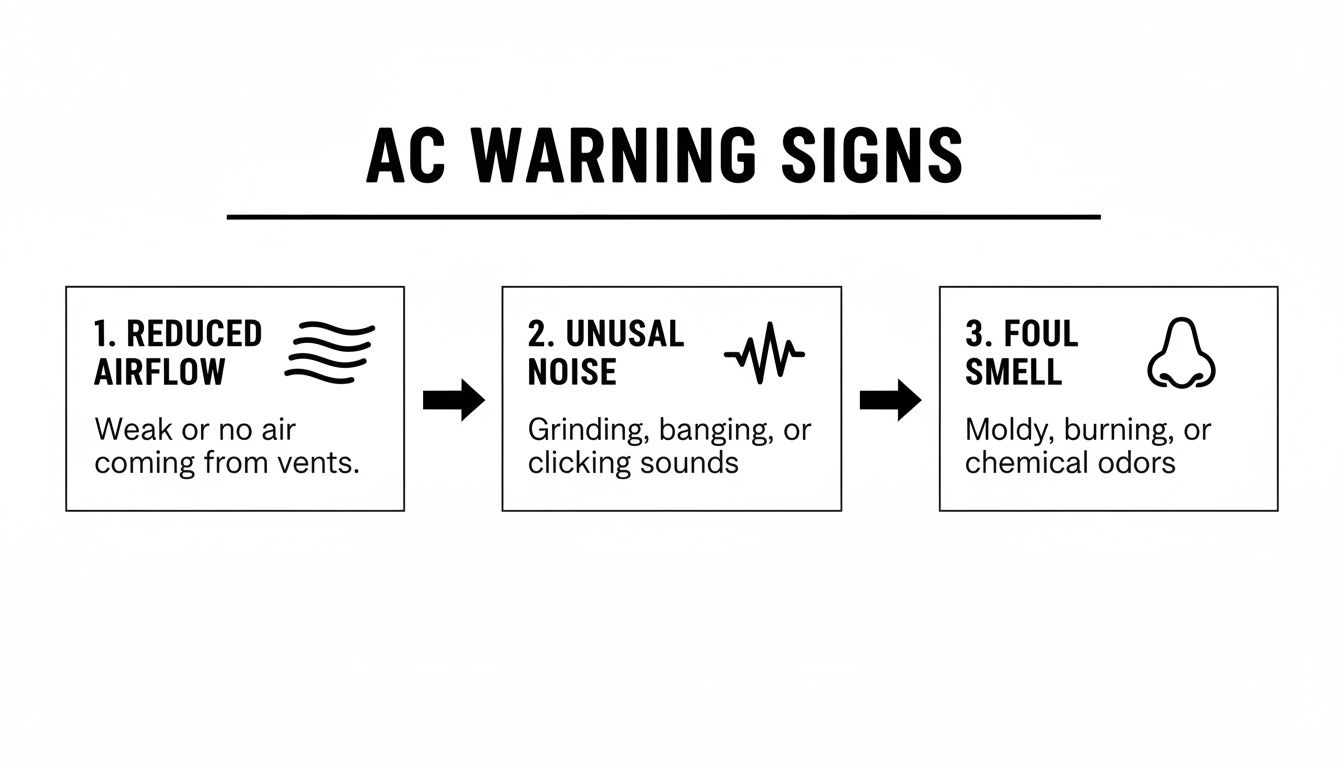
This visual shows the sensory clues we look for—weak airflow, strange noises, and funky smells—that often point directly to specific system failures.
The Recharge and Recovery Process
Once any leaks have been properly repaired, the system is ready for a "recovery and recharge" service. This is far more precise than a simple top-off. First, a special recovery machine safely removes every last bit of old refrigerant and oil from your system.
Next, that same machine pulls the entire system into a deep vacuum for at least 30 minutes. This is a non-negotiable step. It boils off any moisture that has crept into the system, which is the absolute arch-nemesis of your AC. When moisture mixes with refrigerant, it forms a corrosive acid that silently eats away at expensive components from the inside out.
Finally, with the system clean and dry, we recharge it with the exact amount of fresh, clean refrigerant and the correct type of compressor oil. This is measured precisely to the gram, according to your vehicle manufacturer’s specifications. That precision is what guarantees peak cooling performance and protects your compressor from damage, getting you back on the road feeling cool and confident.
What Goes Wrong With Car AC Systems? A Look at the Usual Suspects
Your car's air conditioning isn't a single part; it's a whole team of components working in sync. When you're stuck with warm air blowing from your vents, it usually means one of the players on that team has dropped the ball. Getting to know the key components makes it much clearer why a specific air conditioning service auto repair is necessary.
Think of the AC compressor as the heart of the whole operation. It's connected to your engine by a belt, and its sole purpose is to squeeze the refrigerant and get it flowing through the system. This part works hard, and one of its most common failure points is the magnetic clutch. After thousands of cycles, it can simply wear out and stop engaging, which means your AC won't even turn on.
From the compressor, that hot, pressurized refrigerant gas heads over to the condenser.
The Big Two: Condenser and Evaporator
The condenser is that radiator-like part you can see at the very front of your car, right in the line of fire. Its job is to let the heat escape from the refrigerant, turning it back into a liquid. Because of where it lives, it’s a magnet for road debris—bugs, leaves, and dirt can clog it up. A clogged condenser can't get rid of heat properly, and that cripples your AC's cooling power.
Next, the liquid refrigerant makes its way to the evaporator core, which is hidden deep inside your dashboard. This is where the real cooling magic happens. The refrigerant expands back into a gas, and in doing so, it absorbs all the heat from the air blowing across it. The result? That refreshingly cold air you feel from the vents. A common problem here isn't a mechanical failure but moisture buildup, which can lead to mould and mildew and that awful musty smell.
At its core, your car's AC is just moving heat from inside the cabin to the outside air. Each component plays a vital role in this heat transfer process, and a failure in any one part breaks the chain.
Knowing how these parts work together shows why you can't just guess what's wrong. For a closer look at how a technician pinpoints and fixes these issues, our guide on complete air conditioning repair for your car walks you through the entire process.
The Unsung Heroes: Expansion Valve and Receiver/Drier
A couple of other crucial parts work behind the scenes to keep everything running smoothly. The expansion valve is like a gatekeeper, carefully controlling how much refrigerant flows into the evaporator. If it gets stuck open, it can flood the evaporator; if it gets stuck closed, it starves it. Either way, you get poor cooling.
Finally, there's the receiver/drier, which acts as the system's filter and bodyguard. Its job is to absorb any moisture and trap debris that could wreck the compressor. Like any filter, it eventually gets saturated and can't do its job anymore. That’s why it’s standard practice to replace it whenever the AC system is opened up for a major repair.
Keeping these components in good shape is non-negotiable. Here in Whitby, proper vehicle maintenance is essential for everyone, from daily commuters to commercial fleets. A working AC isn't just about comfort—it protects your investment, helps the engine run more efficiently, and can even bump up your car's resale value down the road.
Simple Maintenance to Keep Your AC Running Cold
They say the best repair is the one you never have to make. That’s especially true for your car’s air conditioning. A few simple, proactive habits can save you from a major headache and a hefty repair bill down the road, and you don’t need to be a certified technician to do them.

One of the most powerful things you can do costs absolutely nothing. Make it a habit to run your AC on full blast for about ten minutes at least once a week, even during the coldest winter months. I know it sounds counterintuitive, but this simple action is vital for the system's health.
Running the AC circulates the refrigerant and the special oil mixed in with it. Think of it like a quick workout; it keeps all the seals, gaskets, and hoses lubricated, which prevents them from drying out, cracking, and causing those sneaky, slow leaks.
Keep Your Filters and Condenser Clean
Another easy but crucial task is keeping an eye on your cabin air filter. This little filter is the gatekeeper for all the air that enters your vehicle, trapping dust, pollen, and other gunk. When it gets clogged, it chokes off the airflow, forcing your AC system to work much harder to cool you down.
For most cars and trucks, changing the cabin air filter is a surprisingly simple job that only takes a few minutes. Check your owner’s manual for its location—it’s often just behind the glove box.
Your AC system can only cool the air it can pull in. A clean cabin air filter and a clear front condenser are the two most important factors for ensuring maximum airflow and cooling efficiency.
Finally, give your condenser some attention. It’s located right at the front of your vehicle, so it takes the full brunt of whatever the road throws at it.
- Clear Debris: Every so often, take a peek at the condenser and clear away any trapped leaves, bugs, or road grime.
- Gentle Cleaning: When you wash your car, a gentle spray from a garden hose is perfect for rinsing away any buildup. Just be sure to avoid using a high-pressure washer, as the force can easily bend the delicate cooling fins.
These small acts of maintenance really do add up. By keeping the system lubricated, ensuring clean airflow, and keeping the condenser clear, you are actively extending the life of your AC components. It’s the easiest way to make sure you get that blast of cold air the moment you need it, avoiding an unexpected and costly air conditioning service auto repair.
Why Whitby Drivers Trust Carmedics Autowerks for AC Service

When your car's AC starts acting up, you need a shop that does more than just guess. For an air conditioning service auto specialist here in Whitby, drivers trust Carmedics Autowerks because we treat these complex systems with the precision they require. We don't just throw parts at a problem; we find the root cause.
Our process starts with modern diagnostic equipment to get a clear, accurate picture of what’s going on. We get the unique challenges our local climate throws at vehicles—from the heavy humidity of a Durham summer that really works the compressor, to the harsh road salt in winter that can eat away at delicate condenser fins. That local insight helps us know exactly what to look for.
We also make sure you’re part of the process. We’ll show you what's wrong and walk you through the solutions in plain English, so you can make an informed decision without feeling pressured.
Local Experts Committed to Quality
Here at Carmedics Autowerks, we’re more than just technicians—we’re car people who understand that every single part needs to work just right. That passion is what drives our careful approach to every job, whether it's a simple O-ring fix or a complete compressor replacement. We treat your vehicle as if it were our own.
Trust your comfort and your vehicle’s health to a team that combines advanced technical skill with a genuine passion for automotive excellence. We deliver results, not excuses.
Our reputation in Whitby is built on one thing: providing reliable repairs that last. To see everything we do, from specialized AC work to routine maintenance, take a look at the full range of our professional auto repair services in Whitby, Ontario.
Don’t sweat through another drive. Get in touch with Carmedics Autowerks to schedule an inspection and feel the difference of working with a local team that’s truly dedicated to keeping you cool on the road.
Your Top Car AC Service Questions, Answered
When it comes to your car's climate control, a few questions always seem to pop up. Getting straight answers helps you know when it’s time for a professional air conditioning service auto check-up, saving you from future headaches and a sweltering car ride.
How Often Should I Get My Car AC Serviced?
Unlike an oil change, there isn't a strict mileage or time interval for AC service. A good rule of thumb, though, is to have the system inspected every one to two years. This proactive check lets a technician look for tiny leaks, test the compressor, and make sure your refrigerant is at the perfect level.
Think of it like a dental check-up for your car's AC. A quick, regular inspection is far less painful and expensive than waiting for a serious problem to develop.
Catching a small issue early can save you from a complete system meltdown later on.
Are Those DIY AC Recharge Kits a Good Idea?
I get it, the low price on those DIY kits is tempting. But honestly, they can be a real gamble. They only mask one symptom—low refrigerant—without ever touching the real problem, which is almost always a leak somewhere in the system.
Worse yet, it's incredibly easy to overcharge the system with one of those cans. Pumping in too much refrigerant can destroy your AC compressor, turning a small issue into a massive repair bill. Proper air conditioning service auto maintenance demands precise equipment and measurements that you just can't get from a DIY kit.
Why Does My AC Smell Like a Damp Basement?
That funky, musty odour you're smelling? That’s usually mould and bacteria having a party on the evaporator core, which is tucked away inside your dashboard. It's dark and damp in there—the perfect breeding ground for that unpleasant growth.
A professional service can safely clean out the evaporator and the entire ventilation system, which gets rid of the smell and drastically improves your cabin's air quality. Changing your cabin air filter regularly is another great way to keep that musty scent from coming back.
Don't let a faulty AC system ruin your drive. For expert diagnostics and reliable repairs right here in Whitby, you can trust the team at Carmedics Autowerks. Schedule your service today and get back to driving in comfort.