


Suspension repair is all about servicing or replacing the key parts—like shocks, struts, and springs—that give your vehicle its smooth ride, sharp handling, and crucial safety. A healthy suspension keeps your car stable and comfortable, soaking up bumps and keeping your tires glued to the road. Without it, every drive feels rough, unpredictable, and frankly, a bit of a workout.
Why Your Car's Suspension Is So Important
Ever thought about your car's suspension system? Most people don't, until something goes wrong. A great way to think about it is to compare it to an athlete's knees. Just as a runner's knees absorb the shock of every step, your suspension handles the jolts from potholes, speed bumps, and all the lovely imperfections on our roads.
This intricate network of parts is constantly working to keep your ride smooth and your car under control. When it’s doing its job right, you barely even notice it's there. But when it starts to fail, every trip becomes a jarring, uncomfortable ordeal.
The suspension's job is really a balancing act. It has two main goals: keep the tires in firm contact with the road for maximum grip, and give you and your passengers a comfortable ride. It’s all about finding that sweet spot between razor-sharp handling and a smooth, quiet cabin.
The Foundation of Control and Comfort
Your car's ability to take a corner with confidence, brake hard in an emergency, or even just accelerate smoothly is all thanks to its suspension. It's a team effort, with key players like shocks, struts, springs, and control arms all working together to manage the incredible forces at play when you're driving.
- Shocks and Struts: These are the heart of the system, acting as dampers to control bouncing and prevent that "boat-like" feeling when you turn or stop.
- Springs: These are the muscles, supporting the car's weight and absorbing the big hits from the road.
- Control Arms and Bushings: These are the joints, connecting the suspension to the car's frame and allowing the wheels to move up and down without throwing off your alignment.
A worn-out suspension isn't just about a bumpy ride; it’s a serious safety concern. Worn components can actually increase your vehicle's stopping distance by up to 20%. That could easily be the difference between a close call and a collision.
A well-maintained suspension system isn't a luxury—it is fundamental to your vehicle's stability and your safety on the road. It directly influences how your car brakes, steers, and responds in an emergency.
On top of that, your suspension is directly tied to your tire performance and lifespan. It makes sure your tires maintain the best possible contact with the pavement, giving you the grip you need in any weather. This is why understanding the relationship between your suspension and your tires, like choosing between summer and winter tires for safety and savings, is so critical for your car's overall performance.
Let's dive in and walk through everything you need to know about suspension repair, from spotting the early warning signs to understanding what we do when you bring your car into the shop.
Decoding The Bumps, Clunks, And Noises
Your car has a way of talking to you. It might not use words, but it communicates through a language of sounds and feelings. When something is off with your suspension, these messages can be anything from a subtle new vibration to a loud, unmissable clunk. Learning to translate what your car is trying to tell you is the first step in figuring out what’s wrong.
These aren't just little quirks to ignore—they're early warnings. A solid suspension is the foundation for your car's stability, its ability to brake effectively, and how it responds to your steering. Put simply, when you ignore these signs, you're not just risking a bigger repair bill down the road; you're compromising your safety.
This chart breaks it down perfectly, showing the direct link between how your car rides and how safe it is.
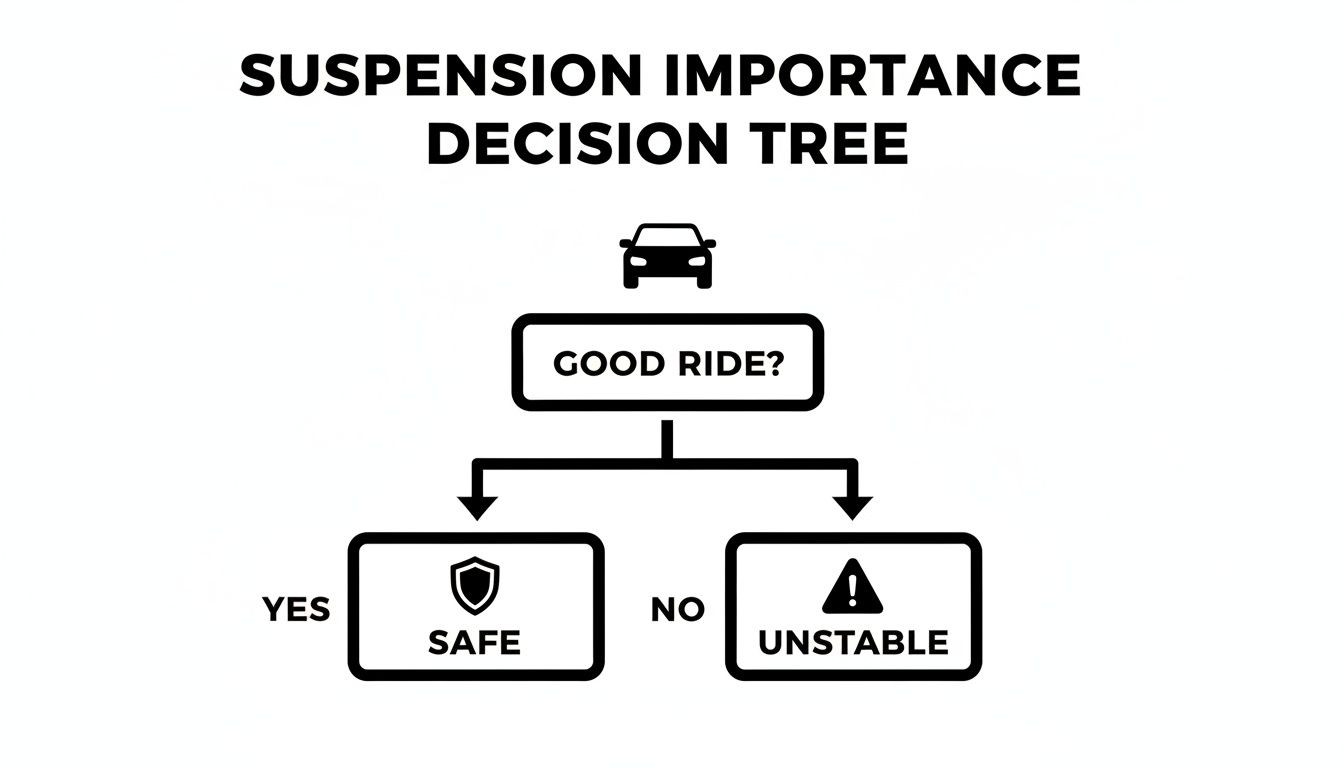
The takeaway here is simple: a bad ride isn't just about comfort. It's a clear signal that your car's stability is compromised.
To help you pinpoint the issue, here's a quick reference guide that connects common symptoms to the likely suspension problem.
Suspension Problem Symptom Checker
| Symptom You Experience | What It Feels or Sounds Like | Likely Culprit(s) |
|---|---|---|
| The Constant Bounce | Your car feels floaty, like a boat, and keeps bouncing after hitting a bump. | Worn-out shocks or struts |
| Front-End Dive or Rear Squat | The nose of your car dips hard when you brake, or the rear drops when you accelerate. | Failing shocks or struts |
| Clunking Over Bumps | You hear a sharp, metallic "clunk" or knocking sound over potholes or speed bumps. | Worn ball joints, control arm bushings, or loose tie rod ends |
| Steering Feels "Off" | The steering wheel feels loose, the car wanders, or you hear creaks when turning. | Worn tie rod ends or failing ball joints |
Let's dive a little deeper into what each of these symptoms really means for your vehicle.
The Constant Bounce
Does your car feel less like it's driving and more like it's floating on a wavy sea? If you hit a dip in the road and your car continues to bob up and down, that's a tell-tale sign of worn-out shocks or struts.
Their whole job is to control the spring's movement and keep your tires pressed firmly to the pavement. When they're shot, the springs are left to bounce around uncontrolled. This seriously affects your ability to steer and brake when you need it most.
The Front-End Dive
Next time you brake, pay close attention to the front of your car. Does it dip or "dive" forward in a really noticeable way? That’s a classic sign your front shocks or struts are too weak to handle the weight transfer. The opposite is also true—if the rear end squats down when you hit the gas, the back components are likely failing.
This kind of instability throws your car's balance off, which can actually increase how long it takes you to stop. It makes the whole car feel unpredictable, especially in a sudden braking situation. A suspension repair is the only way to get that crucial stability back.
That Unsettling Clunk Over Bumps
A sharp, metallic clunk or knock when you go over a speed bump is one of the most common complaints we hear. It’s an unmistakable sound that often means a suspension part is so worn out that there’s too much slack.
A few different parts could be the source, but the usual suspects are:
- Worn Ball Joints: These are the critical joints that let your wheels pivot and turn.
- Failing Control Arm Bushings: These rubber or polyurethane pieces are supposed to absorb road shock. When they wear out, you can get metal hitting metal.
- Loose Tie Rod Ends: These are key to your steering. When they get loose, they make a distinct clunk, especially as you start a turn.
A "clunk" is your suspension's way of shouting for help. It indicates that a component is loose or has failed, creating a direct impact between metal parts that should be cushioned and controlled.
Steering Becomes a Struggle
Your steering and suspension systems are two sides of the same coin; they work together. If your steering wheel suddenly feels loose, the car seems to wander on its own, or you hear creaking when you turn the wheel, you've got a suspension issue.
Most often, this points to worn tie rods—the parts linking your steering rack to your wheels—or failing ball joints. These aren't problems to put off. They directly affect your ability to point the car where you want it to go, and ignoring them can lead to a dangerous loss of control.
Understanding Your Car's Suspension System
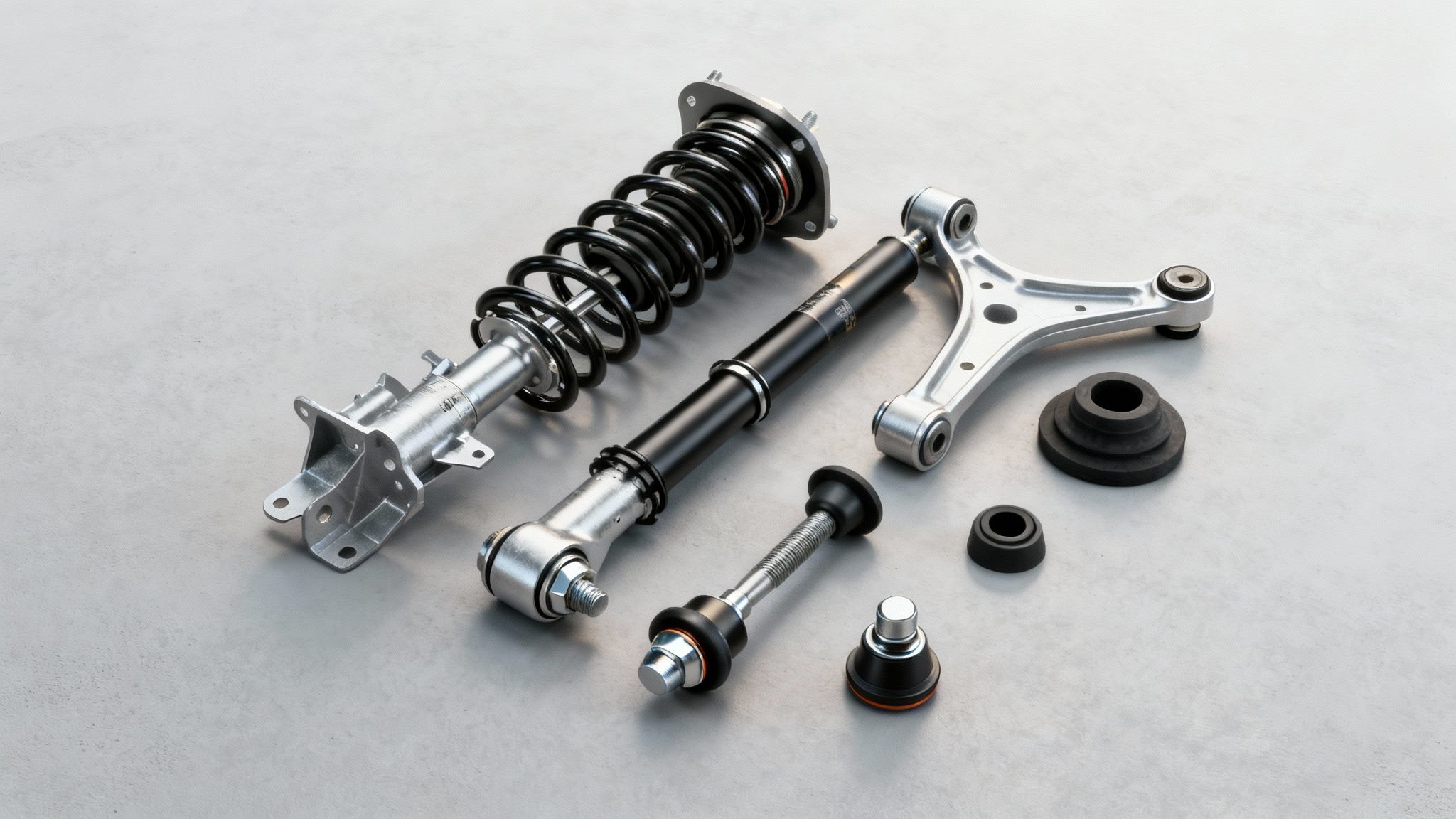
Before we can talk about fixing a car's suspension, it helps to know what’s actually going on under there. The best way to think about it is like your car's own skeleton—a whole network of interconnected parts that support the vehicle, soak up bumps, and give you control. It’s the crucial system that connects your car's body to the wheels, and it's working nonstop to keep your ride smooth and stable.
This isn't just one big part, though. It’s a team of components, from big springs to small rubber bushings, all working in harmony. When even one of these parts starts to fail, it puts more stress on everything else, which can start a domino effect of wear and tear.
Let's pull back the curtain and look at the key players. Once you understand what each one does, it becomes much easier to see why that little clunking noise or that extra bounce is a signal that your car needs a check-up.
Shocks And Struts: The Motion Controllers
These are the parts that keep your car from feeling like a pogo stick. While people often use "shocks" and "struts" to mean the same thing, they have slightly different jobs. At their core, though, both are built to control the bouncing motion of your car’s springs.
Think about what happens when you drop a basketball. It bounces over and over until it finally loses steam. That’s exactly what your car's springs would do after hitting a pothole if not for shocks and struts. They are basically hydraulic (oil-filled) pumps that take all that bouncing energy and turn it into tiny amounts of heat, keeping your tires firmly planted on the road where they belong.
The main difference? A strut is a structural part of the suspension that also houses the shock absorber, while a shock is just the dampening component itself. If your car feels like it’s "floating" down the highway or the front end dives sharply when you hit the brakes, you’re likely feeling a worn-out shock or strut.
Springs: The Heavy Lifters
If shocks and struts control the motion, the springs do the heavy lifting. Their job is to hold up the entire weight of your car and take the first big hit from bumps, potholes, and rough patches of road. You’ll usually see coil springs (the most common kind), but some trucks and older vehicles use leaf springs or torsion bars.
The main task for springs is to keep your vehicle sitting at the correct height. After years and thousands of kilometres, these tough metal springs can get tired, weaken, or even break. You’ll know this is happening if you see one corner of your car sagging or the whole vehicle sits lower than it used to. This isn't just a cosmetic problem—it throws off your wheel alignment and seriously messes with your car's handling.
Think of your suspension as a finely tuned orchestra. The springs handle the powerful, booming notes of a big bump, while the shocks and struts control the vibrations, ensuring the final sound is smooth and controlled, not chaotic.
Control Arms And Ball Joints: The Limbs And Joints
Ever wonder how your wheels can move up and down over bumps while still being securely attached to the car? That’s where control arms and ball joints come in. Control arms are the linkages that connect your wheel assembly to the car's frame, pivoting to let the wheels travel up and down smoothly.
At the ends of these arms, you'll find ball joints. They work almost exactly like the ball-and-socket joint in your shoulder, allowing the wheels to pivot for steering while simultaneously moving with the road's contours.
When a ball joint wears out, it gets loose. This is what causes that classic clunking noise when you go over bumps or a vague, "wandering" feeling in your steering wheel. This is a major safety concern; if a ball joint fails completely, the wheel can partially detach from the suspension, leading to a total loss of control.
Bushings: The Quiet Heroes
All the major suspension parts need to pivot and move, but you don't want metal grinding on metal. That's the job of the bushings—the unsung heroes of a quiet, comfortable ride. These small rubber or polyurethane pads are like the cartilage in your car's joints.
Their job is simple but absolutely essential: absorb vibration and cushion the constant movement between suspension components. You’ll find them wherever control arms meet the frame, where sway bars are mounted, and dozens of other places.
Over time, that rubber breaks down, gets brittle, and cracks. Worn-out bushings are a primary cause of squeaks, rattles, and a general feeling of looseness when you drive. A proper suspension repair always involves a careful inspection of these small but mighty parts. Replacing them can make a car’s handling feel tight and new again.
So, What's This Going to Cost Me? A Realistic Look at Suspension Repair Costs
Let's get right to it—the question on every car owner's mind: how much is this going to set me back? The honest answer is, it depends. There’s simply no one-size-fits-all price tag for suspension work.
Think of it like fixing up a house. Swapping out a leaky faucet is a quick, relatively cheap job. But if you've got major plumbing issues behind the walls, you're looking at a much bigger project and a bigger bill. Suspension repair works the same way. Replacing a single worn-out bushing won't break the bank, but a full strut and shock replacement on all four corners of a high-end SUV is a more serious investment.
My goal here isn't to give you a magic number, but to arm you with knowledge. When you understand what drives the cost, you can walk into a shop with confidence, knowing what to expect and what questions to ask.
Breaking Down the Bill: What You're Paying For
The final invoice for any suspension job really comes down to two things: the parts themselves and the skilled labour needed to install them correctly.
Here’s a breakdown of the main factors that will influence your quote:
- Your Car's Make and Model: This is a big one. Parts for a German sports sedan or a heavy-duty pickup truck are almost always going to cost more than for a common family car. The complexity of the vehicle's suspension system also plays a huge part in the labour time.
- Which Parts Need Replacing: A new pair of rear shocks is a very different job—and a different price—from replacing front control arms, tie rods, and ball joints. Every component has its own cost.
- The OEM vs. Aftermarket Choice: You'll have a choice between Original Equipment Manufacturer (OEM) parts (the same ones your car came with from the factory) and aftermarket alternatives. This decision can significantly impact the cost, and it's important to know the pros and cons. We have a detailed guide to help you decide between OEM vs. aftermarket parts.
- Labour Time and Rates: The technician's time and expertise are a major component of the final bill. More involved repairs that require specialized equipment or significant disassembly will naturally come with higher labour charges.
If your suspension issues stem from an accident, the repair bill is only part of the story. It’s also wise to understand how an accident might impact your vehicle's overall value even after repairs.
Why Skilled Labour and Precision Matter So Much
Labour isn't just about a mechanic turning wrenches; it's about precision, experience, and having the right tools—especially with today's complex vehicles. Just look at the industry trends: labour rates reflect the advanced skills now required for what used to be simpler jobs.
Consider this: after hitting one of Whitby's notorious potholes, your new car might need more than just a new strut. Modern vehicles are packed with Advanced Driver-Assistance Systems (ADAS) like lane-keep assist and automatic braking. A sharp impact can knock these sensitive systems out of alignment. Statistics show that 35.6% of repairs now require electronic calibrations, a significant jump from just 26.9% the previous year. This adds a layer of complexity and cost to many suspension jobs.
A wheel alignment isn't an optional add-on after suspension work—it's the final, non-negotiable step of a proper repair. Skipping it is like buying expensive new running shoes and not tying the laces. You're just asking for trouble and wasting money.
This is precisely why almost every major suspension repair we do at Carmedics Autowerks is finished with a wheel alignment. Once we've replaced core components like struts or control arms, the geometry of your wheels is guaranteed to be off. An alignment service brings everything back to the manufacturer's exact specifications, ensuring your wheels are perfectly straight.
This crucial final step prevents premature and uneven tire wear, makes sure your car tracks straight and true down the road, and lets you get the maximum performance and lifespan out of your brand-new parts.
Choosing Between DIY and Professional Repair

When you start noticing those tell-tale signs of a failing suspension, the big question is always: "Can I fix this myself, or should I take it to a shop?" It’s a classic dilemma. For the seasoned home mechanic, some jobs are definitely manageable. A good visual inspection for leaking shocks or cracked bushings is a perfect place to start and doesn't require much more than a good flashlight and a keen eye.
But once you start unbolting things, the world of suspension repair gets complicated—and fast. The reality is that many suspension jobs aren't just tricky; they can be downright dangerous without the right gear and know-how.
The Risks of a DIY Approach
The biggest safety hazard by far is dealing with coil springs. These heavy-duty springs are under an incredible amount of tension. To remove them safely, you absolutely need a specialized spring compressor. One slip-up, and that spring can launch with enough force to cause serious injury. It's not a risk worth taking.
Beyond the immediate danger, modern vehicles have complex, interconnected systems. What looks like a simple part swap on a YouTube video can quickly snowball into bigger problems.
- Specialized Tools: You'll quickly discover you need more than a standard socket set. Ball joint separators, bearing presses, and heavy-duty torque wrenches are often required to do the job right.
- Precision and Alignment: Suspension work is a game of millimeters. There's no room for guesswork. Every bolt needs to be tightened to exact torque specifications, and the job is never truly finished without a professional wheel alignment. Skipping that last step is a guaranteed way to destroy a new set of tires and end up with a car that handles poorly.
- No Warranty: When you do it yourself, you're on your own. If the new part is faulty or the repair doesn't fix the clunking sound, you're back to square one. You’ve lost time, money, and you still have a broken car.
The Value of a Professional Technician
Bringing your car to a professional isn't just about saving yourself a headache. It's an investment in your safety and your vehicle's longevity. A certified technician has seen it all, and that experience is priceless when it comes to diagnosing those weird, intermittent noises that a manual can't help you with.
Choosing a professional means you're not just paying for a part to be replaced. You're paying for a correct diagnosis, the right tools for the job, expertise with complex systems, and the assurance that the work is guaranteed.
This expertise has never been more critical. A recent 2025 report on the state of auto repair shows that technician shortages are a growing problem, with 31% of shops struggling to find qualified staff for suspension work. We're seeing this trend right here in Whitby, Ontario, which makes the experienced technicians at shops like Carmedics Autowerks more valuable than ever. You can read the full report on the state of auto repair to learn more.
At the end of the day, a professional service gives you the confidence that the job was done safely and correctly the first time. For drivers in Whitby who want that peace of mind, you can learn more about the best auto repair services we offer to keep your ride smooth and safe.
What to Expect From a Professional Suspension Service
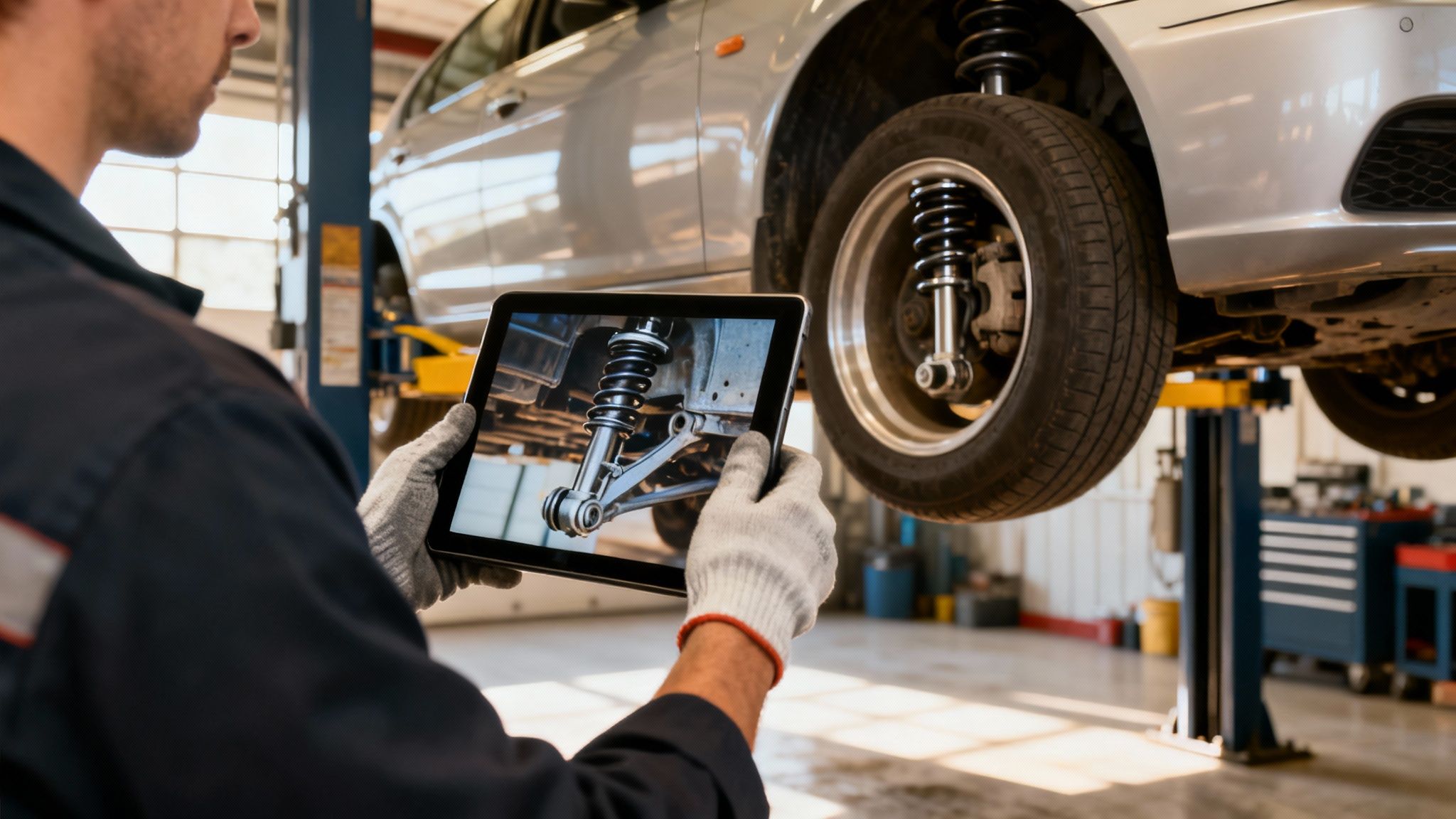
When you bring your vehicle in for a professional suspension service, you're not just paying for a part swap. You’re investing in a detailed process that blends a mechanic's hands-on experience with modern diagnostic technology. At a shop like ours, the first step isn't guesswork—it's a comprehensive digital vehicle inspection.
This isn't your old-school once-over. Our technicians use high-resolution photos and videos to document exactly what's wrong. You’ll see the cracked bushing or the leaking strut for yourself, giving you a clear picture of the situation before we even talk about repairs. This level of transparency is a big part of how the modern automotive industry is shifting to put car owners first.
Our Diagnostic and Quoting Process
After the inspection, we don't just hand you a bill. We build a detailed, easy-to-understand quote that breaks everything down. We explain why a certain component needs replacing and how it impacts your car's safety and performance.
You'll also notice we insist on using high-quality OEM or premium aftermarket parts. Why? Because a good suspension repair is only as strong as its weakest link. Going cheap on parts almost always means you'll be back in the shop sooner than you'd like, often with the same issue. We're focused on getting it right the first time with a durable fix that brings back that solid, new-car feel.
A professional suspension service is more than just replacing parts. It’s a systematic process of diagnosis, transparent communication, precision installation, and final verification to ensure your vehicle is safe, comfortable, and handles exactly as it should.
Expert Service for Today's Complex Vehicles
Modern cars are more complicated than ever. Suspension systems are now deeply integrated with electronic stability controls and advanced driver-assistance systems (ADAS). This means a suspension job requires a level of expertise that goes way beyond just turning a wrench.
Our team has the know-how to work on a huge range of vehicles, making sure every component is installed to the manufacturer’s exact specifications. But the work doesn't stop once the new parts are in. There’s one last, crucial step.
A precision wheel alignment is absolutely essential after most suspension repairs. It protects your investment by preventing uneven, premature tire wear and ensuring your vehicle tracks straight and true down the road.
It's also worth remembering that suspension damage is a common result of collisions. The market for collision-related suspension repairs is massive, projected to grow from $66.35 billion in 2025 to $78.45 billion by 2033. For Whitby drivers, even a minor fender-bender on Highway 401 can cause hidden issues like a bent control arm. With the total loss frequency for collisions reported at 22.8%, proper, high-quality repairs are vital to keeping your vehicle safe and preserving its value. This is where our expertise in both mechanical and collision repair makes us a genuine one-stop shop for getting your car back to 100%.
Your Suspension Repair Questions, Answered
When it comes to suspension repair, a little knowledge goes a long way. It helps you have a more productive conversation with your mechanic and make the right calls for your car. Here are some of the questions we get all the time from drivers here in Whitby, with some straight-up, practical answers.
Think of this as your cheat sheet for keeping your car safe and riding smoothly.
How Often Should I Get My Suspension Checked?
Generally, having a professional look at your suspension once a year or every 20,000 kilometres is a smart move. An annual inspection is the best way to spot a small issue before it turns into a big, expensive headache.
But that's just a guideline. The real answer depends on how and where you drive. If your daily commute involves navigating a minefield of potholes or gravel roads, don't wait for that yearly check-up. A hard hit can cause immediate problems. And for those who love their performance cars, getting a quick look at the suspension every time you rotate your tires is a great habit to get into.
Can I Just Replace One Shock or Strut?
I know it’s tempting to try and save a few bucks by replacing only the part that failed, but this is one corner you really shouldn't cut. Shocks and struts wear out as a team on the same axle. If one is completely gone, its partner is already on its last legs.
Changing just one creates a serious imbalance. You'll have one new, firm component and one old, worn-out one.
This mismatch throws off your car's handling, leading to wonky steering, uneven tire wear, and unpredictable behaviour when you need to brake or swerve suddenly. For your safety and your car's performance, always replace shocks and struts in pairs—either both fronts or both rears.
What's the Real Difference Between Shocks and Struts?
People often use "shocks" and "struts" like they're the same thing, but they play very different roles in your suspension system. Both are dampers that stop your car from bouncing endlessly after hitting a bump, but that's where the similarities end.
- Shocks: A shock absorber does one job: it absorbs and dampens the spring's movement. It's a separate part that doesn't hold up any of the car's weight.
- Struts: A strut, on the other hand, is a major structural part of your suspension. It’s an all-in-one assembly that includes the damper (the shock-like part), a coil spring, and the mounting hardware. Crucially, it also helps support the weight of your vehicle.
Most modern cars use what’s called a MacPherson strut on the front wheels. Knowing whether you have shocks or struts helps you understand why a strut replacement is typically a bigger, more expensive job.
Will New Suspension Parts Really Make My Ride Smoother?
Oh, absolutely. It's often the first thing people notice. As suspension parts wear out, they can no longer cushion you from bumps, cracks, and dips in the road. You start to feel every little imperfection, which makes for a rough and noisy ride.
When you put fresh, high-quality components in, you restore your car’s ability to soak up all those impacts. You'll immediately feel a smoother, quieter ride, but the benefits don't stop there. You'll also notice your car handles better, responds more quickly to steering, and just feels more stable and controlled on the road.
If any of this sounds familiar, or if you just want to get your car checked out by a pro, the team at Carmedics Autowerks is here to help. Schedule your professional suspension inspection with us today and feel the difference a properly tuned suspension makes.