

When you're searching for the best wax for black cars, you’ll find that the top performers aren't just your standard wax. They’re often sophisticated blends of synthetic polymers and specialized pigments designed to fill tiny imperfections and crank up the gloss. Brands like Meguiar's Black Wax and Turtle Wax Hybrid Solutions Ceramic Black Wax consistently come out on top because they're built from the ground up to mask swirls and leave behind a deep, wet-look finish.
Why Black Cars Need a Specialized Wax
There's nothing quite like a perfectly maintained black car. It reflects its surroundings with the clarity of a mirror, a true showstopper. But that same reflective quality is what makes it so tough to care for. Where lighter colours do a decent job of hiding minor blemishes, black paint puts every single flaw on full display.
This is exactly why a specialized wax isn't just a nice-to-have—it's essential. A regular wax might add a bit of shine, but the best wax for black cars goes much further. It’s formulated with micro-fillers and gentle polishing agents that are specifically there to hide the appearance of swirl marks and spiderwebbing, those annoying little scratches that seem to pop out in the sunlight.
These formulas are also engineered to create a deeper, richer gloss. They amplify that jet-black colour, creating a liquid-like depth that makes the paint look darker and more vibrant than you thought possible. The mission here isn't just about protection; it’s about achieving optical perfection.
The Science of Shine and Protection
A high-quality wax for black paint zeroes in on three key areas that are absolutely critical for keeping that fresh-from-the-showroom look. Grasping these will help you pick the right product for your car.
- Imperfection Masking: The secret sauce in specialized black waxes is the fine polishing oils and fillers. They temporarily fill in those microscopic scratches, which creates a perfectly smooth surface that reflects light evenly and hides flaws.
- Colour Deepening: Many of these products contain black pigments or dyes. These don't change your car's colour, but they enrich the paint's natural tone, helping to correct any slight fading and delivering that dramatic, wet-look finish.
- Enhanced UV Defence: Black surfaces absorb a lot more solar energy, which can speed up paint oxidation and fading. A dedicated wax acts as a tough barrier against harmful UV rays, preserving that deep black for longer.
The right wax can take a black car from simply clean to visually stunning. Think of it as an optical illusion in a bottle—it creates a flawless surface by filling the tiny valleys in the clear coat that our eyes see as swirls.
Economic and Protective Benefits
Investing in proper paint care is also a smart financial move. The auto detailing industry is thriving because vehicle owners understand that protection pays dividends. In California, for example, the Car Wash & Auto Detailing industry is on track to have 7,503 businesses by 2025. That growth shows just how much people value premium services to fight off intense UV rays, which can slash a black car's gloss by up to 50% in just a single year without proper care. If you're interested in the numbers, you can find more industry statistics at IBISWorld.
While here at Carmedics Autowerks, we're dealing with harsh Whitby winters instead of relentless sun, the core idea is identical. Protecting your vehicle’s finish is a key part of any solid maintenance plan. You can learn more by checking out our guide on preventive maintenance for vehicles. In the end, a well-maintained black car doesn't just look amazing—it also holds a higher resale value, making a specialized wax an indispensable tool for any owner.
Comparing Wax Formulas for a Perfect Black Finish
When you own a black car, choosing the right wax isn't just about shine—it's about making a statement. You're navigating a world of specialized formulas, each one promising that deep, flawless, mirror-like finish we all crave. The best choice really comes down to your car's paint condition, how you use your vehicle, and what you want to achieve.
The three heavy hitters in this space are natural carnauba, synthetic polymer sealants, and the newer ceramic-infused hybrids. Each brings something different to the table, and knowing the core differences is the first step to getting that perfect, liquid-black look.
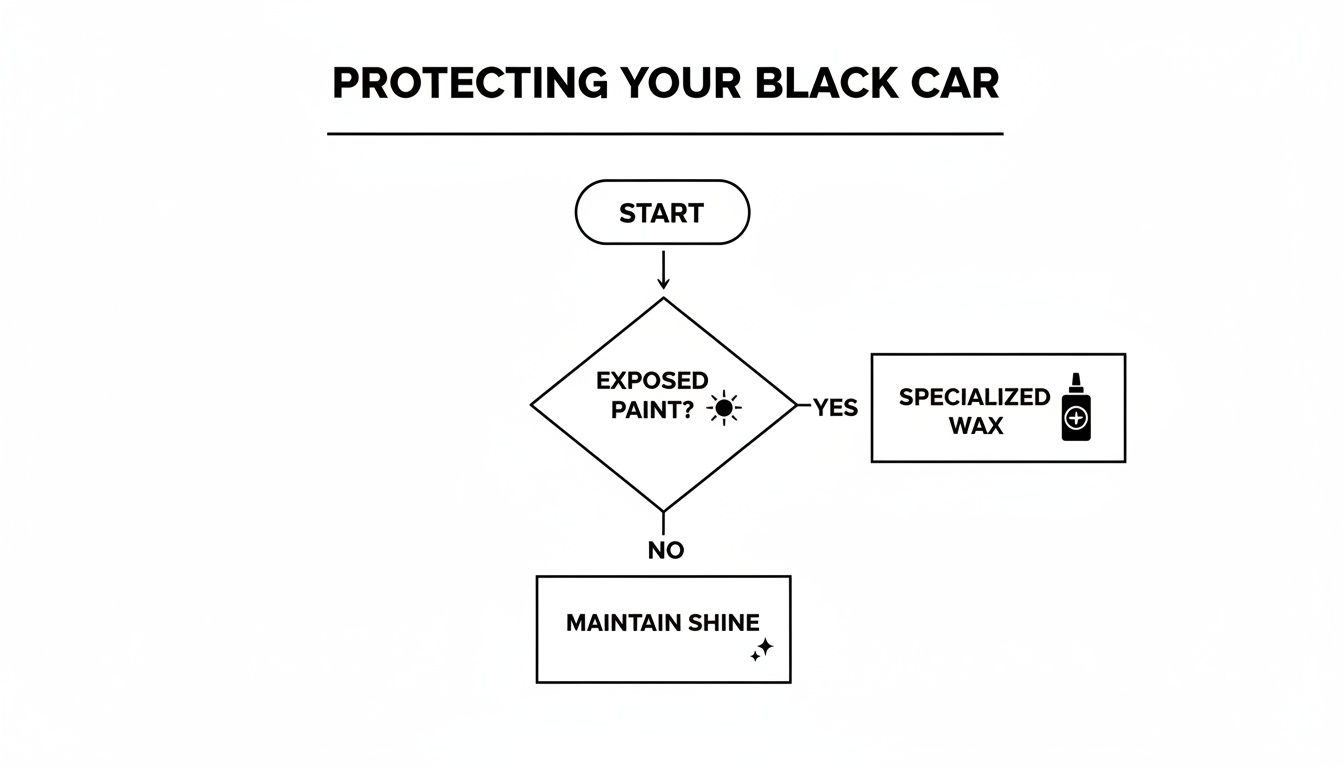
As you can see, it all starts with a proper assessment of your paint. That initial step dictates everything that follows.
Natural Carnauba Wax: The Show Car Favourite
For the purists out there who are chasing an unmatched depth and a warm, wet-looking gloss, nothing really beats a high-grade carnauba wax. Harvested from Brazilian palm tree leaves, this natural wax is prized for its ability to enrich black paint, making it look darker and more liquid than anything else. Its organic oils are brilliant at filling in the tiniest imperfections, creating an optically perfect surface that’s jaw-dropping under showroom lights.
Of course, this stunning look comes with a trade-off. Carnauba is easily the least durable option, typically lasting only six to eight weeks. It offers very little resistance to detergents and environmental grime, making it a high-maintenance choice best reserved for cherished classics or show cars that don’t see a lot of road time.
Synthetic Polymer Sealants: The Daily Driver's Defence
Now, let's step into the lab. Synthetic polymer sealants are engineered for one main purpose: longevity. Unlike carnauba, which just sits on top of the paint, these polymers form a cross-linking chemical bond with your car’s clear coat. The result is a hard, slick shell of protection.
This durable barrier provides fantastic resistance against UV rays, acid rain, road salt, and other contaminants for four to six months, sometimes even longer. While synthetic sealants give you a sharp, highly reflective shine, some enthusiasts find it a bit sterile or "plastic-like" compared to the deep glow of carnauba. For anyone with a daily-driven black car, though, that’s a small price to pay for superior, long-lasting protection.
The choice between carnauba and a synthetic sealant is the classic battle of aesthetics versus endurance. Carnauba wins on pure, rich gloss, but a sealant provides the robust, long-term armour that a black car needs to survive daily driving conditions.
Ceramic-Infused Hybrids: The Modern Solution
The newest evolution in paint protection comes from ceramic-infused hybrid waxes. These formulas brilliantly blend advanced SiO2 (silicon dioxide) technology—the same stuff in professional ceramic coatings—with easy-to-use wax or sealant applications. What you get is a product that genuinely delivers the best of both worlds.
Ceramic hybrids offer a deep, candy-like gloss that rivals carnauba while providing the kind of durability and chemical resistance you'd expect from a synthetic sealant. They also create an intensely hydrophobic surface, which makes water bead up and roll right off. This helps keep black paint looking cleaner for longer. With durability rated at six months or more, they strike the ideal balance for most black car owners today.
These innovations are also a response to changing environmental standards. For example, California's strict regulations have pushed manufacturers to create more eco-friendly formulas with fewer harsh chemicals. In fact, data shows synthetic-based waxes outperform natural ones by 45% in UV resistance, which is critical for preserving the deep colour of black paint. Whether you're dealing with salty roads in Whitby or intense sun on the West Coast, these advanced products are a smart investment. You can learn more about how these trends are shaping the industry and see why ceramic-based protection is so popular in California.
Black Car Wax Comparison: Carnauba vs. Synthetic vs. Ceramic Hybrid
To make the decision a little easier, I’ve broken down how these three formulas perform based on the criteria that matter most for a black finish.
| Feature | Carnauba Wax | Synthetic Sealant | Ceramic-Infused Wax |
|---|---|---|---|
| Gloss & Depth | Unmatched warm, wet look. Deepens colour significantly. | Sharp, sterile, mirror-like reflection. | High-gloss, candy-like shine. Excellent depth. |
| Swirl Filling | Good. Oils temporarily fill minor swirls effectively. | Fair. Can slightly mask light swirls but is not its primary function. | Very Good. SiO2 and polymers fill imperfections well. |
| Durability | Low (6-8 weeks). Breaks down with detergents. | High (4-6 months). Excellent chemical resistance. | Very High (6+ months). Superior chemical and UV resistance. |
| Application | Can be finicky; requires thin coats and proper curing. | Very easy to apply and remove. Forgiving for beginners. | Easy application, similar to sealants. Buffs off cleanly. |
| Best For | Show cars, weekend drivers, and gloss fanatics. | Daily drivers needing long-lasting, low-maintenance protection. | Enthusiasts seeking the best balance of looks and durability. |
Ultimately, the best wax for your black car is the one that fits your life. If you love the ritual of waxing your car and demand the absolute richest shine possible, carnauba is your go-to. For set-it-and-forget-it protection, a synthetic sealant is the practical choice. But for most of us, a ceramic-infused hybrid offers a nearly perfect compromise, delivering stunning looks and formidable, modern protection.
The Essential Guide to Applying Wax on Black Paint
Let's be honest: applying wax to black paint is less about the product you choose and more about the process you follow. You can have the best wax in the world, but if your technique is off, a black car will show every single mistake. Shortcuts will be amplified, turning what should be a satisfying weekend project into a frustrating mess of streaks and swirls.
But when you get it right, the result is absolutely breathtaking. With the proper technique, you can achieve that deep, swirl-free finish that makes black paint look like a pool of liquid ink. This guide breaks down the essential steps, from prep to final buff, so you can get professional-level results every time.
Step 1: Start with a Pristine Surface
Before a single drop of wax touches your car, the paint must be immaculately clean. Think of it this way: wax is designed to protect a perfect finish, not hide a dirty one. Applying wax over contaminants just traps them against the paint, which can cause scratches and ruin the shine you're working so hard to create.
The prep work has three stages, and none of them are negotiable.
- A Thorough Wash: Start with the two-bucket wash method to avoid dragging dirt back onto the paint. Use a pH-neutral car shampoo that won’t strip any existing sealants or waxes, paired with a high-quality chenille or microfibre wash mitt. This careful approach is your first line of defence against inflicting new swirl marks—the number one enemy of black paint.
- Decontamination with a Clay Bar: After washing and drying, put your hand inside a plastic sandwich bag and gently glide it over the paint. Feel that gritty texture? Those are bonded contaminants that a simple wash can't remove. A clay bar treatment is essential here to gently lift those particles, leaving the clear coat perfectly smooth and ready for what’s next.
- Paint Correction and Polishing: This is the most critical step for getting that flawless look on black paint. Using a fine-grade polish with a dual-action polisher will gently remove existing swirl marks, fine scratches, and any oxidation. If you skip this, you’re just applying wax over the imperfections, basically highlighting them for everyone to see.
Step 2: Master the Application Technique
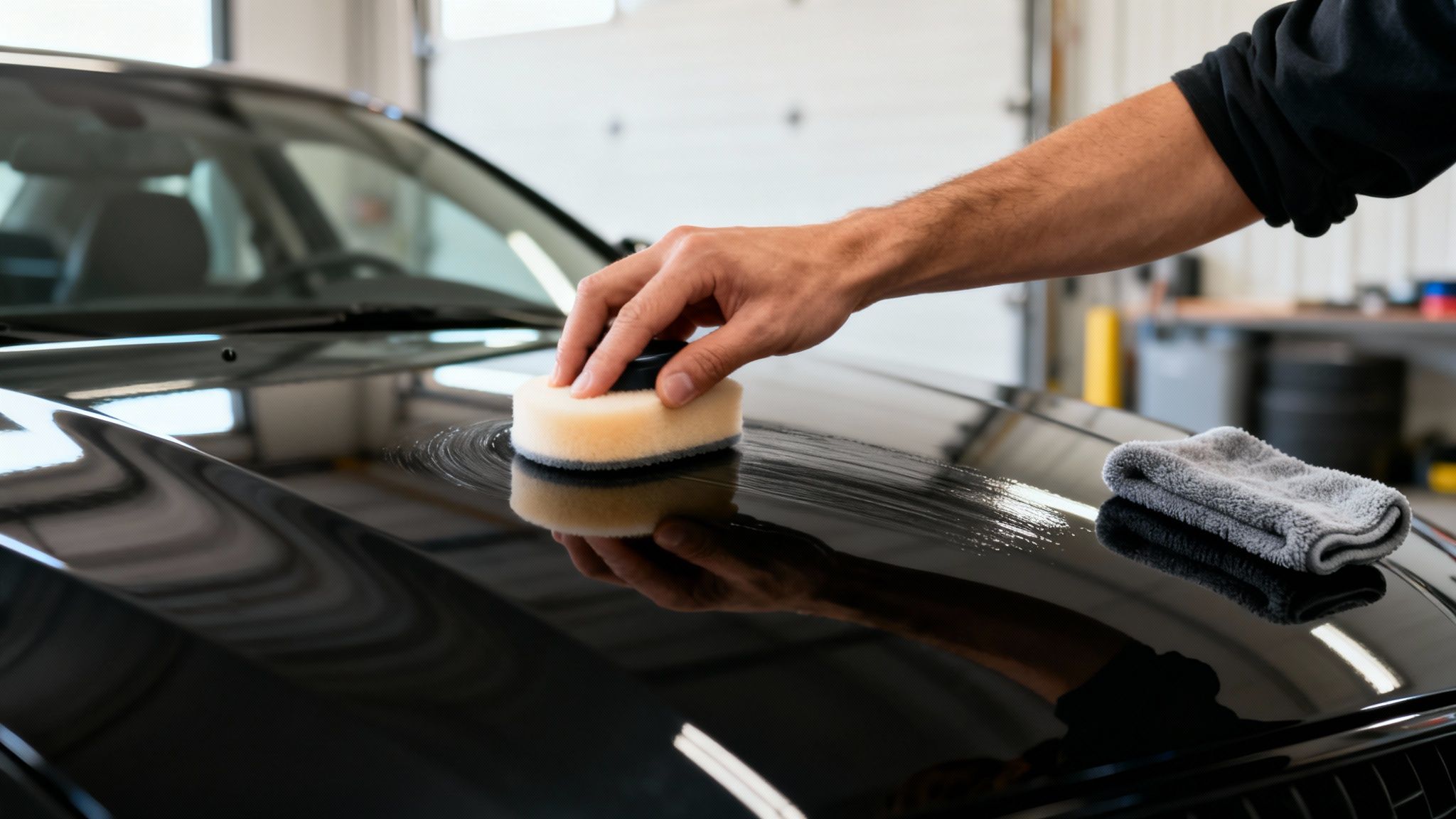
Once the surface is fully prepped, you're ready for the wax. Your technique here is everything, especially on dark colours where high spots and streaks are incredibly obvious. The goal is an ultra-thin, perfectly even coat.
Always work in a shaded area on a panel that's cool to the touch. Direct sunlight can make the wax dry way too fast, leading to a streaky mess that's a nightmare to remove.
Remember the golden rule of wax application: "less is more." A thick coat doesn't offer more protection. It just makes the wax much harder to buff off and seriously increases the chance of leaving behind a hazy, uneven finish.
Break the job down into small, manageable sections, like a quarter of the bonnet or half a door. This helps you focus on applying a consistent layer and buffing it off at just the right time before it hardens completely.
Step 3: Perfect the Final Buff
How you remove the wax is just as important as how you put it on. This is where many people accidentally create new swirls by using the wrong towel or a heavy hand. The key is using the right tools with a gentle touch.
- Use High-Quality Microfibre Towels: Invest in a few plush, edgeless microfibre towels. Look for a high GSM (grams per square metre) rating; something around 350-500 GSM is ideal. These towels are incredibly soft and will lift the wax residue without scratching the delicate clear coat on your black paint.
- The Initial Wipe: Once the wax has hazed (check the product’s instructions for the specific cure time), gently wipe it away with one side of a clean microfibre towel. Use light pressure and long, straight-line motions—avoid aggressive circular rubbing.
- The Final Buff: Flip the towel to a clean, dry side or grab a second fresh one for the final buff. This removes any leftover haze and reveals that deep, glossy shine underneath. Take a moment to inspect your work under different lights to catch any high spots or streaks before the wax fully cures.
Following this detailed process ensures your application of the best wax for black cars gives you that flawless, mirror-like finish. It takes patience, but the jaw-dropping result is more than worth the effort.
Troubleshooting Common Issues on Black Finishes
Let's be honest: even with the best wax and the most careful technique, black paint can be unforgiving. It's notorious for showing every tiny flaw, turning minor imperfections into glaring eyesores that can drive you crazy. This section is your field guide for tackling those frustrations head-on.
Knowing how to diagnose what you're seeing is the first step. Whether it’s those dreaded swirl marks or stubborn water spots, a little know-how goes a long way in bringing back that flawless, liquid-black shine you're after.
Identifying and Fixing Swirl Marks
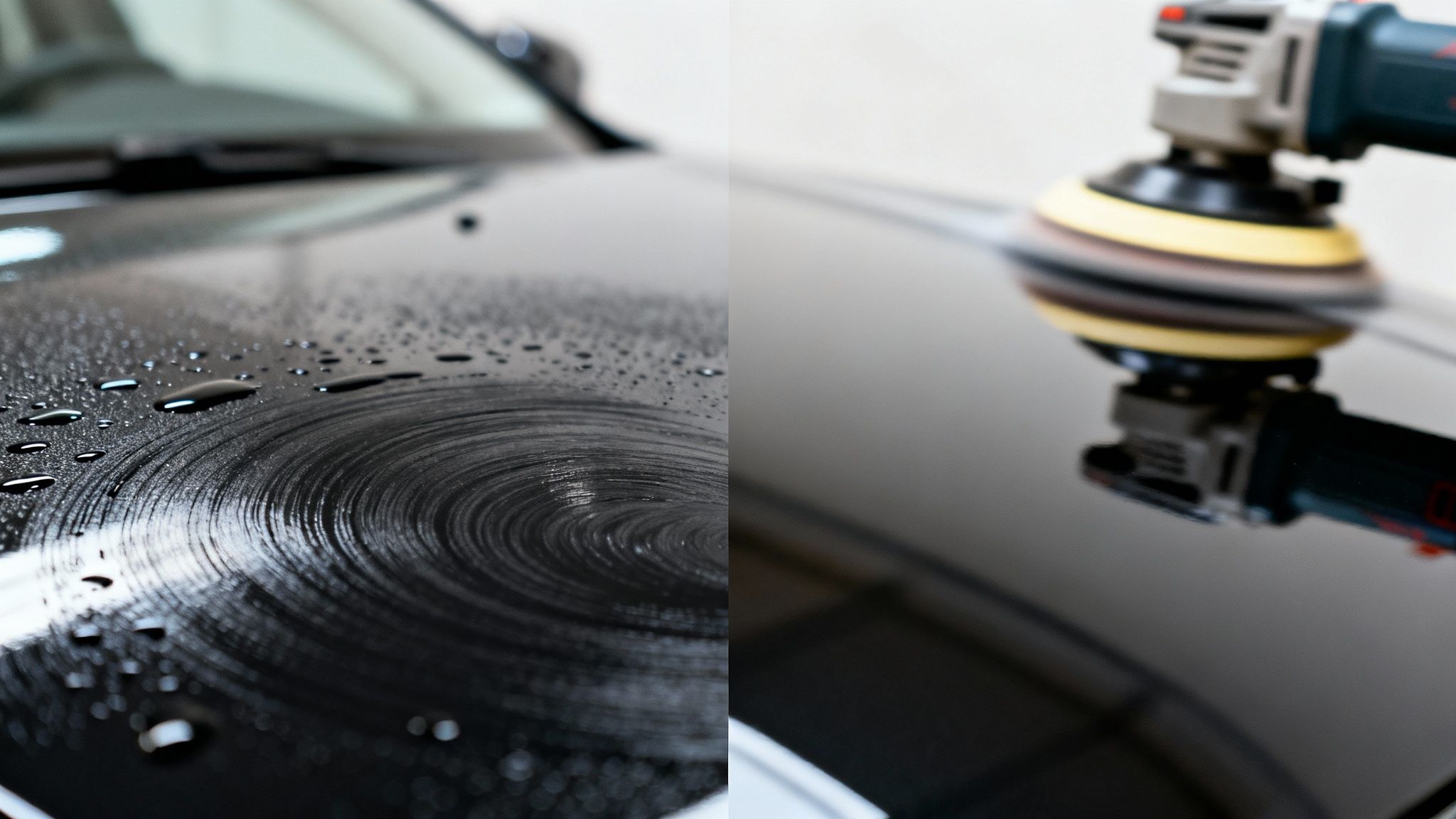
Swirl marks are the absolute nemesis of a dark finish. They’re essentially microscopic, circular scratches in the clear coat that catch the light, creating a spiderweb effect that utterly kills the paint’s depth and reflection. The usual culprits are automatic car washes with their abrasive brushes or even just using a gritty sponge or dirty towel at home.
Before you even think about applying wax, these have to go. A light polish is the answer.
- The Fix: Grab a fine-cut polish and a dual-action (DA) polisher fitted with a soft foam polishing pad. A DA polisher is your best friend here—it’s much more forgiving for enthusiasts than a high-speed rotary buffer, minimizing the risk of burning the paint. Work in small 2×2 foot sections, using slow, overlapping passes until you see the marks vanish.
- Prevention is Key: To stop them from coming back, adopt the two-bucket wash method. Always use clean microfibre wash mitts and dedicated, plush drying towels. It’s all about minimizing friction.
Tackling Machine-Induced Holograms
Holograms, sometimes called buffer trails, are a different beast altogether. These are hazy, shimmering trails left in the paint that follow the path of a machine polisher. They're a tell-tale sign of improper technique, usually from an aggressive rotary buffer used by an inexperienced operator. In direct sun, they create a weird, almost 3D-like haze.
Fixing them requires finesse, not more aggression.
One of the biggest mistakes I see is people trying to "wax over" holograms. A wax might temporarily fill the lightest of scratches, but it stands no chance of hiding the distinct patterns of buffer trails. Polishing is the only real fix.
The solution is to refine the finish. Step down to a much less aggressive combination, like a DA polisher with an ultra-fine finishing polish and a soft finishing pad. This gentle approach will level out the microscopic ridges causing the holograms, restoring a perfectly uniform, deep shine.
Eradicating Stubborn Water Spots
Water spots are the mineral deposits left behind when water evaporates. On black paint, they look like chalky, greyish circles that stick out like a sore thumb. You’ll run into two main types:
- Type I (Mineral Deposits): These are fresh spots that are just sitting on top of the paint. You can usually knock them out with a quick detailer spray or a dedicated water spot remover. Easy.
- Type II (Etching): This is what happens when you let spots sit, especially in the sun. The minerals start to eat into the clear coat, creating a permanent etch that won't just wipe away.
For these etched-in spots, you need to break out the polisher. Start with a light polish and a polishing pad on your DA. This will gently level the clear coat, effectively erasing the etched mark. If you’re dealing with a really stubborn spot, you might need to step up to a more aggressive compound, but always follow it up with a finishing polish to bring back that high gloss. Afterwards, applying a quality ceramic-infused wax will create a great hydrophobic barrier to help stop future spots from forming in the first place.
Moving Beyond Wax to Professional Paint Protection
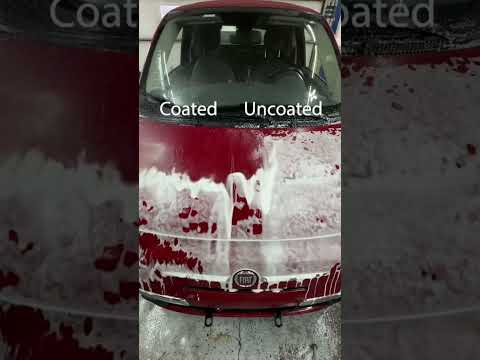
Finding a great wax for your black car can produce a jaw-dropping gloss, but we have to be honest about its limits. Wax is, by design, a sacrificial layer. It looks fantastic, but it’s meant to wear away after a few weeks or maybe a couple of months. For owners who want a more permanent solution, it's time to look beyond the wax aisle and into professional-grade paint protection.
This isn't just a small step up; it's a completely different way of thinking about how to defend your car's finish. We're shifting from temporary shine to long-term preservation. The two technologies leading the charge are professional ceramic coatings and Paint Protection Film (PPF), and both offer a level of defence that no off-the-shelf wax can ever hope to achieve.
Consumer Waxes vs. Professional Coatings: What's the Real Difference?
One of the biggest points of confusion I see is the difference between a consumer "ceramic wax" and a true, professional-grade ceramic coating. Yes, they both use SiO2 (silicon dioxide), but their formulas and performance are night and day. It’s like comparing a decent raincoat to a permanent, hurricane-proof shelter.
- Consumer Ceramic Wax: These are fantastic, user-friendly products designed for easy application at home. They blend a small amount of SiO2 with traditional polymers and waxes. You’ll get better water-beading and durability than a classic carnauba, but it still only forms a weak, temporary bond with the paint. You can expect it to last around 6-12 months.
- Professional Ceramic Coating: This is a whole different beast. It's a highly concentrated liquid polymer that, when applied by a certified pro, forms a permanent chemical bond with your car's clear coat. This creates a semi-permanent, glass-like shell that is far harder and thicker than any wax. We're talking years of protection, not months.
The professional installation isn't just a suggestion; it's a requirement. For a coating to bond properly, the surface must be perfectly prepared—decontaminated, stripped of old products, and almost always paint corrected. A botched application can leave you with high spots, cloudy patches, and an uneven finish that's a nightmare to remove.
The Durability and Resistance Showdown
Where professional protection really shows its worth is how it stands up to the real world, especially on unforgiving black paint.
A professional ceramic coating is a true investment in your vehicle’s future. It provides a level of chemical resistance and hardness that no wax can replicate, defending against environmental hazards that would easily compromise a waxed surface.
Let's put the differences side-by-side.
| Protective Feature | Consumer Ceramic Wax | Professional Ceramic Coating |
|---|---|---|
| Chemical Resistance | Low. Quickly stripped away by harsh car wash soaps, bird droppings, and road salt. | Extremely High. Shrugs off chemical etching from bird droppings, bug guts, and tree sap. |
| UV Protection | Good. Offers a solid defence against fading compared to old-school waxes. | Superior. Packed with powerful UV inhibitors that stop oxidation and fading in their tracks for years. |
| Hardness (Scratch Resistance) | Minimal. Doesn't add any real, measurable hardness to your clear coat. | Significant. Adds a measurable layer of hardness (often rated 9H), helping resist light swirls and wash-induced scratches. |
| Longevity & Durability | 6-12 months. Needs to be reapplied often to keep up its protective qualities. | 2-10+ years. A semi-permanent shield that lasts for a huge portion of your car's life. |
The Ultimate Defence: Paint Protection Film (PPF)
Even a top-tier ceramic coating has its limits when it comes to physical damage. That’s where Paint Protection Film (PPF) enters the picture. PPF is a crystal-clear, self-healing urethane film that we apply directly to your vehicle's paint.
Think of it as body armour for your car. It’s engineered to absorb the impact from rock chips, road debris, and minor scrapes, stopping them from ever touching your precious black paint. For high-impact zones like the front bumper, hood, and mirrors, PPF is the only surefire way to prevent chips and deep scratches.
Here at Carmedics Autowerks, we often recommend a hybrid approach for the ultimate black car finish. This involves installing PPF on the most vulnerable panels and then layering a professional ceramic coating over the entire vehicle—including the film. This combination delivers unmatched protection against both physical impacts and environmental contamination. If you want to dive deeper into this technology, you can explore The Ultimate Guide to Paint Protection Film to see how it can safeguard your investment.
Your Top Questions About Waxing Black Cars Answered
Even after you've got the basics down, working with black paint always seems to bring up a few more questions. Let's tackle some of the most common ones we hear from black car owners. Getting these details right is what separates a decent shine from that truly jaw-dropping, mirror-like finish.
How Often Should I Be Waxing My Black Car?
There’s no single answer here—it really comes down to the type of wax you’re using and what your car goes through every day. The local climate is a huge factor. Here in Whitby, our harsh winters and constant battle with road salt mean your car’s paint needs a more robust defence.
- Natural Carnauba Wax: If you love that deep, warm glow, carnauba is fantastic. But it's not built to last. You'll want to reapply it every 6 to 8 weeks to keep that shine and protection topped up.
- Synthetic Polymer Sealant: These are the workhorses of paint protection. A good sealant will easily give you 4 to 6 months of coverage, making it a smart choice for a daily driver that sees all kinds of weather.
- Ceramic-Infused Wax: This is the modern hybrid, giving you a bit of everything. You get brilliant gloss and serious durability, often lasting 6 months or even longer. It's a great way to cut down on your maintenance time without sacrificing results.
Can Wax Really Get Rid of Scratches?
This is a big one we hear all the time. The short answer is no. While the best wax for black cars often has filling agents that do a surprisingly good job of hiding very light swirl marks and micro-marring, they can't magically fix deeper scratches. Wax is just a temporary filler, not a permanent repair.
Think of it this way: wax can smooth over the microscopic valleys that cause those annoying spiderwebs in direct sunlight, but it can't fill a deep gouge. If you can catch the scratch with your fingernail, it’s beyond what any wax can conceal. For that kind of damage, the only real fix is paint correction, where we carefully polish the clear coat to level out the surface.
Wax is the finishing touch, not a shortcut. Its job is to protect an already perfected surface and make it pop. Trying to use it to hide noticeable flaws will just leave you frustrated.
Is It Better to Apply Wax by Hand or With a Machine?
Honestly, you can get a phenomenal result either way when applying a final coat of wax. The choice really boils down to your personal preference and what the product instructions recommend.
- Hand Application: There's something satisfying about applying wax by hand. It gives you a real feel for the car's curves and makes it easy to work into tight spots. A good foam applicator is all you need to lay down a thin, even coat. It’s a classic method for a reason.
- Machine Application: Using a dual-action (DA) polisher with a soft finishing pad is the most efficient route. You can lay down an incredibly thin and perfectly uniform layer of wax across big panels like the hood or doors. This helps the wax bond better and can save you a lot of time, though it does take a little practice.
At the end of the day, the goal is the same: apply a thin coat. Piling on wax doesn't add more protection—it just makes it a nightmare to buff off and leads to streaking.
Will Wax Protect My Car From Rock Chips?
Absolutely not. Wax provides zero protection against rock chips, door dings, or any other kind of physical impact. A wax or sealant forms an incredibly thin, invisible shield against things like UV rays, bird droppings, and acid rain. It was never designed to stop a rock flying at your car on the highway.
For real impact protection, you need a physical barrier. That’s where professional solutions like Paint Protection Film (PPF) come into play. PPF is a thick, durable, and often self-healing film that acts as armour for your paint. To get a better sense of how these advanced options stack up, you can read our detailed guide comparing Ceramic Coating vs PPF.
For professional advice on achieving and maintaining a perfect black finish, or to explore advanced protection like PPF and ceramic coatings in Whitby, trust the experts at Carmedics Autowerks. Visit our website to learn more about our services.