
If you operate a commercial vehicle in Ontario, that little decal on your windshield is a big deal. The annual safety inspection sticker is proof that your truck, trailer, or bus has passed a thorough safety check and meets the strict standards set by the province. It's a mandatory requirement for any commercial vehicle with a gross weight that tips the scales over 4,500 kg.
What’s the Deal with the Ontario Annual Safety Inspection Sticker?
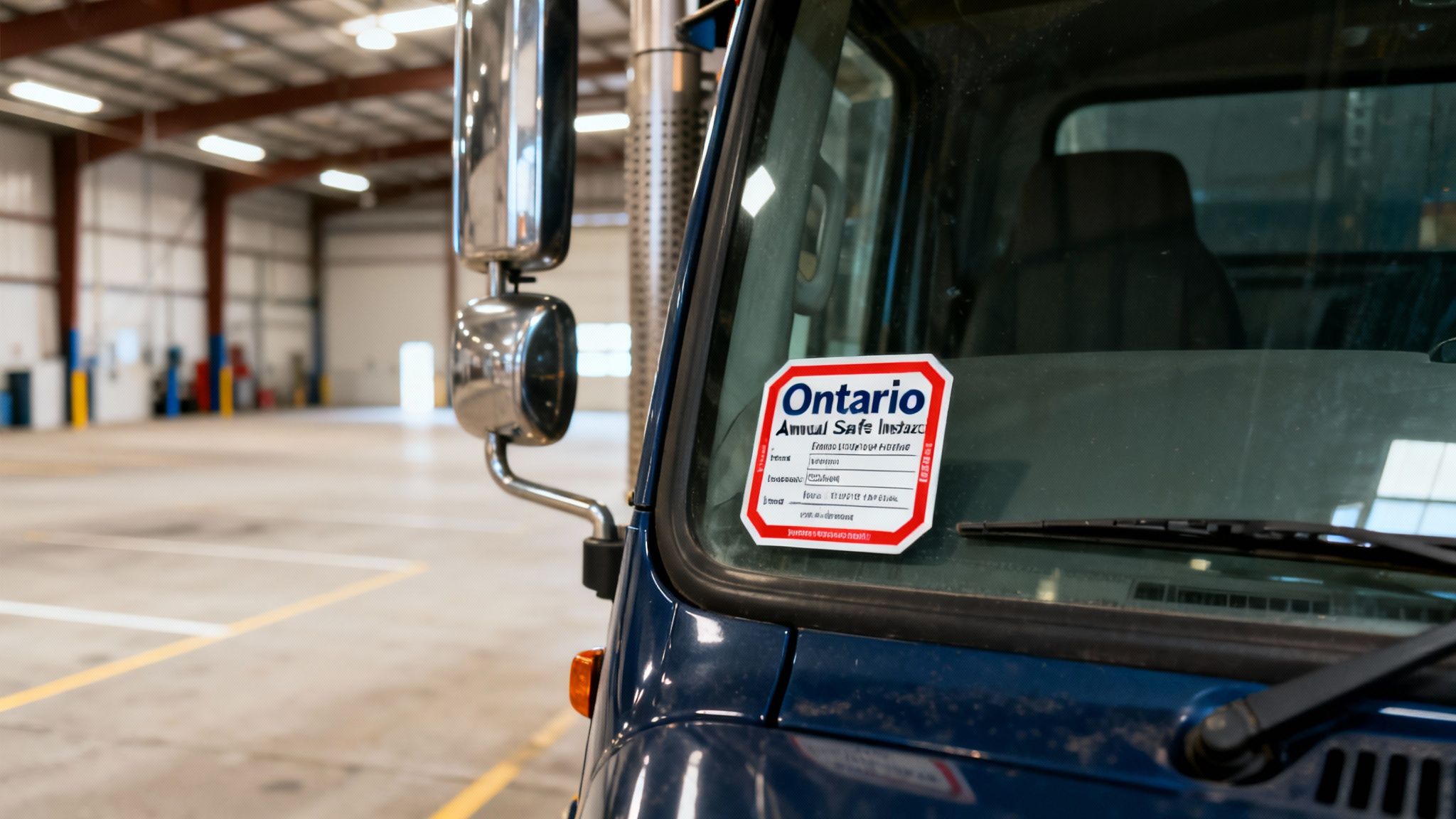
Think of the annual safety inspection sticker as more than just a regulatory hurdle. It’s a cornerstone of road safety in Ontario. Its job is simple: to show everyone, from law enforcement to the public, that a commercial vehicle has met the Ministry of Transportation's (MTO) minimum safety and maintenance standards.
This whole program is legally required for a reason. By catching mechanical problems before they lead to a breakdown or an accident, it helps keep our roads safe for everyone.
Who Exactly Needs an Annual Safety Sticker?
This isn't something every driver in Ontario needs to worry about. The annual safety inspection is specifically for larger vehicles that carry a higher risk if they aren't kept in top shape.
So, who's on the list? Here's a clear breakdown of the vehicles that must undergo this inspection.
Vehicles Requiring an Annual Safety Inspection Sticker in Ontario
| Vehicle Type | Gross Weight Threshold | Inspection Frequency |
|---|---|---|
| Trucks & Trailers | Registered Gross Vehicle Weight (RGVW) over 4,500 kg | Annual |
| Buses (including school buses) | All weights | Semi-Annual |
| Accessible Vehicles & School-Purpose Vehicles | All weights | Semi-Annual |
| Tow Trucks | All weights | Annual |
Essentially, if you're operating a heavy truck, a large trailer, or any kind of bus or tow truck, this inspection is part of your annual (or semi-annual) routine.
This sticker program acts as a crucial layer of accountability. It ensures that fleet operators and independent owners are actively maintaining their equipment to a provincial standard, preventing potentially dangerous vehicles from operating on public highways.
The Big Switch to the DriveON Program
If you've been in the industry for a while, you'll know about the recent shift from the old-school, paper-based Motor Vehicle Inspection Station (MVIS) system to the new digital DriveON program. This isn't just a minor update; it's a complete overhaul designed to bring inspections into the 21st century.
The new system creates a digital trail for every inspection, making the process more transparent and cutting down on fraud. This change directly affects how safety stickers are issued for vehicles needing 12-month inspections, like heavy trucks and tow trucks. Navigating these new rules means finding a trustworthy https://carmedicsautowerks.com/automotive-service-centre-near-me/ that's fully equipped for the DriveON system.
Of course, road safety extends beyond just commercial trucks. While our focus here is on MTO regulations, it's worth remembering that safety is key for all forms of transport. For example, cyclists can find great resources covering important electric bike safety tips to keep themselves safe on the road.
Getting Your Vehicle Ready for Its Safety Inspection
Passing your annual safety inspection on the first try feels great, but more importantly, it saves you money and a major headache. Nobody wants to book a second appointment, take more time off work, and face a surprise repair bill. A quick pre-inspection of your own car can help you catch small issues before they become official, failed items on a report.
This isn't about doing a mechanic's job. It's about spotting the low-hanging fruit—the obvious things an inspector is legally required to flag. A little bit of prep work goes a long way and can be the difference between a pass and a fail.
The At-Home Pre-Inspection Checklist
Before you even think about calling a shop, take a few minutes to walk around your car. You’d be surprised how many common failure items you can spot yourself. This simple habit can save you a world of trouble.
First, check the easy stuff that's just as easy to forget.
- All Your Lights: Grab a friend or family member to help you check every single exterior light. Cycle through your headlights (both high and low beams), brake lights, turn signals, and four-way flashers. And don't forget the licence plate light—a burnt-out bulb there is a classic, easy-to-avoid reason for failure.
- Horn and Wipers: Give the horn a solid beep. Then, test your windshield wipers and make sure the washer fluid sprays properly. If your wipers leave big streaks or judder across the glass, they'll need replacing.
- Mirrors and Glass: Look over your mirrors for any cracks that mess with your view. Scan the windshield for chips or cracks, paying close attention to the area directly in front of the driver. A crack in the driver's line of sight is a definite no-go.
Think of it this way: a proactive check is your best defence. The technician has a strict, government-mandated list to follow. To them, a burnt-out bulb is just as much of a failure as a bigger mechanical problem. Don't hand them an easy reason to fail you.
A Closer Look at Critical Components
With the basics out of the way, it's time to check the parts of your car that do the heavy lifting. These systems are under a microscope during an inspection because they are absolutely critical to your safety.
Your tires are your car's only connection to the road, so their condition is a big deal. Eyeball the tread depth—if the grooves look shallow, it’s a red flag. Be on the lookout for cuts, bulges on the sidewall, or weird wear patterns. Uneven wear often points to bigger issues with your alignment or suspension.
Next, just listen to your brakes as you drive. Do you hear any high-pitched squealing, deep grinding, or scraping noises when you stop? Does the car pull to one side when you press the pedal? These are tell-tale signs that your brake system needs a look before it gets to the inspection bay. This is all part of a good preventive maintenance for vehicles routine, which really pays off when inspection day rolls around.
So, What Actually Happens During the Inspection?
Pulling into the shop for your annual safety inspection can feel a bit like a final exam for your car. But it’s a lot less intimidating when you understand what the technician is actually looking for. This isn't just a quick once-over; it's a thorough, systematic review of your vehicle’s most important safety components, all guided by a strict checklist from the Ministry of Transportation.
When you arrive at a licensed Motor Vehicle Inspection Station, the technician's process is methodical. They're not hunting for things to fail you on. Instead, they’re verifying that every key part of your vehicle meets the minimum standards to be considered safe for Ontario roads. It’s all about catching potential problems before they become dangerous failures.
Before they even touch a wrench, you'll need to hand over your vehicle's ownership and proof of insurance. It's a good idea to have those ready in your glove box. The technician will also check your Vehicle Identification Number (VIN) to make sure the car matches the paperwork.
The graphic below highlights a few of the core areas of focus—and conveniently, these are things you can easily give a quick look-over yourself before your appointment.
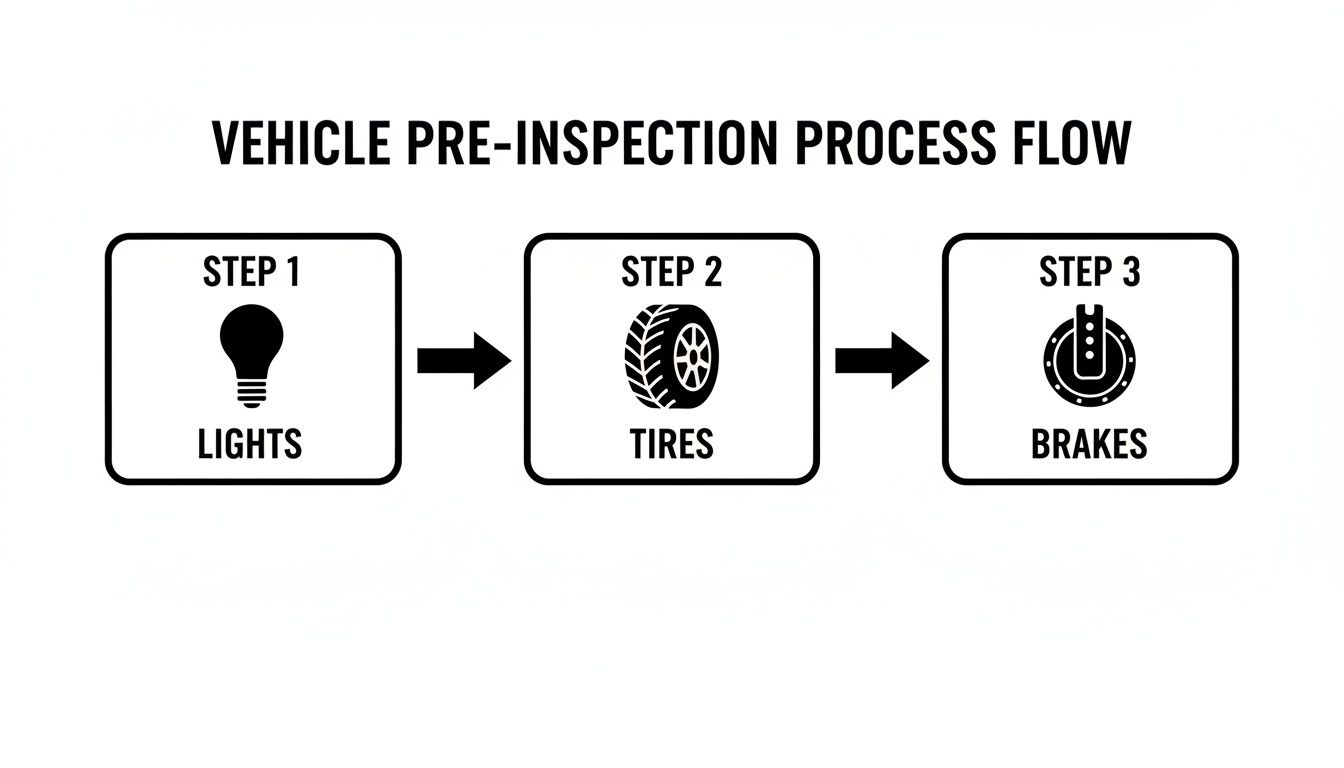
As you can see, foundational components like lights, tires, and brakes are always front and centre. They’re the first line of defence in vehicle safety and get a lot of attention right from the start.
The Mechanical Deep Dive
After the initial checks, the real work begins. Your vehicle will likely be put on a hoist, giving the technician a clear view of the undercarriage—an area where many common safety issues love to hide. This is where a trained, experienced eye makes all the difference.
The technician will meticulously go through:
- The Braking System: This is one of the most critical parts of the inspection. They’ll measure the thickness of your brake pads and rotors, hunt for any leaks in the hydraulic lines, and test the parking brake to make sure it holds firm.
- Steering and Suspension: Here, they're checking for excessive looseness or "play" in steering parts like tie rods and ball joints. Leaky or worn-out shocks and struts are another common failure point they'll be looking for.
- Frame and Body Integrity: The inspector examines the vehicle’s skeleton for any structural rust or corrosion that could compromise its strength. A bit of surface rust is expected, but any rot that weakens the frame or body mounts is an immediate fail.
It's important to remember that the technician's job is to be objective. They are legally accountable for every vehicle they pass, so they can't just let "minor" issues slide. Their signature on that safety certificate is a professional guarantee that your vehicle met the required standard on that specific day.
Powertrain and Electrical Systems Check
The inspection doesn't stop at the chassis. The technician also has to assess the powertrain and electrical systems to confirm they're functioning correctly and don't pose a hazard.
This stage involves several key checks:
- Exhaust System: The entire exhaust is inspected from front to back, checking for leaks that could let dangerous carbon monoxide into the cabin and ensuring everything is securely mounted.
- Electrical System: This is more than just a light check. They’ll confirm every single exterior light works—headlights (high and low beams), turn signals, brake lights, and licence plate lights. They'll also test the horn and look for any dodgy, unsafe wiring.
- Wheels and Tires: Going beyond just tread depth, the inspector will look for cracks in the rims, make sure all the lug nuts are present and properly torqued, and check for any other signs of damage that could lead to a failure.
Every single one of these steps is documented, creating a detailed report on your vehicle's condition when the inspection is complete.
Common Failure Points and How to Avoid Them
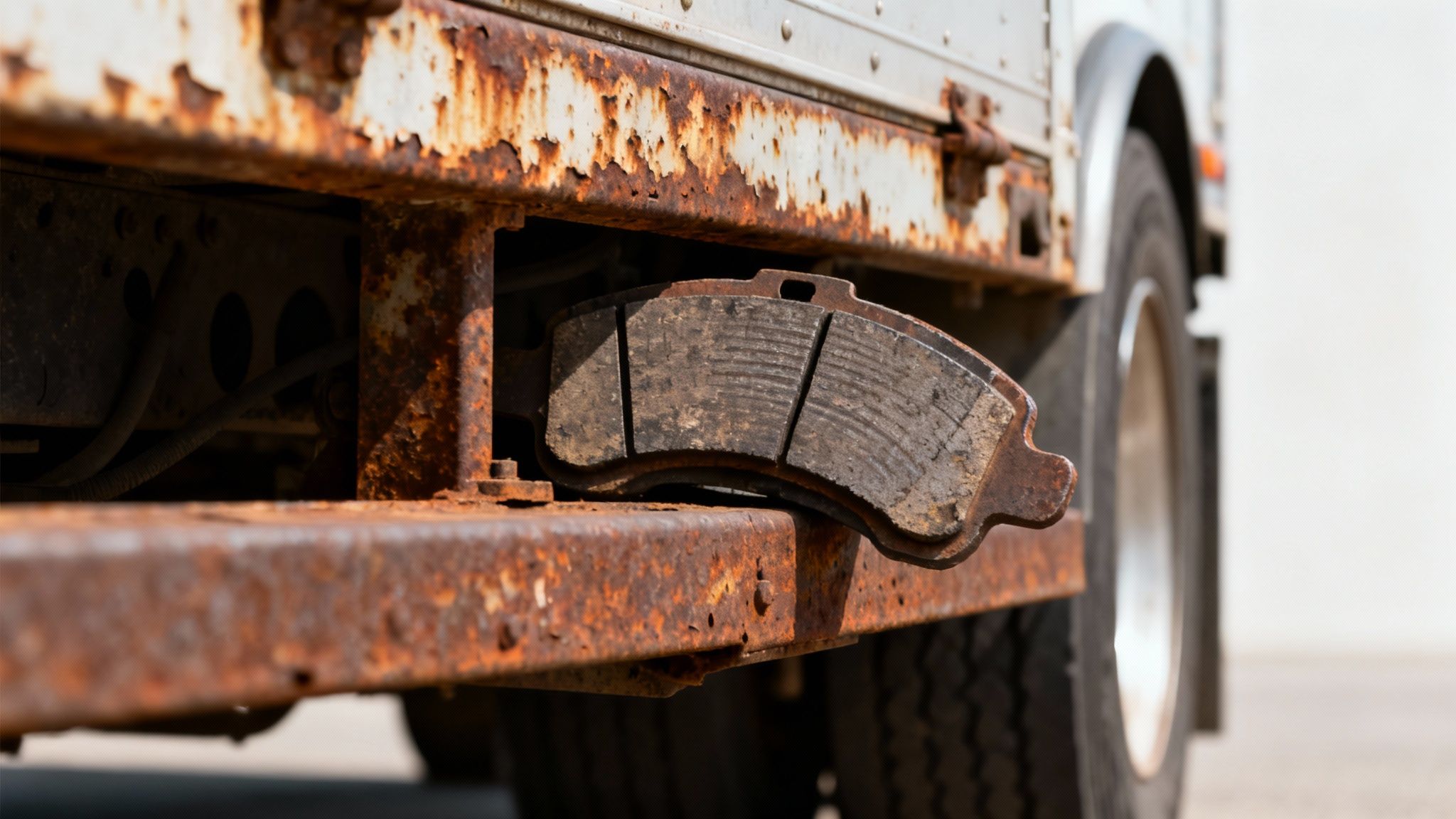
Knowing what’s on the checklist is a good start, but the real trick is understanding why vehicles actually fail the inspection. This is where you can save yourself a lot of time, money, and frustration. A failed inspection isn't just an inconvenience—it's the official word that your vehicle is below the minimum safety standard for Ontario roads.
The good news is that most failures aren't caused by strange, one-off problems. As technicians, we see the same handful of issues pop up constantly. Getting familiar with these common culprits means you can spot and fix them before you roll into the shop.
Brakes: The Number One Culprit
It will probably come as no surprise that the braking system is, by far, the most frequent reason for a failed safety. It's a complex system with a ton of parts that wear out, and for obvious reasons, inspectors have zero tolerance for any issues here.
Here are the usual suspects we see:
- Worn Brake Pads and Rotors: A technician will physically measure the thickness of your pads and rotors. If they’re worn down past the manufacturer's minimum spec, it’s an automatic fail. No wiggle room.
- Leaking Brake Lines: Any hint of fluid seeping from brake lines, hoses, or calipers is a huge red flag. It points to a potential loss of braking pressure, which is incredibly dangerous.
- Parking Brake Failure: Your emergency brake isn't just for show. It has to be strong enough to hold the vehicle steady on a hill. A weak or completely non-functional parking brake won’t pass.
Staying on top of your brake maintenance is absolutely non-negotiable. If you hear grinding sounds, feel the pedal getting soft, or notice the vehicle pulling to one side when you stop, get it checked out. Knowing the warning signs can help you figure out how often to change brake pads and avoid a guaranteed failure.
Structural Integrity and Suspension Woes
Right after brakes, problems with the vehicle's frame and suspension components are the next most common failure points. These issues are often much harder for an untrained eye to spot, which is why the inspection on a hoist is so critical.
The technician will be hunting for excessive rust or corrosion on the frame, body mounts, and key suspension parts. A little surface rust is one thing, but any rot that creates holes or weakens the chassis is an immediate fail.
Similarly, worn-out suspension parts like ball joints, tie rods, and wheel bearings create looseness, or "play," in the system that directly impacts steering and control. Problems with components like wheel bearings are common culprits; you can learn more about what's involved in repairing front wheel bearings to see why it's a critical safety item.
Top Reasons for Failing an Ontario Safety Inspection
To give you a clearer picture, we've put together a quick summary of the most common issues we see that lead to a failed safety inspection.
| Failure Point | System Affected | Typical Fix / Complexity |
|---|---|---|
| Worn Brake Pads/Rotors | Brakes | Replacement of pads, rotors, and sometimes calipers. Moderate. |
| Leaking Brake Lines/Hoses | Brakes | Replacement of the affected line or hose. Low to Moderate. |
| Rotted Frame/Body | Structural | Welding and fabrication required. High complexity. |
| Worn Ball Joints/Tie Rods | Suspension | Part replacement and wheel alignment. Moderate. |
| Leaking Exhaust System | Exhaust | Patching or replacing sections of pipe/muffler. Low to High. |
| Cracked Windshield | Body/Glass | Windshield replacement. Moderate. |
| "Bald" or Worn Tires | Wheels/Tires | Tire replacement. Low. |
This isn't an exhaustive list, of course, but it covers the vast majority of problems that will stop you from getting that sticker on your first try.
Exhaust System and Other Common Failures
A vehicle's exhaust is another area that frequently causes a vehicle to fail its test for the annual safety inspection sticker Ontario. The main concerns here are leaks and security.
An inspector will run through the entire system looking for two things:
- Leaks: Any hole or crack in the exhaust pipes, muffler, or manifold means you fail. This isn't just about the noise; it’s about preventing deadly carbon monoxide from getting into the cabin.
- Secure Mounting: The whole system has to be securely fastened with no broken or missing hangers. A dangling exhaust pipe is a serious road hazard.
Lastly, don't get tripped up by the simple stuff. We’ve seen vehicles fail for a burnt-out licence plate bulb, a crack in the windshield that blocks the driver's view, or tires that are worn below the minimum tread depth. These are often the most frustrating failures because they are so easy to prevent.
What to Expect: Costs, Sticker Rules, and Staying Compliant
You’ve passed the inspection—congratulations! Now, let's talk about the final steps: paying for the service and understanding the rules that come with that little sticker on your windshield. Getting a handle on the costs and renewal timelines is just as crucial as the inspection itself.
How Much Does an Ontario Safety Inspection Cost?
One of the first questions on everyone's mind is, "What's this going to cost me?" It's a common myth that there's a set, province-wide price. The truth is, the cost for an annual safety inspection is set by the individual licensed Motor Vehicle Inspection Station, not the government.
This means prices can differ from one shop to another, often depending on their location and specific labour rates. Generally, you can expect to pay somewhere in the range of $120 to $200, plus HST. My advice? It never hurts to call two or three local, reputable shops to get a feel for the going rate in your area.
Getting Your Sticker: From Certificate to Decal
Once your vehicle gets the green light, the technician will complete a Safety Standards Certificate (SSC). Think of this as the official proof that your truck or trailer met all the required safety standards on the day of the inspection.
With the SSC paperwork sorted, the shop will issue the annual safety inspection sticker Ontario requires. The technician then applies it to a specific spot on your vehicle—usually the bottom corner of the driver's-side windshield or a designated plate—so it’s easy for officials to see.
Don't mistake that sticker for a simple decoration. It's a legal necessity. Driving a commercial vehicle without a valid, properly displayed sticker is a direct violation of the Highway Traffic Act, and the consequences are immediate.
Staying on Schedule: Sticker Validity and Renewals
So, how long does that sticker last? For nearly all commercial trucks and trailers, the annual safety sticker is valid for exactly 12 months from the day it was issued. The expiry date is printed right on the decal, making it easy to track.
There’s absolutely no grace period here. As the owner or operator, the responsibility is on you to keep an eye on that expiry date and book your next inspection before the current one runs out. I always tell my clients to schedule their next appointment a few weeks ahead of time. That way, if any unexpected repairs pop up, you have a built-in buffer to get them done without any last-minute panic.
The High Cost of Non-Compliance
Letting your sticker expire isn't something to take lightly. MTO officers and police are always on the lookout, and getting caught with a missing or expired decal can seriously derail your operations and hit your wallet hard.
Here’s what you could be up against:
- Hefty Fines: We’re talking fines that can easily run from hundreds into thousands of dollars.
- Demerit Points: The driver will likely receive demerit points, which can lead to higher insurance premiums.
- Vehicle Pulled Off the Road: In more serious cases, an officer has the authority to pull your plates or have your vehicle towed right then and there.
These penalties make it crystal clear: keeping up with your annual safety inspection is about more than just checking a box. It’s a fundamental part of keeping your business running and ensuring everyone stays safe on the road.
Common Questions About Ontario's Safety Inspection
Even when you know the steps, a few specific questions always pop up. Let's clear the air and tackle some of the most common queries we hear from drivers about the annual safety inspection sticker.
How Long Does a Safety Sticker Last?
For the vast majority of commercial vehicles—think trucks with a registered gross weight over 4,500 kg—your annual safety sticker is good for exactly 12 months from the day of the inspection.
There are a few exceptions, though. Vehicles that carry passengers, like buses, school buses, and accessible vans, are held to a higher standard. They need to be inspected every six months. In any case, the expiry date is always printed right on the decal, so you'll never have to guess.
What if My Vehicle Fails the Inspection?
Failing an inspection isn't the end of the world, but it does mean your vehicle isn't getting a sticker just yet. The mechanic will hand you a detailed report that spells out exactly what didn't meet the minimum safety standards.
You then have a 10-day window to fix the issues and bring the vehicle back to the same inspection station for a re-check. Many shops will offer a reduced fee for this follow-up, but it's best to ask about their policy upfront. If you miss that 10-day deadline, you're back to square one and will have to pay for a full inspection all over again.
Keep in mind, driving a commercial vehicle that requires a sticker without a valid one is illegal. A failed inspection means your vehicle is officially considered unfit for the road. Getting those repairs done quickly is a legal necessity, not just a recommendation.
Can I Get an Extension on an Expired Sticker?
In a word: no. The Ministry of Transportation (MTO) is very clear on this—there are no extensions for expired annual safety stickers. The date on your decal is a hard deadline.
Getting caught with an expired sticker, even by one day, can result in hefty fines and penalties for both the driver and the company. The best approach is to book your next inspection a few weeks before the current one expires. This gives you a comfortable cushion to sort out any unexpected repairs without the pressure of a looming deadline.
Do I Need a Safety Inspection to Sell a Used Commercial Vehicle?
Absolutely. If you're selling a used vehicle that falls under the annual inspection requirement, you must provide the buyer with a valid Safety Standards Certificate (SSC).
This certificate is the official document you receive when the vehicle passes its inspection. It confirms that, at the time of the test, the vehicle met all of Ontario's minimum safety requirements. It's a non-negotiable part of the sale process that protects the buyer and ensures unsafe vehicles aren't changing hands without transparency.
Staying on top of your annual safety inspection is just part of being a responsible vehicle owner in Ontario. If you have more questions or you're ready to book your inspection, the team at Carmedics autowerks inc is here to help. We provide thorough, MTO-compliant inspections to keep you safe, legal, and confidently on the road. Schedule your appointment with us today at https://www.carmedicsautowerks.com.com.