

When you think about window tinting, what comes to mind first? For most people, it's that sleek, custom look that makes a car stand out. But there's so much more going on with that thin layer of film than just aesthetics.
Think of it as a high-tech shield for your car. Quality window films are engineered to be a protective barrier that blocks up to 99% of harmful UV radiation, dramatically cuts down on heat, and adds a serious layer of privacy. It’s a functional upgrade that improves your comfort and protects your car's interior every single time you drive.
Your Guide to Automotive Window Tint Films
At its core, automotive window tint is like a sophisticated pair of sunglasses for your vehicle. Sure, it looks great, but the real magic is in the benefits you feel—a cooler cabin on a scorching summer day, less glare from the sun, and the peace of mind that comes from protecting your interior from fading and cracking.
This guide is here to cut through the confusion and technical jargon. We'll walk you through everything, from the different types of film on the market to the specific laws you need to know about. Our goal is to arm you with the knowledge to choose the perfect tint for your car and your lifestyle.
What You Will Learn in This Guide
To make a smart choice, you need to understand what you're buying. We’re going to break down the most important aspects of window tinting so you can feel confident in your decision.
Here’s a quick look at what we’ll cover:
- The Main Types of Tint: We'll dive into the five major film technologies—dyed, metalized, hybrid, carbon, and ceramic. You'll learn how they're different and which one is the right fit for your budget and performance needs.
- Decoding Performance Metrics: We’ll translate the technical specs like Visible Light Transmission (VLT), UV Rejection, and Infrared (IR) Rejection into plain English, so you know exactly what you're getting.
- Navigating Local Laws: Tint laws vary, and getting it wrong can lead to a ticket. We'll give you a clear rundown of California's specific regulations to keep your car looking good and staying legal.
- Installation Choices: Should you try it yourself or hire a pro? We’ll explore the pros and cons of DIY kits versus professional installation to help you understand what it takes to get that bubble-free, perfect finish.
Choosing the right automotive window tint film is about finding the perfect balance between looks, performance, and legality. The best choice is one that protects your vehicle, makes your drive more comfortable, and delivers value for years to come.
Ultimately, tinting is about enhancing your entire driving experience. A cooler interior means your A/C doesn't have to work as hard, which can even help with fuel efficiency. Plus, by cutting down on blinding glare from the sun and headlights, a quality tint reduces eye strain and makes driving safer. Let's get started.
Exploring the Main Types of Window Tint Film
Choosing the right automotive window tint isn't just about looks; it's like picking the perfect lens for a camera. Each type of film is engineered for a different job and delivers a completely different result. Not all films are created equal, and understanding what makes each one tick is the first step toward a smart investment in your car's comfort, privacy, and protection.
The world of window tinting has come a long way. What started as simple coloured sheets has blossomed into a high-tech industry. Today's films are designed for specific performance goals, from basic privacy to space-age heat rejection. Let's break down the five main players you'll find on the market.
Dyed Window Tint Film
Dyed window tint is the old-school classic and the most budget-friendly option out there. Think of it as a simple pair of sunglasses for your car—its main purpose is to make your windows darker. The film has a layer of dye that absorbs sunlight and heat.
This absorption is the key to how it works. While it darkens the glass and cuts down on glare, it doesn't actually reflect the heat away. It just soaks it up, and some of that heat eventually radiates into your cabin anyway. Over time, the sun's UV rays can also cause the dye to fade, often turning it a purplish colour and reducing its effectiveness.
Metalized Window Tint Film
Take a big step up in performance, and you get metalized film. This type of tint has microscopic metal particles embedded right into the film. Instead of just absorbing sunlight, these tiny particles act like a mirror, reflecting heat and harmful UV rays away from your car before they ever get inside.
It’s almost like having a one-way mirror on your windows. This technology provides fantastic heat rejection and is far more durable than a basic dyed film. The one well-known hiccup? All that metal can sometimes interfere with electronic signals, like your mobile phone, GPS navigation, and even your radio reception.
Hybrid Window Tint Film
So, how do you get the performance of a metalized film without the signal interference? You create a hybrid. Just as the name suggests, these films cleverly combine a layer of dyed film with a layer of metalized film.
This combination gives you the best of both worlds. The metalized layer does the heavy lifting for heat and UV rejection, while the dyed layer adds to the dark, sleek, non-reflective appearance. By using a much lower concentration of metallic particles, hybrid films get the job done without messing with your electronics, striking a great balance between performance, looks, and practicality.
The following infographic shows the core benefits that every quality automotive window tint, from a good hybrid to a top-tier ceramic, should deliver.
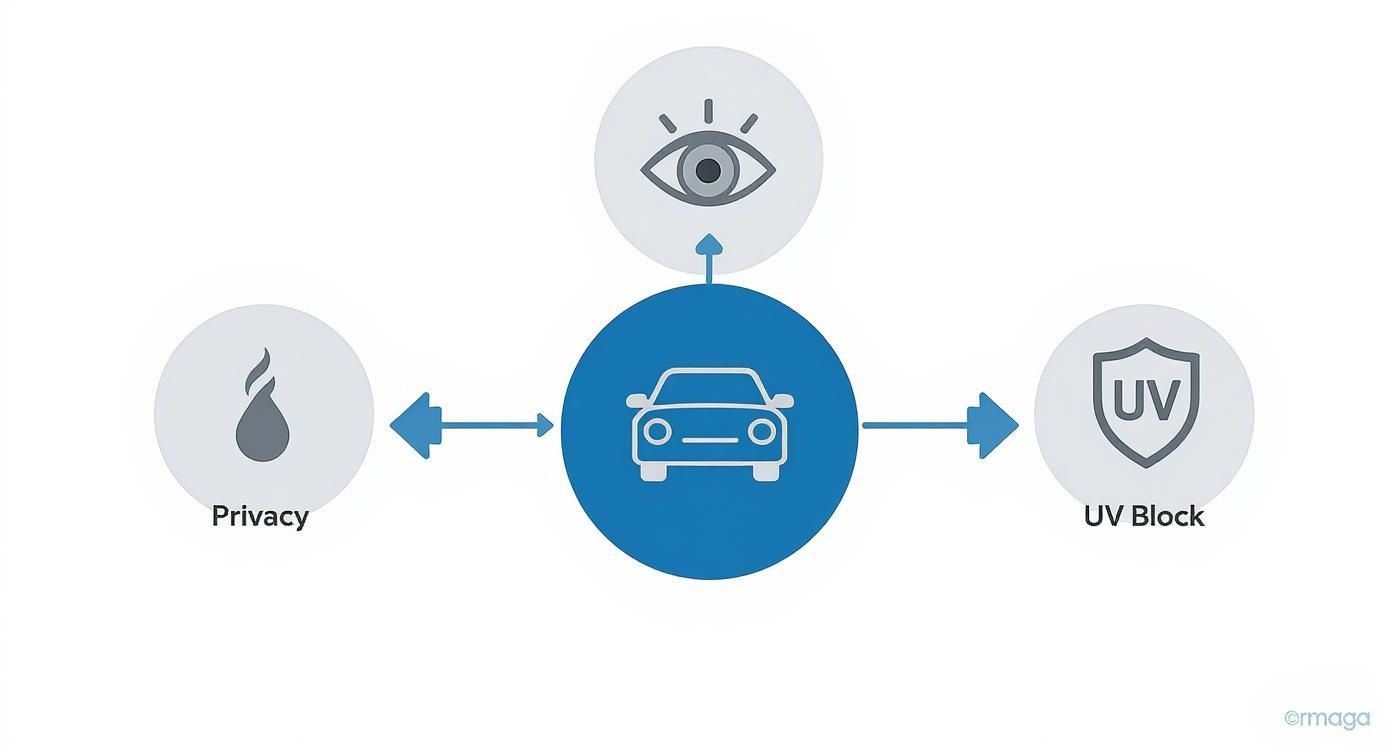
As you can see, the right tint improves your driving experience by enhancing privacy, blocking UV rays, and reducing uncomfortable glare.
Carbon Window Tint Film
Carbon window tint represents another major leap forward in film technology. Instead of dye or metal, this film is made with thousands of microscopic carbon fibre particles. These particles are amazing at blocking infrared light—that's the type of light that makes you feel the sun's heat.
A quality carbon film is a game-changer for comfort, capable of blocking up to 40% of the infrared light hitting your windows. This keeps your car's interior much cooler without any risk of signal interference.
On top of that, carbon films have a signature matte finish that looks fantastic and won't fade over time like dyed films can. You get a sleek, custom look that's built to last.
Ceramic Window Tint Film
At the very top of the food chain is ceramic window tint. This is the most advanced technology you can get, using non-metallic, non-conductive ceramic nanoparticles to stop heat in its tracks. It's basically a sophisticated heat shield for your glass, similar to technology used in other high-end applications where managing extreme temperatures is critical.
Premium ceramic films are engineered to reject an incredible amount of infrared radiation—some can block more than 90% of it. This gives you the absolute best heat rejection possible, and you don't even need a super-dark "limo tint" to achieve it. It's the ultimate choice for drivers who want maximum comfort and protection without sacrificing visibility. And since it has zero metal, it’s guaranteed not to interfere with any of your car's electronics.
You can learn more by exploring the many benefits of ceramic window tinting for your car.
Comparing Window Tint Film Technologies
With so many options, it helps to see everything laid out side-by-side. Each film technology offers a different blend of performance, aesthetics, and cost.
This table breaks down the key differences to help you zero in on the perfect match for your needs and budget.
| Film Type | Key Benefit | Primary Drawback | Price Point | Best For |
|---|---|---|---|---|
| Dyed | Privacy & Affordability | Fades over time, minimal heat block | $ | Budget-conscious drivers wanting a darker look. |
| Metalized | Excellent Heat Rejection | Can interfere with electronics | $$ | Durability and heat rejection on a budget. |
| Hybrid | Balanced Performance | Better options exist for top heat block | $$$ | A great all-around mix of looks and function. |
| Carbon | Great Heat Rejection, No Fade | Higher cost than hybrid/metalized | $$$$ | A matte finish and lasting, signal-safe performance. |
| Ceramic | Maximum Heat & UV Rejection | Premium price point | $$$$$ | Drivers who want the absolute best comfort and clarity. |
Ultimately, the best film is the one that aligns with what you value most, whether that’s a simple aesthetic upgrade or creating the most comfortable cabin environment possible.
How to Read Window Tint Performance Metrics
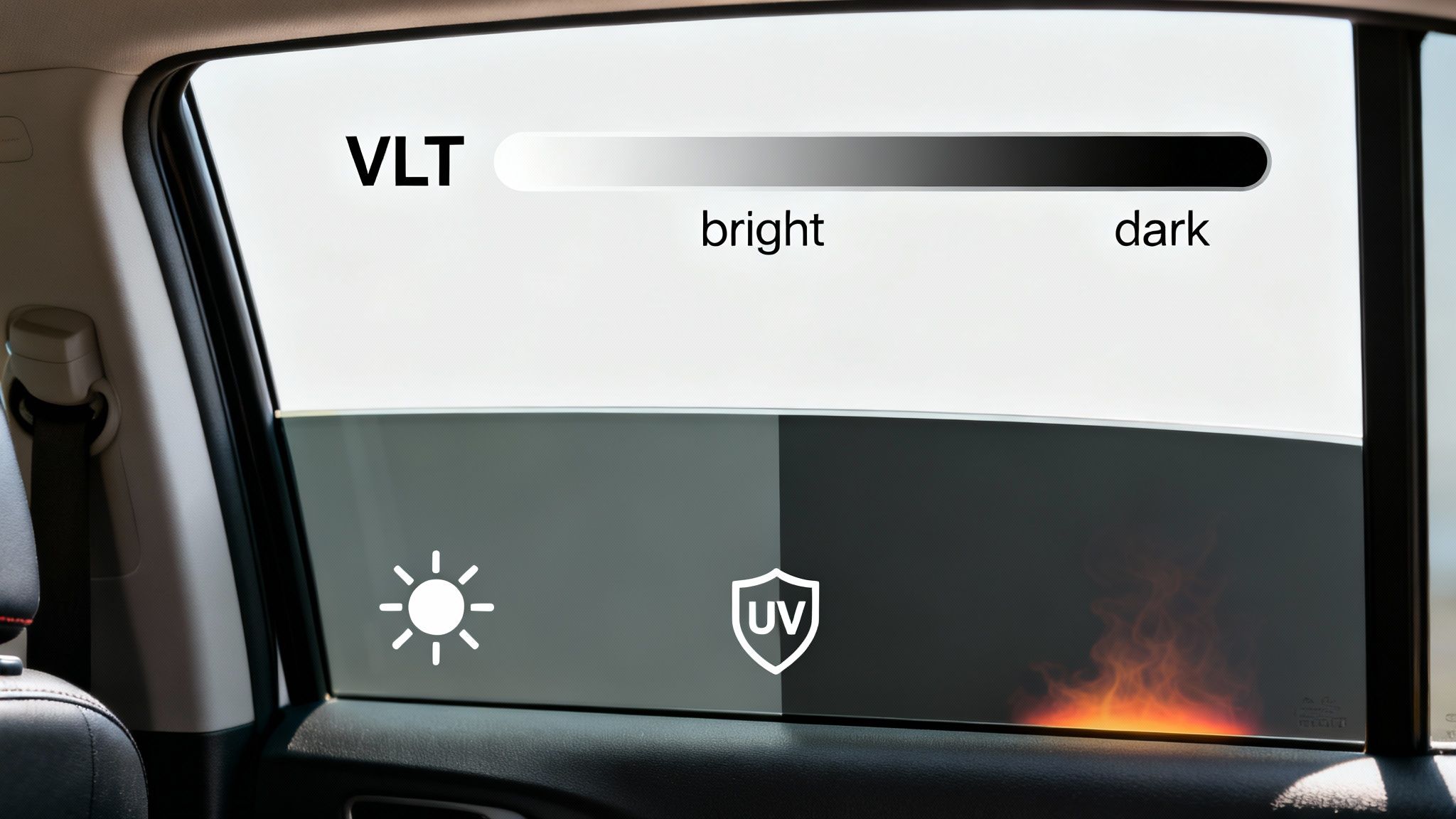
When you start digging into different automotive window tints, you’ll be hit with a wall of technical terms and acronyms. It can feel like you’re trying to learn a new language. But these numbers are the key to understanding exactly how a film will perform on your vehicle.
Think of them like the spec sheet for your car's windows. They cut through the marketing fluff and tell you precisely what you're getting. Once you know what to look for, you can choose a tint based on real-world benefits, not just how dark it looks. Let's break down the three most important metrics you'll see.
Visible Light Transmission (VLT)
This is the one most people are familiar with. Visible Light Transmission, or VLT, simply measures the percentage of visible light that can pass through your tinted window. In other words, it’s a number that tells you how dark the tint is.
The lower the VLT number, the darker the film. A tint with 5% VLT is what you’d call "limo tint"—it's extremely dark because only 5% of light gets through. On the other end of the spectrum, a 70% VLT film is very light and subtle, letting in 70% of the light.
- Low VLT (5% – 20%): Delivers maximum privacy and that classic, blacked-out look. It’s a great choice for back windows where privacy is a priority.
- Medium VLT (25% – 50%): This is the sweet spot for many drivers. It offers a nice balance between a custom look, good privacy, and clear visibility.
- High VLT (50% – 80%): Perfect if you want all the heat and UV blocking benefits without dramatically changing your car’s appearance.
Before you decide, it's critical to check your local tint laws. They set legal limits on VLT percentages, especially for the front driver and passenger windows.
Ultraviolet (UV) Rejection
Think of UV Rejection as applying a powerful sunscreen directly to your windows. This metric tells you how effectively the film blocks the sun's damaging ultraviolet rays. These are the invisible rays that cause your dashboard, seats, and interior trim to fade, crack, and look old before their time.
Even more importantly, those UV rays are harmful to you and your passengers. The constant exposure you get during a daily commute can lead to skin damage.
A quality automotive window tint film is your first line of defence. Thankfully, just about any reputable film today—from basic dyed to high-end ceramic—blocks 99% or more of harmful UV radiation. This makes it one of the single biggest health and preservation upgrades you can make to your vehicle.
This is one spec you shouldn't have to compromise on. Always aim for a film that offers at least 99% UV Rejection. It’s a non-negotiable for protecting both your car’s interior and your skin.
Infrared (IR) Rejection and Heat Rejection
Here’s where you can really feel the difference, especially on a hot, sunny day. Infrared (IR) rays are the part of the light spectrum that we feel as heat. A film's ability to block these rays is its IR Rejection power, and it’s the main reason your car feels cooler after being tinted.
While a dark dyed film might absorb a bit of heat, it doesn't do much to block IR. This is where advanced carbon and ceramic films truly excel—they are engineered to reflect that heat away from your car before it ever gets inside.
- Total Solar Energy Rejected (TSER): This is the most complete metric for heat blocking. It takes everything into account: visible light, UV, and infrared rays. The higher the TSER number, the better the film is at keeping your cabin cool.
- Infrared Rejection (IRR): This focuses specifically on the heat-causing infrared rays. A premium ceramic film can have an IRR of 90% or higher, which translates directly into a more comfortable drive and putting less strain on your air conditioner.
If your main goal is to beat the heat, the IR Rejection and TSER ratings are the numbers you need to pay close attention to. They'll guide you to the films that offer the biggest improvement in comfort.
Making Sense of California's Window Tint Laws
Choosing the right window tint isn't just about looks and performance—you've got to know the local laws. Get it wrong, and that slick upgrade can quickly turn into a costly ticket and a "fix-it" order to strip the film off. Here in California, the rules are specific and they are enforced, so making sure your tint is legal is step number one.
These rules aren't just there to be difficult. They’re all about safety. The goal is to make sure drivers can see clearly, especially at night or in bad weather. It's also for the safety of law enforcement officers, who need to be able to see into a vehicle during a traffic stop. Playing by the rules from the get-go means your tint will be a legal, stress-free investment for years to come.
Front Window VLT Requirements
The most important rule in California covers your front side windows—the ones for the driver and front passenger. These windows must allow at least 70% of light to pass through, which is known as 70% Visible Light Transmission (VLT). That number includes the combination of both the glass and the film.
Most cars come from the factory with a slight tint already in the glass, usually around 88% VLT. So, you can't just slap a 70% film on and call it a day, because the final VLT will be much lower. A professional installer knows this and will use a special meter to measure the combined VLT, ensuring you stay on the right side of the law and avoid any nasty surprises down the road.
It’s a common mistake to think that if a film looks light, it must be legal. The law is based on a precise measurement, and the California Highway Patrol carries VLT meters to check it. Compliance isn't a suggestion—it's the law.
The Rules for Your Rear and Back Windows
Things get a lot more relaxed when you move to the back of the vehicle. In California, you can go as dark as you want on the rear passenger windows and the back windshield. This is where you can get maximum privacy and heat rejection, even opting for a very dark 5% VLT (often called "limo tint").
There's one catch, though. If you decide to tint your rear windshield, your vehicle must have side mirrors on both sides. This is a common-sense rule to make sure you can still see what's happening behind you, since your view through the back glass will be limited.
Banned Tints and Required Paperwork
Beyond just darkness, California law also says no to certain types of window tint.
- Reflective Tints: You can't have mirrored or highly reflective films on your front and side windows. The law states the tint can't be more reflective than a standard, untreated car window.
- Restricted Colours: Watch out for certain colours. Red, amber, or blue tints are strictly forbidden on the front side windows because those colours are reserved for emergency vehicles.
To keep everything above board, the state also requires that tint film manufacturers certify that their products meet these standards. When you get your tint installed, you should receive a certificate or sticker that lists the film's VLT and manufacturer. You need to keep this proof of compliance in your vehicle at all times. If you're pulled over, failing to show it could get you a ticket, even if your tint is technically legal.
California's vehicle tinting standards are some of the toughest out there. The front side windows need to let in at least 70% of light, while the back can be as dark as you like, as long as you have dual side mirrors. Highly reflective films and certain colours are a no-go.
It's also a good idea to be aware of any federal guidelines, like the DOT window tint regulations, which cover broader vehicle safety standards. For a complete local breakdown, check out our detailed guide on understanding California's window tint laws.
DIY Tinting vs. Professional Installation
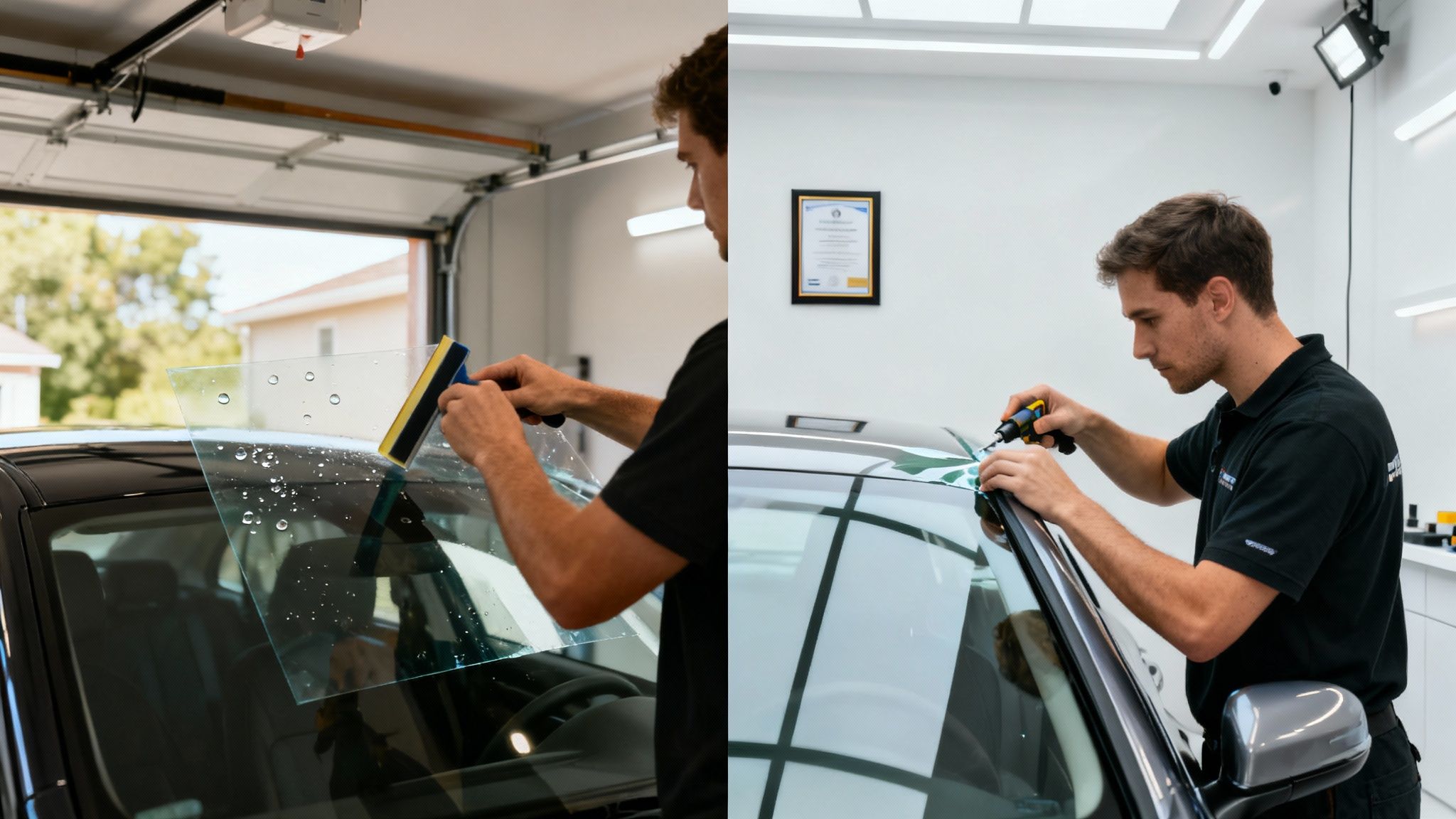
So, you’ve decided to tint your vehicle's windows. The next big question is: who’s going to do the job? On one hand, a do-it-yourself (DIY) kit from the local auto parts store seems like a great way to save a few bucks. But what looks like a simple weekend project can quickly turn into a frustrating, costly mess.
Applying window tint is all about precision, patience, and having the right environment. One tiny speck of dust, a single air bubble, or an edge that’s a millimetre off can ruin the whole look. Paying for a professional installation isn't just about the labour; it's an investment in a perfect finish, high-quality materials, and the peace of mind that comes with knowing the job is done right the first time.
The Common Pitfalls of a DIY Tint Job
Trying to tint your own car windows usually ends in a few predictable and very visible ways. The truth is, getting that clean, factory-like finish takes skills that are built over years of daily practice, and the average home garage just isn't the right place for it.
Here’s what we often see with DIY attempts:
- Bubbling and Peeling: This is the classic, tell-tale sign of a DIY job. Trapped air or water, combined with improper squeegee work, creates ugly bubbles that just get bigger over time. Peeling edges happen when the film isn't cut precisely to the shape of the glass.
- Contamination: Professional tint shops are kept incredibly clean for a reason. Your garage, on the other hand, is full of floating dust, pet hair, and pollen. Every one of those particles is just waiting to get trapped under the film, creating permanent little specks and blemishes.
- Creasing and Imperfections: Trying to handle a large, thin sheet of tint film is way trickier than it looks. It's so easy to accidentally crease or fold it, leaving a permanent mark that you can't get out.
- Poor Film Quality: Let's be honest, most DIY kits come with cheap, dyed films. These are notorious for scratching easily, fading to that awful purple colour, and offering next to no real heat rejection compared to the professional-grade carbon and ceramic films.
In the end, a botched DIY job means you've wasted your time, your money on the kit, and now you have to pay a professional to painstakingly remove the failed attempt before they can even start to install it correctly.
A professional tint installation is defined by what you don't see—no bubbles, no dust, no peeling edges, and no imperfections. It’s a seamless integration of film and glass that enhances the vehicle’s value and appearance.
The Unmatched Value of Professional Installation
When you choose a professional installer like Carmedics Autowerks, you're turning a risky gamble into a guaranteed success. The massive difference in quality really boils down to three things: better tools, expert techniques, and a clean, controlled environment.
Professionals have access to tools that you won't find in any DIY kit. We're talking about computer-controlled plotters that cut the automotive window tint films to the exact dimensions of your specific car model, ensuring a perfect fit with no gaps or overlaps. We also use specialized heat guns and application tools to meticulously shrink and mould the film to the complex curves of modern car windows—something that's nearly impossible to get right without them.
More than that, you're paying for experience. A seasoned pro knows exactly how different films react to heat and pressure and has perfected the little techniques needed for a totally dust-free application. That expertise, backed by a solid warranty that protects your investment against issues like bubbling or fading, gives you a level of quality and security that a DIY project simply can't offer. It's the difference between a temporary cosmetic fix and a lasting, high-performance upgrade for your vehicle.
Choosing the Right Window Tinting Partner
https://www.youtube.com/embed/7we-9Vi2qts
Picking out the perfect window tint film is only half the job. The other, arguably more critical half, is choosing the right people to install it. A top-of-the-line ceramic film can end up looking worse than a basic dyed film if it’s put on by an amateur. It's the skill of the installer that turns that roll of high-tech material into a seamless, permanent upgrade for your vehicle.
A truly professional shop obsesses over quality. They start with the best materials from trusted brands known for performance and longevity, not just whatever is cheapest. They also maintain a meticulously clean, dust-free installation bay—the kind of controlled environment that prevents those maddening little bubbles and specs from getting trapped under the film.
What Defines an Expert Tint Shop
So, what separates the pros from the rest? It’s more than just fancy tools. Their technicians have a deep, hands-on understanding of how different films behave. They know that materials like ceramic and carbon need a specific touch to shrink and mould perfectly to the complex curves of modern car windows. That kind of skill only comes from years of dedicated practice.
Beyond the technical craft, a true partner is also an expert on local laws. They’ll confidently walk you through California's specific tinting regulations, making sure the VLT you choose is 100% legal and won’t get you a ticket. They should be able to clearly explain the performance numbers and help you find a film that genuinely matches what you need, whether it's maximum heat rejection, privacy, or pure style.
A great window tinting partner doesn’t just sell you a product; they provide a consultation. They take the time to listen, look at your vehicle, and recommend a solution that hits the sweet spot between performance, aesthetics, and legal compliance.
More Than Just Window Tinting
Often, the best automotive styling shops don't stop at just one service. A partner like Carmedics Autowerks offers a whole range of vehicle protection services, including Paint Protection Film (PPF). There's a real advantage to choosing a shop that can do it all, because they understand how different products, like tint and PPF, can work together to protect your entire vehicle.
This one-stop-shop approach means you get a consistent standard of quality across every service. Once you find a team you trust, you have a reliable go-to for all your car's needs, knowing the workmanship will always be top-notch.
A great way to begin your search is to look for the best auto tinting services near you and then dig into their customer reviews, check out their facility, and see what materials they use.
Your Top Questions About Automotive Window Tint Answered
So, you've learned about the different kinds of tint and what they can do, but maybe a few questions are still rattling around. That's completely normal. Let's tackle some of the most common things drivers ask us, giving you straight, simple answers to help you feel totally confident in your choice.
This is your go-to cheat sheet for those final details, from how long the film will last to whether it really makes a difference on a hot day. Let's get right to it.
How Long Does Automotive Window Tint Film Last?
This one really comes down to two things: the quality of the film you choose and who puts it on. A cheap, basic dyed film might look okay for a little while, but you can expect it to start fading and turning that classic purple colour within about five years. At that point, it’s not doing much for you.
On the other hand, high-performance carbon and ceramic films are built to go the distance. When a certified pro installs them, you can expect them to last 10 years or more—often looking just as good as day one for the entire time you own the car. The professional installation is what really guarantees that longevity.
Can You Remove Window Tint?
Yes, absolutely. Window tint isn't a permanent change, and it can definitely be removed. But, and this is a big but, it's a job that demands a lot of patience and the right equipment to avoid scratching your glass. The rear windshield is especially tricky because of the delicate defroster lines—one wrong move, and they're toast.
A professional will use tools like a steamer and special solvents to gently loosen the adhesive. This allows the film to peel off in one clean piece, leaving no sticky mess behind. While you can find DIY kits out there, we always recommend having a pro handle it to protect your windows and get a perfect finish for a new tint.
One of the best things about modern window tint is that it's completely reversible. A professional can update or remove the film without leaving a trace, which is great for preserving your vehicle's condition and value.
Does Ceramic Tint Really Block More Heat?
Without a doubt. This is precisely where ceramic tint earns its reputation and proves it's more than just hype—it's advanced technology at work. The film is infused with nano-ceramic particles that are non-metallic and non-conductive, specifically engineered to target and block infrared (IR) radiation, which is the part of the sunlight that you actually feel as heat.
Cheaper, darker films might absorb a bit of heat, but they don't reject it. That absorbed heat eventually just radiates into your car anyway. Ceramic film is different; it acts like a smart shield, reflecting a huge amount of that IR energy away from your vehicle before it ever gets in. A top-tier ceramic film can block over 90% of infrared heat, which makes a massive difference in how cool your car stays, all without having to be limo-dark. You get maximum comfort and keep great visibility, a winning combo other films just can't deliver.
Ready to upgrade your vehicle with the best in comfort, privacy, and protection? The expert technicians at Carmedics autowerks inc are here to help you choose and install the perfect automotive window tint films for your needs. Visit our website to schedule your professional consultation today.